Mars Rover Curiosity Investigates Enigmatic Mineral Formations
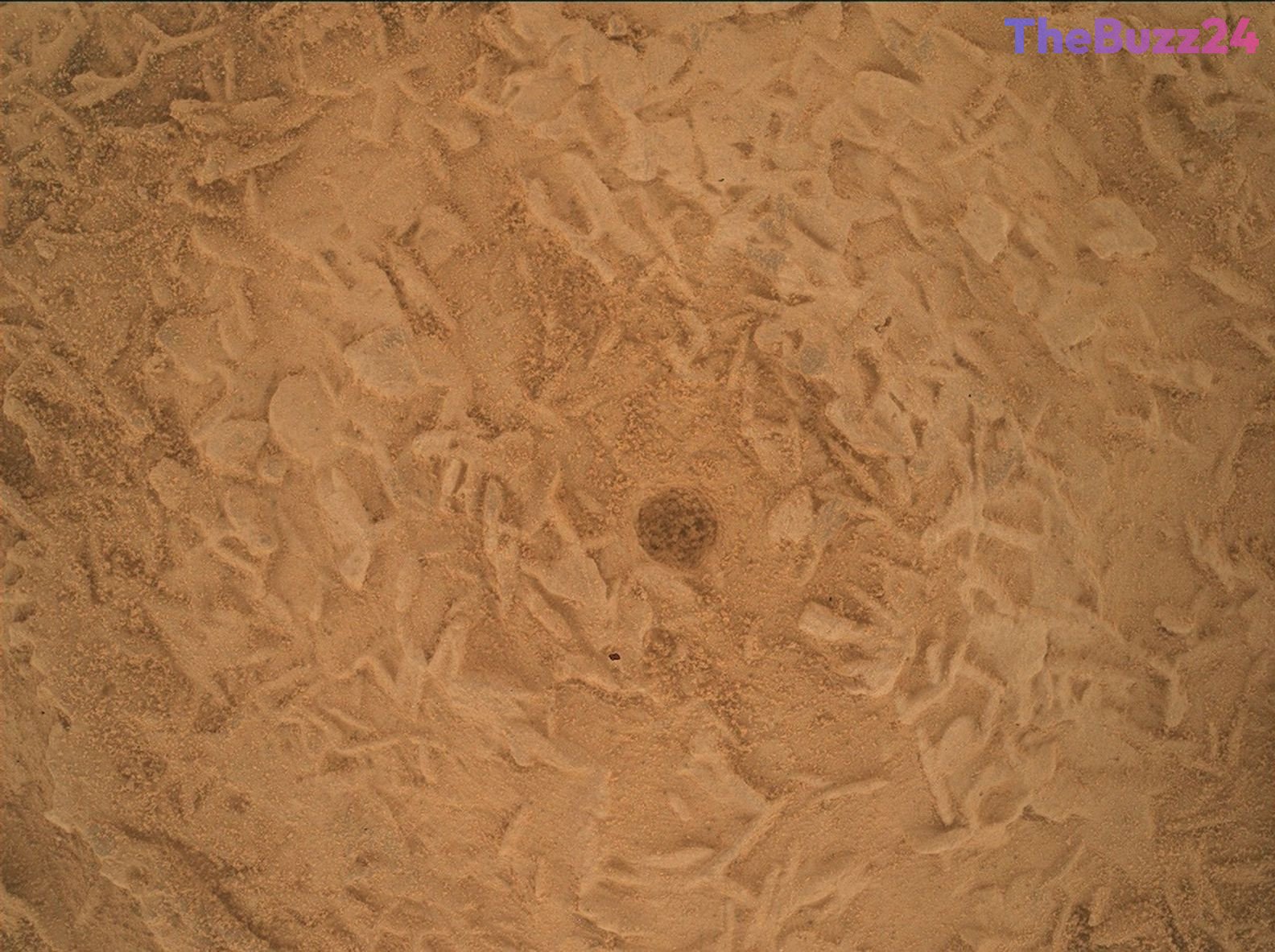
The Mars Science Laboratory mission’s Curiosity rover has recently encountered and begun detailed investigation of unusual disc-shaped features embedded within Martian bedrock. These intriguing formations, informally named “Salar de Vacas,” represent a significant departure from the finely layered rock textures observed previously in the sulfate unit workspaces. Measuring approximately 3-4 millimeters across and about 1 millimeter thick, these features have prompted scientists to deploy the rover’s advanced imaging and analytical tools for closer examination.
To capture the intricate details of these structures, Curiosity utilized its Mars Hand Lens Imager (MAHLI), a specialized close-up camera mounted on the robotic arm. The rover performed an onboard focusing process, merging multiple images taken at varying focal depths to create a composite picture that brings as many features as possible into sharp relief. Similar disc-like formations have been noted earlier in the mission, near areas like the Pahrump Hills, and are also known to occur in terrestrial environments where minerals precipitate from evaporating fluids. Researchers are currently exploring two primary hypotheses: that these shapes are the result of specific crystalline mineral growth habits, or that they are fragments of a harder rock layer that broke apart and accumulated in this location.
To unravel the mystery of their origin and composition, Curiosity is employing a suite of instruments. Mastcam and MAHLI are providing additional morphological details on blocks informally named “Yungay” and “Chiu Chiu.” The Chemistry and Camera (ChemCam) Laser-Induced Breakdown Spectroscopy (LIBS) instrument is being used on targets such as “Puya Raimondii,” “Liolaemus Tacnae,” and “Pisqu Warkatana,” while the Alpha Particle X-ray Spectrometer (APXS) is analyzing “Salar de Vacas.” Beyond these localized studies, the rover is also conducting long-distance imaging projects, including ChemCam remote imager (RMI) and Mastcam mosaics of buttes flanking Valle Grande. These “cutaway” views are crucial for mapping sedimentary structures in upcoming units and understanding the geological processes that shaped these Martian landscapes.
A critical next step in identifying the minerals involved is a new drilling campaign, which will utilize the CheMin X-ray diffraction instrument. This marks the first drilling operation above the erosional supersurface since Curiosity’s last drill site at Campo Marte, over a kilometer away. The rover has successfully positioned itself near a promising drill workspace, informally designated “Torres del Paine,” and is currently performing site characterization using its arm-mounted instruments (“Alberta Wild Rose,” “Moonraker Mountain”), ChemCam LIBS (“Osoyoos”), and Mastcam (“Trincomali Channel,” “Yellow Lady’s Slipper”). A specific drill target has been selected, and a short drive is planned to bring it within reach for initial contact science, followed by a preload test, and ultimately, the drilling operation itself.
Key Takeaways
- Curiosity rover has discovered unusual disc-shaped features on Martian bedrock, prompting detailed investigation into their origin and composition.
- Scientists are exploring hypotheses that these features could be crystalline mineral growths or fragments of a harder rock layer, using multiple instruments for analysis.
- A new drilling campaign is underway, marking the first drill above the erosional supersurface in over a kilometer, to identify the specific minerals involved.
Editor’s Analysis & Impact
The discovery of these enigmatic disc-shaped features by the Curiosity rover underscores the dynamic and complex geological history of Mars. Each new finding, particularly those suggesting mineral precipitation from fluids, adds crucial pieces to the puzzle of whether Mars once harbored conditions suitable for life. This ongoing research not only deepens our scientific understanding of planetary evolution but also informs the design and objectives of future missions, including human exploration. The continuous refinement of remote sensing and in-situ analysis techniques demonstrated by Curiosity pushes the boundaries of robotic exploration, paving the way for more sophisticated investigations into the Red Planet’s past habitability and potential resources.
Frequently Asked Questions
Q: What are the "disc-shaped features" Curiosity found?
A: The Curiosity rover has discovered unusual formations on Martian bedrock, informally named “Salar de Vacas,” which are roughly disc-shaped, measuring 3-4 millimeters across and about 1 millimeter thick. Scientists are investigating whether they are crystalline mineral growths or fragments of a harder rock layer.
Q: Why are these features significant to Mars exploration?
A: These features are significant because similar formations on Earth are often associated with minerals precipitating from evaporating fluids, which could indicate past water activity on Mars. Understanding their origin and composition can provide crucial insights into Mars' geological and hydrological history, and its potential for past habitability.
Q: What instruments is Curiosity using to study these features?
A: Curiosity is employing a suite of instruments including the Mars Hand Lens Imager (MAHLI) for close-up imaging, Mastcam for broader views, the Chemistry and Camera (ChemCam) for elemental analysis, and the Alpha Particle X-ray Spectrometer (APXS) for compositional analysis. A planned drilling campaign will also utilize the CheMin X-ray diffraction instrument for mineral identification.
AI Disclosure: This article is based on verified data and official reports. Our Team and AI have cross-referenced every financial detail with primary sources to ensure total accuracy.
More from this Category