NASA Achieves Major Milestone as Artemis III SLS Core Stage Mates with Rocket Boosters
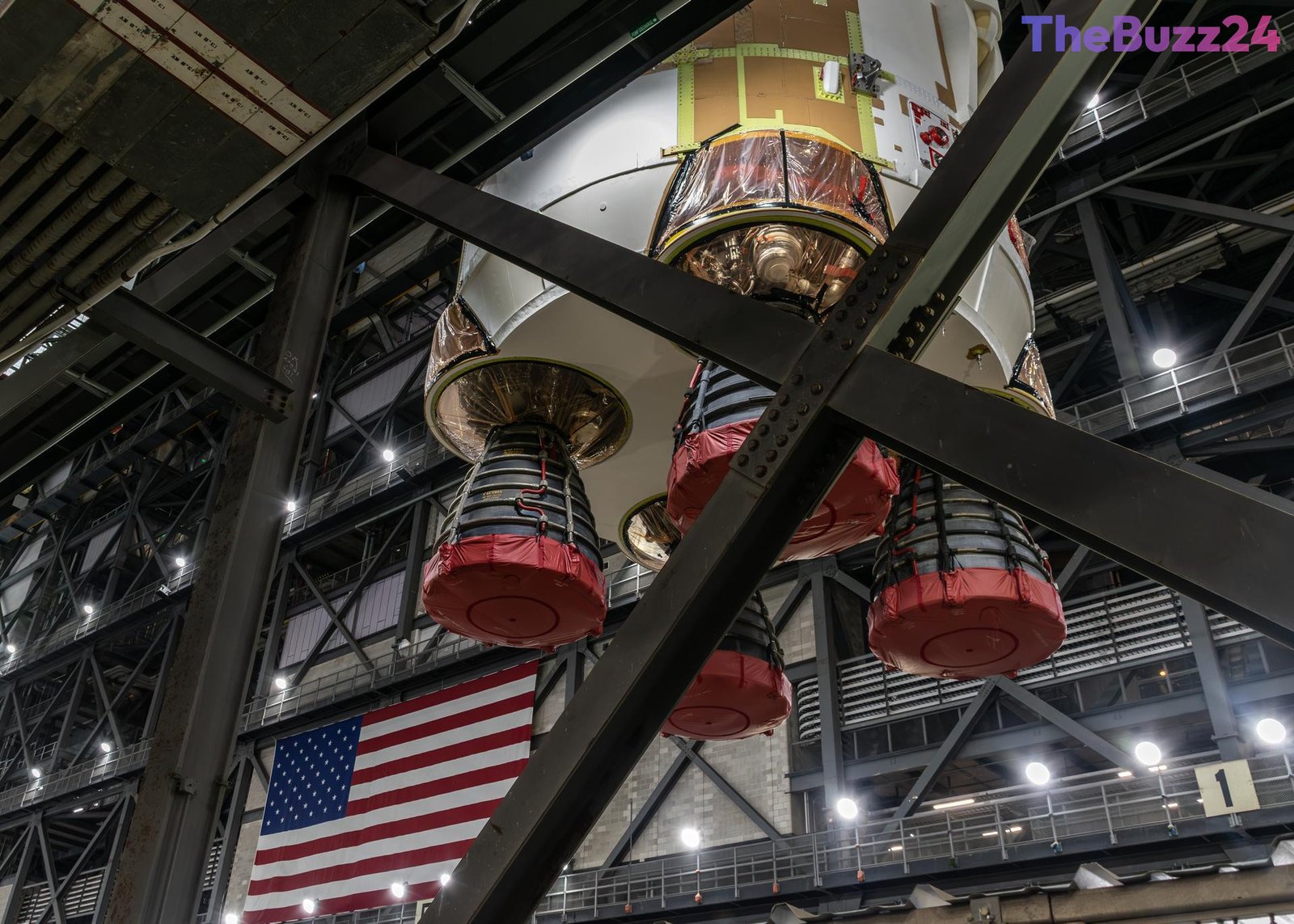
Preparations for NASA’s historic Artemis III mission have advanced significantly as ground teams at Kennedy Space Center in Florida completed the integration of the Space Launch System (SLS) core stage with its twin solid rocket boosters. Working inside the iconic Vehicle Assembly Building, technicians positioned the massive 212-foot rocket stage between the dual boosters using a specialized, custom lifting beam, officially finalizing the vehicle’s “short stack” configuration in High Bay 3.
The complex assembly operation marks an essential step forward in the multi-week preparation sequence. Before the rocket can take to the skies, engineering teams will conduct comprehensive systems checkouts and integration tests within the facility. Following initial validations, the combined booster and core stage structure will roll out to Launch Pad 39B for an intensive cryogenic tanking demonstration. During this pad test, teams will pump liquid oxygen and liquid hydrogen into the core stage to evaluate countdown procedures and fuel loading protocols under simulated launch day conditions.
The Artemis III mission represents a pivotal chapter in international deep-space exploration, designed to send a crew of four astronauts on a high-stakes flight to evaluate critical mission capabilities. The assigned crew includes NASA astronauts Randy Bresnik, Frank Rubio, and Andre Douglas, alongside European Space Agency (ESA) astronaut Luca Parmitano. Riding aboard the Orion spacecraft, the crew will focus on validating rendezvous and docking maneuvers with lunar exploration landers developed by commercial aerospace partners, including SpaceX and Blue Origin, establishing the foundation for sustained human return to the lunar surface.
Key Takeaways
- NASA successfully integrated the 212-foot Artemis III SLS core stage with its twin solid rocket boosters inside the Vehicle Assembly Building.
- The upcoming evaluation phase includes a critical wet dress rehearsal and tanking test at Launch Pad 39B to practice countdown operations.
- The Artemis III crew, featuring astronauts from NASA and ESA, will test rendezvous and docking procedures with commercial human landing systems from SpaceX and Blue Origin.
Editor’s Analysis & Impact
The successful mating of the SLS core stage and solid rocket boosters marks a tangible operational leap for the Artemis program. By advancing hardware through the final stacking phase, NASA is solidifying the operational timeline for deep space exploration while navigating intense scrutiny over mission scheduling and budget expenditures. Artemis III is especially pivotal because it bridges government infrastructure—represented by SLS and the Orion spacecraft—with commercial space providers like SpaceX and Blue Origin. Testing in-orbit docking mechanisms with private lunar landing vehicles validates the public-private partnership model that defines modern space policy. Continued execution without major technical delays will sustain congressional support and set a benchmark for future commercial lunar logistics.
Frequently Asked Questions
Q: What is the next major step for the Artemis III rocket stack?
A: Following internal system tests inside the Vehicle Assembly Building, the integrated stack will move to Launch Pad 39B for a cryogenic tanking test to evaluate fuel loading and simulated countdown timelines.
Q: Who are the astronauts selected for the Artemis III mission?
A: The mission crew includes NASA astronauts Randy Bresnik, Frank Rubio, and Andre Douglas, as well as European Space Agency astronaut Luca Parmitano.
Q: What is the primary objective of Artemis III?
A: Artemis III focuses on testing key deep-space operational capabilities, particularly the rendezvous and docking between the Orion spacecraft and commercial landers from SpaceX and Blue Origin, laying the groundwork for landing astronauts on the Moon.
AI Disclosure: This article is based on verified data and official reports. Our Team and AI have cross-referenced every financial detail with primary sources to ensure total accuracy.
More from this Category