Breaking the Sound Barrier on Mars: NASA Successfully Tests Next-Gen Helicopter Blades Beyond Mach 1
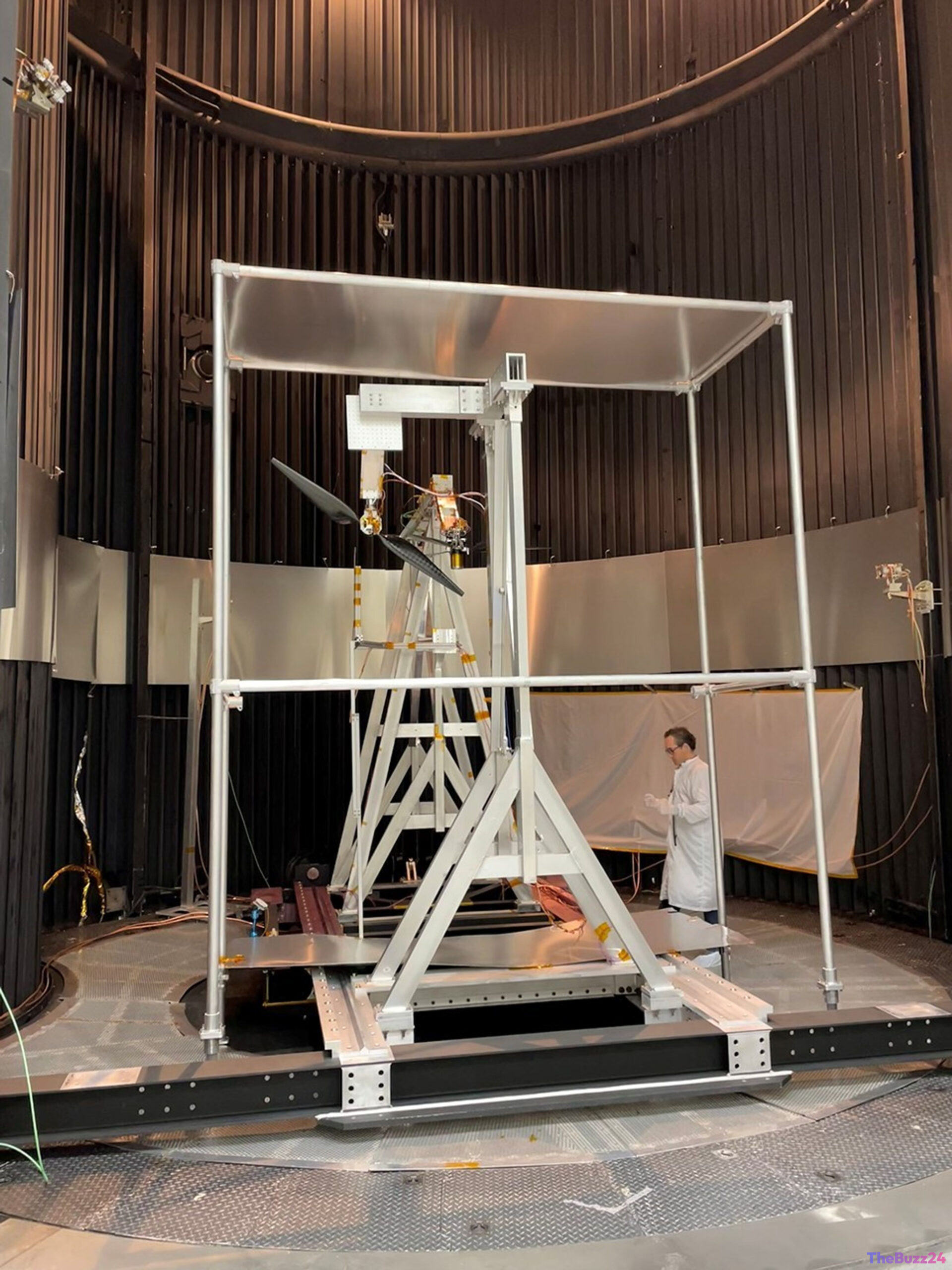
Engineers have achieved a significant milestone in extraterrestrial aviation by successfully testing next-generation helicopter rotor blades designed for Mars at speeds exceeding the speed of sound. Conducted inside the specialized 25-Foot Space Simulator at the Jet Propulsion Laboratory (JPL) in Southern California, the experimental campaign demonstrated that these advanced rotors can withstand the extreme aerodynamic forces of supersonic rotation without structural failure.
The testing, which took place in November 2025, was overseen by engineer Fernando Mier-Hicks, who inspected the high-speed test stand used to simulate the thin Martian atmosphere. Because the atmosphere on Mars is incredibly sparse—boasting only about 1% of the density of Earth’s atmosphere—helicopter blades must spin at much higher velocities to generate sufficient lift. Pushing these blades past Mach 1 represents a major engineering hurdle, as the transition to supersonic speeds introduces severe shockwaves and structural stress.
This ambitious research initiative was funded by the Mars Exploration Program, which aims to dramatically expand the aerial capabilities of future missions to the Red Planet. Managed by Caltech on behalf of NASA’s Science Mission Directorate, JPL’s successful test campaign paves the way for larger, faster, and more capable aerial vehicles. These future aircraft will be able to explore rugged Martian terrains that are entirely inaccessible to traditional wheeled rovers, marking a new era of planetary exploration.
Key Takeaways
- Engineers successfully tested next-generation Mars helicopter rotor blades at supersonic speeds exceeding Mach 1.
- The high-speed tests were conducted inside the 25-Foot Space Simulator at the Jet Propulsion Laboratory (JPL) in Southern California.
- The breakthrough will enable future Mars aircraft to generate greater lift in the thin Martian atmosphere, expanding exploration capabilities.
Editor’s Analysis & Impact
The successful testing of supersonic rotor blades marks a pivotal moment for planetary exploration, shifting the paradigm of how we study other worlds. Following the historic success of the Ingenuity helicopter, which proved that powered flight on Mars is possible, this technological leap addresses the physical limitations of the thin Martian atmosphere. By proving that rotor blades can safely exceed Mach 1, engineers are unlocking the potential for much larger, heavier aerial payloads. This will allow future missions to carry advanced scientific instruments, map vast regions of Mars rapidly, and scout landing sites for human missions. From an industry perspective, these advancements in lightweight materials and high-speed aerodynamics could also yield spin-off technologies for high-altitude flight and drone operations here on Earth, reinforcing the dual-use value of deep-space research.
Frequently Asked Questions
Q: Why do Mars helicopter blades need to spin so fast?
A: The atmosphere on Mars is extremely thin, with only about 1% of the density of Earth's atmosphere. To generate enough lift to fly, helicopter blades must spin much faster than they would on Earth, often approaching or exceeding the speed of sound.
Q: What is the significance of reaching Mach 1 in these tests?
A: Reaching Mach 1 (the speed of sound) creates intense aerodynamic stress and shockwaves that can cause rotor blades to vibrate violently or break apart. Successfully testing blades beyond this threshold proves they can survive these extreme forces, enabling more powerful future aircraft.
Q: Who managed and funded this research?
A: The test campaign was funded by the Mars Exploration Program under NASA's Science Mission Directorate and managed by the Jet Propulsion Laboratory (JPL), a division of Caltech.
AI Disclosure: This article is based on verified data and official reports. Our Team and AI have cross-referenced every financial detail with primary sources to ensure total accuracy.
More from this Category