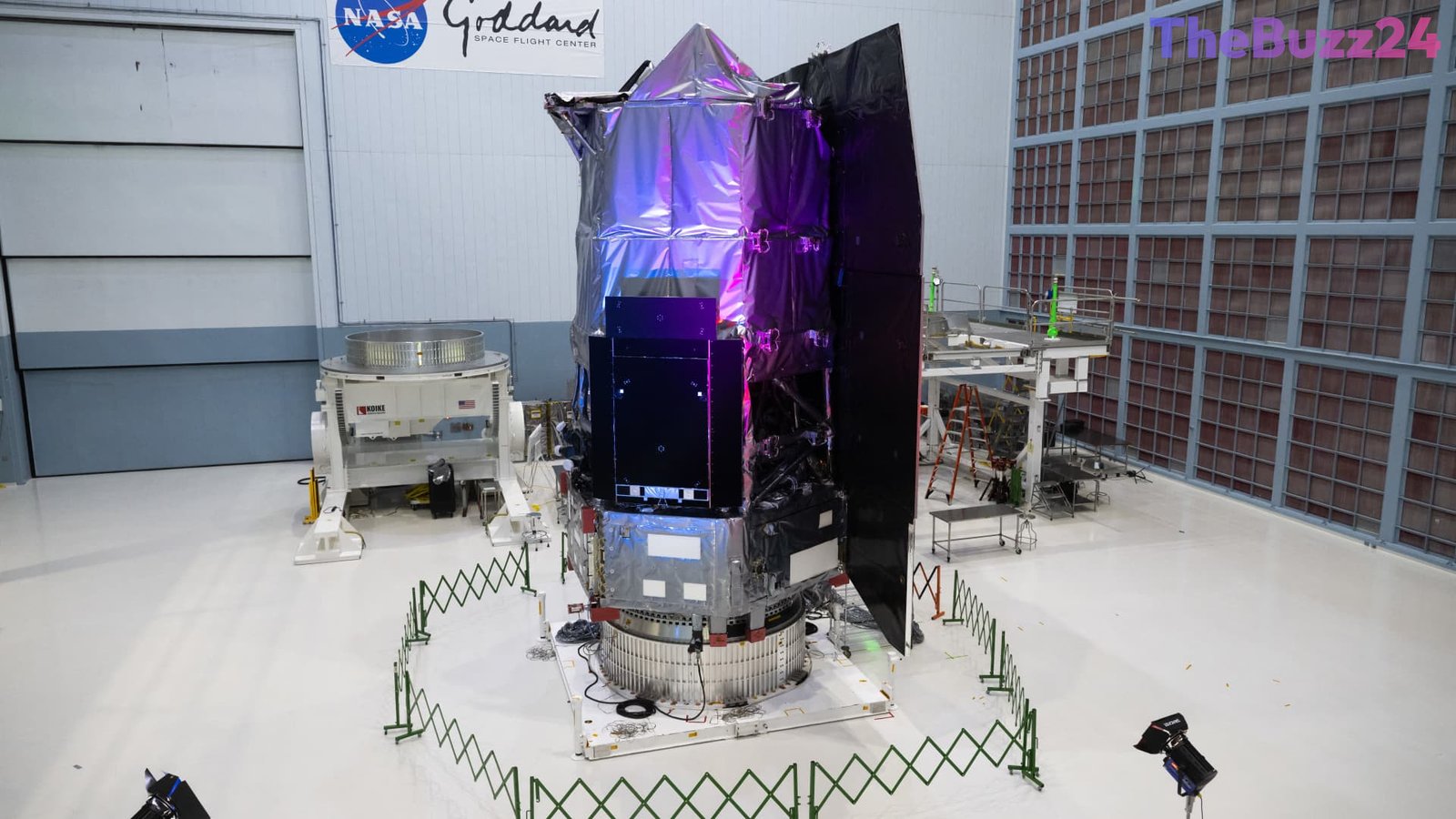
NASA Unveils Next-Gen Observatory to Unlock Cosmos’ Deepest Mysteries
A powerful new astronomical instrument has successfully lifted off, embarking on a monumental journey to scan distant worlds, investigate elusive dark energy, and survey the cosmos with unprecedented scope. Lift-off occurred shortly after dawn from the Kennedy Space Center, propelled by a heavy-lift rocket system that carried the massive observatory toward its designated observation post one million miles away.
Positioned near the vicinity of existing orbital telescopes, the bus-sized apparatus will spend the coming months navigating to its final operational zone. Once fully deployed, it is expected to capture the broadest celestial views ever achieved from space, mapping billions of galaxies, countless stars, and thousands of planetary bodies with remarkable swiftness. Officials note that its sweeping field of view will operate at speeds exponentially faster than legacy instruments, effectively redefining large-scale astronomical surveys.
The newly launched facility will work in tandem with other premier space-based and ground-based observatories. While narrow-focused instruments can zoom in on ancient cosmic structures, this wide-angle marvel will sweep massive sections of the galaxy in record time. Furthermore, its advanced instruments feature experimental technology designed to block starlight, enabling researchers to directly capture imagery of faint exoplanets orbiting distant stars.
Constructed ahead of schedule and remaining within its financial framework, the observatory honors a pioneering NASA astronomer who championed space-based exploration decades ago. Utilizing surplus optical hardware originally acquired years prior, the mission represents a major leap forward in humanity’s quest to understand the expansion of the universe and the mysterious forces that govern it.
Key Takeaways
- The newly launched telescope will survey distant exoplanets, galaxies, and dark energy at unprecedented speeds.
- The observatory's field of view is vastly wider than that of the Hubble Space Telescope, allowing it to scan large areas of space rapidly.
- Named after NASA's first chief astronomer Nancy Grace Roman, the mission utilizes surplus optical hardware to achieve its goals efficiently.
Editor’s Analysis & Impact
The successful deployment of this advanced space telescope marks a transformative milestone for observational astronomy and aerospace engineering. By combining ultra-wide field imaging with exceptional speed, the mission bridges the gap between broad cosmic surveys and targeted deep-space analysis. This capability will likely accelerate discoveries related to exoplanet habitability and the enigmatic properties of dark energy. From an industry perspective, the efficient use of repurposed surplus hardware demonstrates a cost-effective blueprint for future multi-billion-dollar scientific endeavors. As this observatory begins its collaborative partnership with existing space-faring instruments, the resulting influx of deep-space data will drive significant advancements in astrophysics and reshape our fundamental understanding of the universe.
Frequently Asked Questions
Q: What is the primary mission of the newly launched space telescope?
A: The telescope aims to hunt for exoplanets, explore dark energy, and survey billions of galaxies and stars with a massive field of view and unprecedented speed.
Q: Where is the telescope headed?
A: It is traveling to an observation point roughly 1 million miles (1.6 million kilometers) away from Earth, near the location of the Webb Space Telescope.
Q: Who is the telescope named after?
A: It is named after Nancy Grace Roman, who served as NASA's first chief astronomer and was instrumental in advocating for space-based observatories.
AI Disclosure: This article is based on verified data and official reports. Our Team and AI have cross-referenced every financial detail with primary sources to ensure total accuracy.
More from this Category