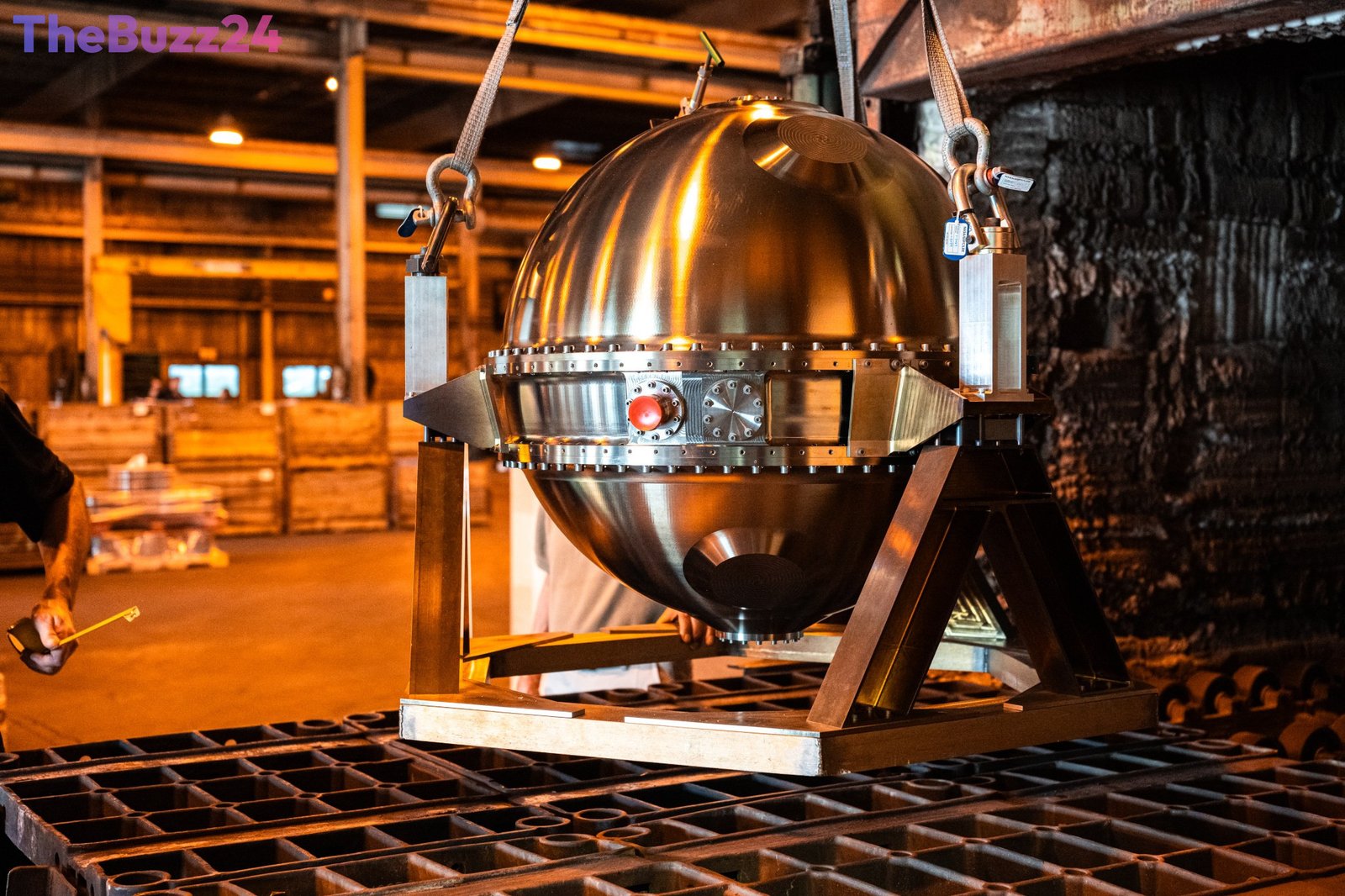
NASA’s DAVINCI Probe Endures Venus’ Fiery Descent in Crucial Test
NASA’s DAVINCI probe has successfully passed a critical thermal test, demonstrating its ability to withstand the scorching conditions expected during its descent to the Venusian surface. The engineering model of the Deep Atmosphere Venus Investigation of Noble gases, Chemistry, and Imaging (DAVINCI) mission endured temperatures reaching 869 degrees Fahrenheit (465 degrees Celsius) in a specialized chamber designed to simulate the planet’s extreme environment.
During the rigorous test, which spanned from August 28 to September 10, the DAVINCI team gradually increased the heat within a ceramic-lined chamber to mimic the probe’s actual atmospheric entry. This crucial milestone signifies a major step forward for the mission, which aims to unravel the mysteries of Venus’s past and present state. The probe, roughly the size of a yoga ball, is engineered to survive the intense heat and pressure as it plunges through the dense Venusian atmosphere.
The DAVINCI mission is designed to provide unprecedented insights into Venus’s origin and evolution. Scientists hope to determine if the planet, often referred to as Earth’s ‘sister planet,’ was once a habitable world with liquid water. The probe’s advanced instruments will analyze the noble gases and chemistry of the atmosphere, while also capturing detailed imagery, offering a comprehensive look at the planet’s complex atmospheric layers and surface conditions.
Key Takeaways
- NASA's DAVINCI probe engineering model successfully passed a critical thermal test simulating Venus's extreme temperatures.
- The probe endured temperatures up to 869°F (465°C) during the test, proving its resilience for atmospheric descent.
- DAVINCI aims to study Venus's atmosphere and surface to understand its origin, evolution, and potential past habitability.
Editor’s Analysis & Impact
This successful thermal test is a significant achievement for NASA’s DAVINCI mission, bringing scientists closer to understanding the enigmatic planet Venus. The ability of the probe to withstand such extreme temperatures is a testament to advanced engineering and materials science. As the probe prepares for its journey, the data it collects could revolutionize our understanding of planetary evolution, particularly concerning the conditions necessary for habitability. This mission underscores the growing interest in Venus as a target for scientific exploration, potentially offering comparative insights into Earth’s own climate and future.
Frequently Asked Questions
Q: What is the primary goal of the DAVINCI probe?
A: The primary goal of the DAVINCI probe is to study the origin, evolution, and present state of Venus's atmosphere and surface to determine if it was once a habitable planet, potentially with liquid water.
Q: How hot are the conditions on Venus that DAVINCI must withstand?
A: Venus has an extremely hot surface temperature, averaging around 869 degrees Fahrenheit (465 degrees Celsius), with immense atmospheric pressure. The DAVINCI probe is designed to survive these harsh conditions during its descent.
Q: What does 'noble gases' refer to in the DAVINCI mission name?
A: Noble gases are a group of inert chemical elements. Studying their composition and distribution in Venus's atmosphere can provide crucial clues about the planet's formation and atmospheric history.
AI Disclosure: This article is based on verified data and official reports. Our Team and AI have cross-referenced every financial detail with primary sources to ensure total accuracy.
More from this Category