NASA’s NEO Surveyor Mission Nears Launch with Critical Sunshade Inspection
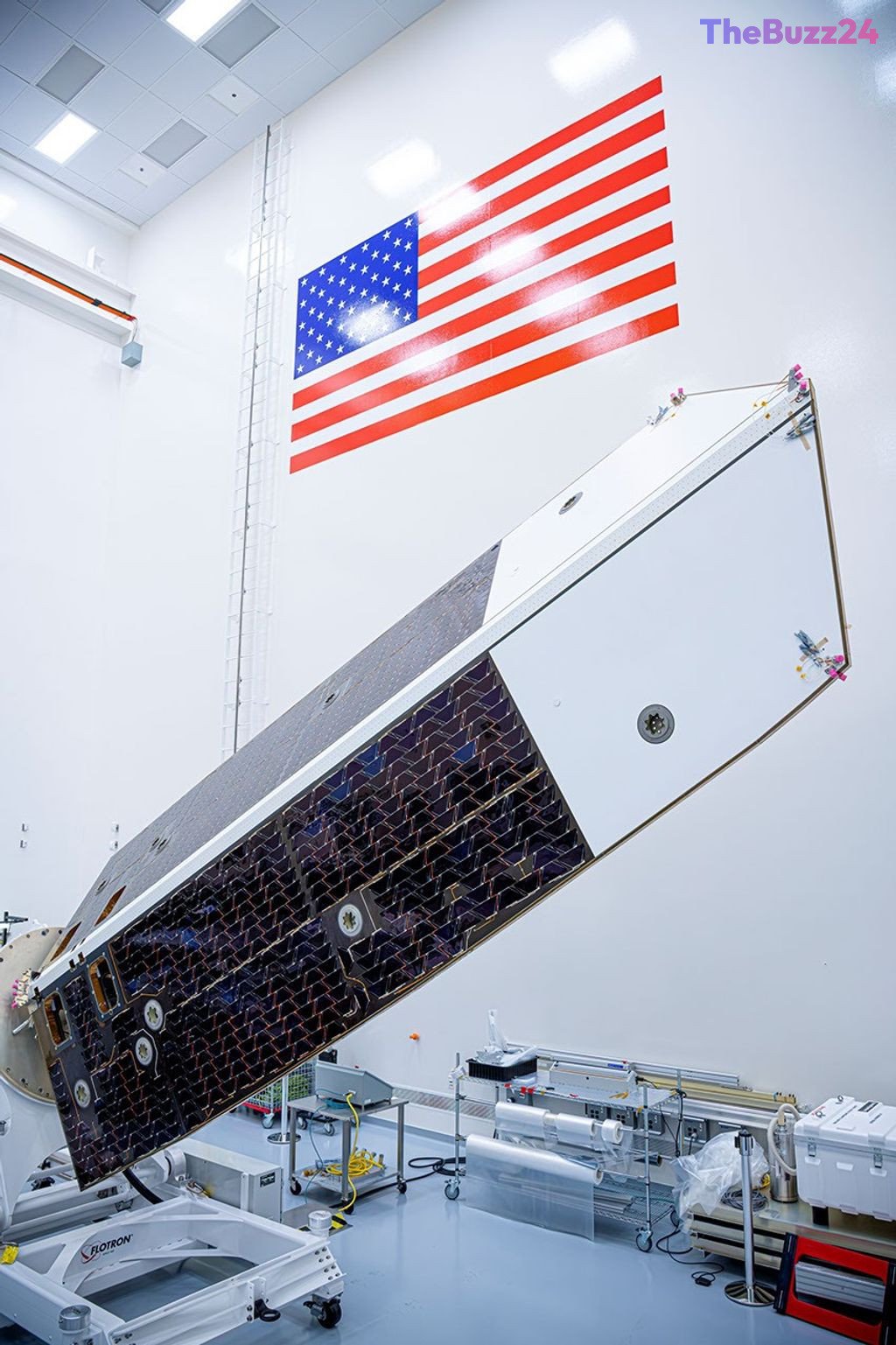
NASA’s Near-Earth Object (NEO) Surveyor mission recently marked a significant milestone with the inspection of its large, specialized sunshade. This crucial component, designed to protect the spacecraft’s sensitive instruments and generate power, underwent thorough examination in a clean room at BAE Systems Space & Mission Systems in Boulder, Colorado, in July 2026. This inspection signifies a vital step forward for the mission, which is dedicated to identifying potentially hazardous asteroids and comets.
Standing an impressive 20 feet (6 meters) tall and measuring 8 feet (2.4 meters) wide at its base, the sunshade is an engineering marvel. Its unique design features two flat panels joined at a 23.5-degree angle, meticulously covered with 864 interconnected solar cells. These cells are engineered to produce up to 2 kilowatts of power, essential for charging the onboard batteries that will sustain the spacecraft’s systems throughout its operational life. The sunshade structure was initially built by Applied Aerospace in Stockton, California, with SolAero Technologies in Albuquerque, New Mexico, responsible for outfitting it with its advanced solar cells in January.
The component’s journey to inspection included rigorous environmental testing, which was successfully completed in March at a commercial thermal vacuum testing facility in El Segundo, California. Demonstrating efficient project management, the sunshade and its solar array were delivered to BAE Systems Space & Mission Systems ahead of schedule in May. Once deployed in space, the NEO Surveyor spacecraft will embark on its mission to locate some of the most elusive asteroids and comets, particularly those situated in the direction of the Sun. This region of the sky poses a significant challenge for ground-based optical telescopes, making the NEO Surveyor’s specialized capabilities indispensable for a comprehensive planetary defense strategy.
Key Takeaways
- NASA's NEO Surveyor mission is progressing with the inspection of its critical sunshade at BAE Systems Space & Mission Systems.
- The sunshade, built by Applied Aerospace and SolAero Technologies, is 20 feet tall, features 864 solar cells, and generates 2 kilowatts of power for the spacecraft.
- The mission aims to detect hard-to-find asteroids and comets, especially those obscured by the Sun, enhancing planetary defense efforts.
Editor’s Analysis & Impact
The progress of NASA’s NEO Surveyor mission, highlighted by the successful inspection of its sunshade, underscores the growing global emphasis on planetary defense. This mission is critical for identifying Near-Earth Objects (NEOs) that pose potential impact risks, especially those difficult to detect from Earth due to solar glare. The ability to survey the sunward region of space fills a crucial gap in current asteroid detection capabilities, significantly enhancing our early warning systems. Beyond immediate defense, a comprehensive NEO catalog could unlock future opportunities in asteroid mining and resource utilization. The timely development and testing of key components like the sunshade reflect robust engineering and project management, setting a positive precedent for future complex space missions aimed at safeguarding our planet and expanding our understanding of the solar system.
Frequently Asked Questions
Q: What is the primary purpose of NASA's NEO Surveyor mission?
A: The NEO Surveyor mission's main goal is to detect and characterize Near-Earth Objects (NEOs), including asteroids and comets, especially those that are difficult to observe from Earth due to their proximity to the Sun. This enhances planetary defense efforts by providing early warnings of potential impact threats.
Q: Why is the sunshade a critical component of the NEO Surveyor spacecraft?
A: The sunshade is critical for two main reasons: it protects the spacecraft's sensitive instruments from the intense heat and glare of the Sun, and its integrated solar cells generate up to 2 kilowatts of power, which is essential for charging the onboard batteries and operating all of the spacecraft's systems.
Q: Which companies were involved in the development and testing of the sunshade?
A: The sunshade structure was built by Applied Aerospace in Stockton, California. SolAero Technologies in Albuquerque, New Mexico, outfitted it with its solar cells. Environmental testing was conducted at a commercial thermal vacuum testing facility in El Segundo, California, and the final inspection took place at BAE Systems Space & Mission Systems in Boulder, Colorado.
AI Disclosure: This article is based on verified data and official reports. Our Team and AI have cross-referenced every financial detail with primary sources to ensure total accuracy.
More from this Category