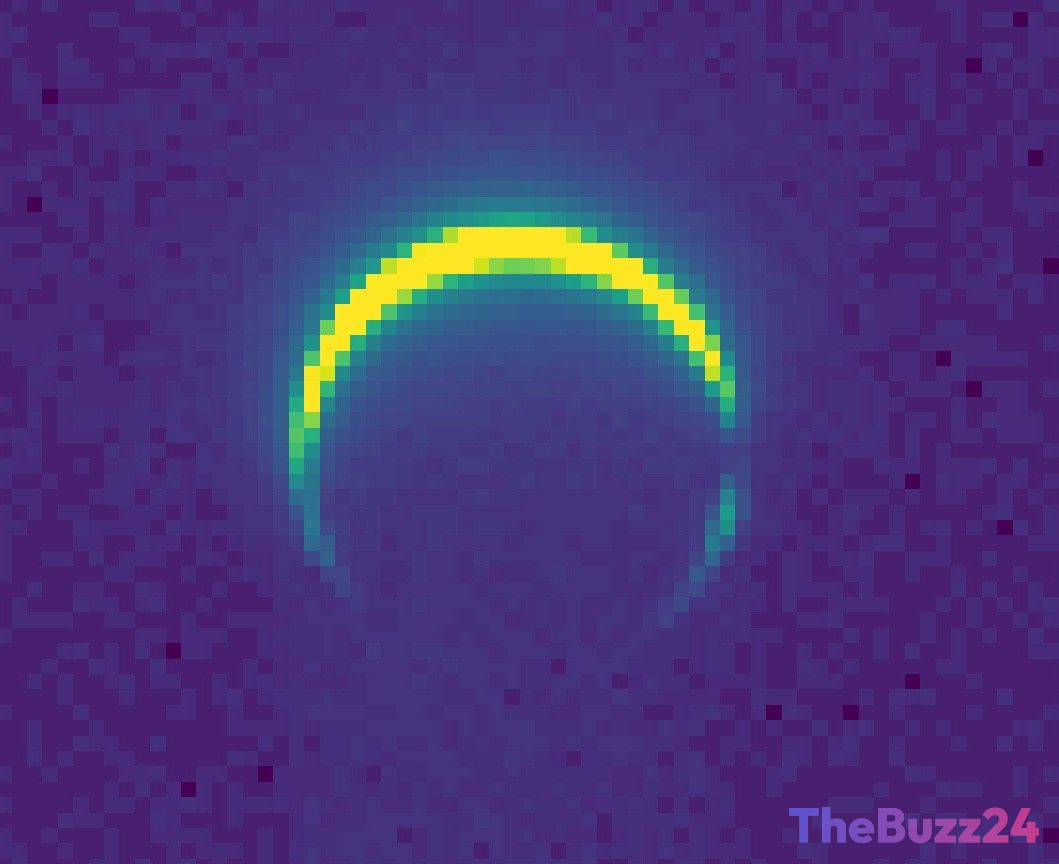
NASA’s Psyche Spacecraft Captures Rare Crescent View of Mars During Deep Space Maneuver
The Psyche spacecraft, currently on a multi-year journey to explore a metal-rich asteroid, has successfully captured a high-resolution image of Mars. The photograph, taken from a distance of roughly 3 million miles, depicts the Red Planet as a glowing, thin crescent. This visual milestone occurred as the craft approached Mars to execute a critical gravity assist maneuver, a technique used to harness the planet’s gravitational pull to adjust the spacecraft’s velocity and trajectory for its ongoing mission.
Beyond its aesthetic appeal, the image provides valuable scientific insight into the Martian atmosphere. Because the spacecraft viewed the planet from a high-phase angle, the crescent appears elongated due to the way atmospheric dust scatters sunlight. Mission specialists identified a notable gap in the crescent, which they attribute to the planet’s north polar cap. It is believed that seasonal clouds and hazes, characteristic of the Martian winter, are currently masking the atmospheric dust that would otherwise scatter light in that region.
This operation served as more than just a photo opportunity; it functioned as a vital calibration test for the spacecraft’s multispectral imager. By capturing the image with a precise two-millisecond exposure, engineers were able to test the camera’s performance in deep-space conditions. These calibration exercises are essential for ensuring that the onboard instruments are fully optimized to study the asteroid Psyche upon the mission’s expected arrival in 2029.
Key Takeaways
- The Psyche spacecraft captured a detailed crescent image of Mars while performing a gravity assist maneuver.
- The image reveals atmospheric phenomena, including light scattering by dust and the obscuring effect of seasonal clouds over the north polar cap.
- The maneuver served as a critical calibration test for the spacecraft's multispectral imager to ensure data accuracy for the 2029 asteroid arrival.
Editor’s Analysis & Impact
The successful imaging of Mars by the Psyche spacecraft underscores the sophisticated engineering required for long-duration deep-space missions. By utilizing gravity assists, NASA is effectively extending the operational life and reach of the mission without relying solely on fuel-heavy propulsion. The calibration of the multispectral imager is particularly significant; as we move toward an era of increased asteroid exploration, the ability to interpret high-fidelity data from extreme distances is paramount. This mission not only aims to uncover the composition of the asteroid Psyche—which could offer clues about the formation of planetary cores—but also demonstrates the robustness of current autonomous navigation and imaging technologies. As the spacecraft continues its journey, these practice maneuvers will be instrumental in mitigating risks and ensuring the success of the final scientific objectives in 2029.
Frequently Asked Questions
Q: Why did the Psyche spacecraft take a picture of Mars?
A: The primary purpose was to calibrate the spacecraft's multispectral imager during a gravity assist maneuver, ensuring the camera is optimized for its final mission at the asteroid Psyche.
Q: What does the gap in the crescent image represent?
A: The gap corresponds to the Martian north polar cap, where seasonal clouds and hazes are likely obscuring the atmospheric dust that typically scatters sunlight.
AI Disclosure: This article is based on verified data and official reports. Our Team and AI have cross-referenced every financial detail with primary sources to ensure total accuracy.
More from this Category