NASA’s SkyFall Helicopters Set to Revolutionize Martian Exploration
NASA is preparing for its next ambitious Mars mission, featuring three advanced SkyFall helicopters designed to significantly enhance our understanding of the Red Planet. These sophisticated rotorcraft are poised to collect crucial data from the Martian surface and subsurface, building upon the groundbreaking achievements of previous aerial missions.
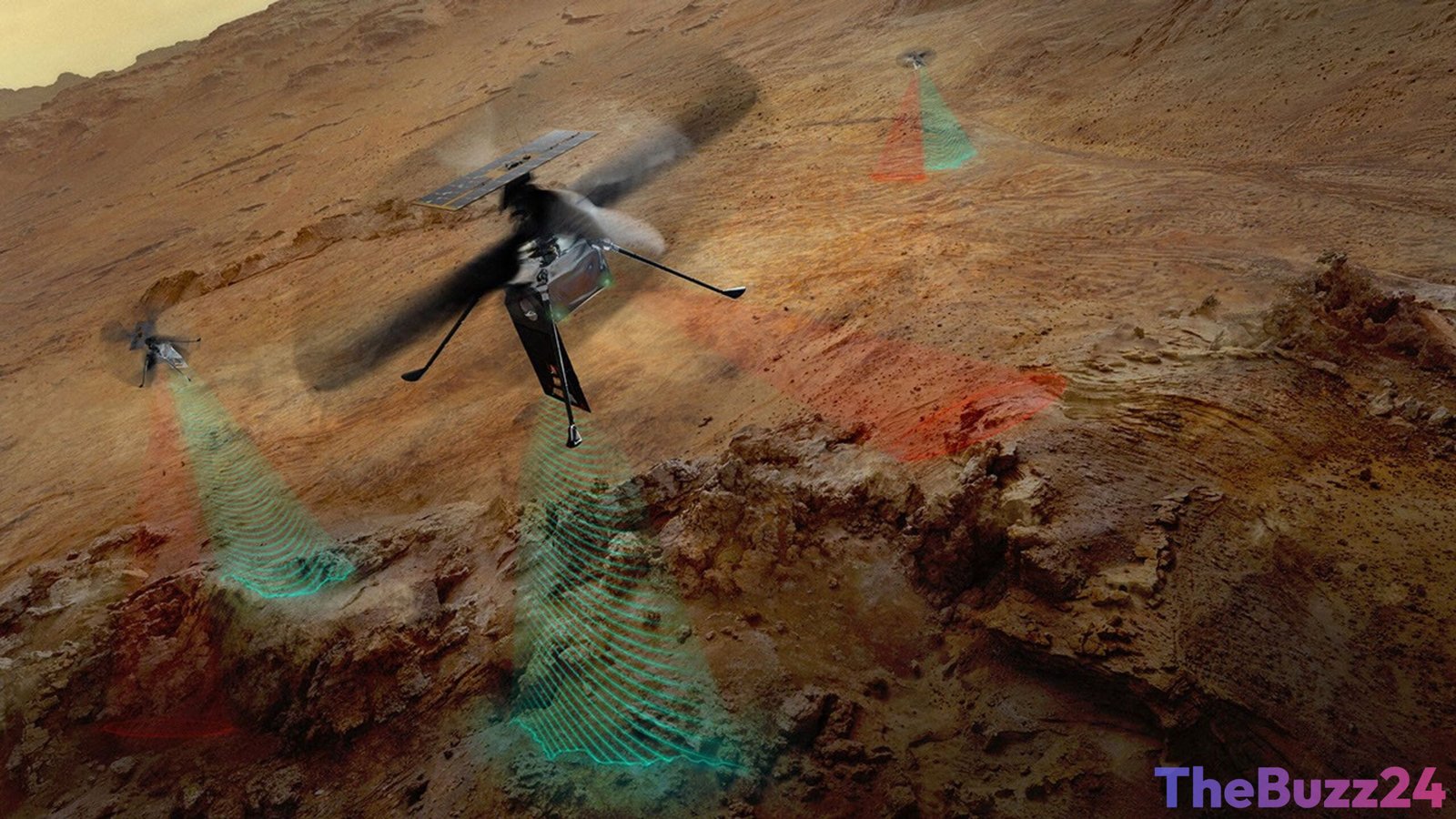
Each SkyFall helicopter will be equipped with four sophisticated instruments, enabling a dual approach to data collection. Artist’s concepts depict green frequency waves emanating from their large antennas, representing the collection of subsurface radar data. Simultaneously, red beams illustrate the gathering of near-infrared imagery from the Martian regolith (crushed rock and dust) and other surface features. This comprehensive data acquisition will provide unprecedented insights into Mars’ geological composition and structure.
The SkyFall project directly follows in the footsteps of the agency’s Ingenuity Mars Helicopter, a technology demonstrator that defied expectations by completing 72 flights over nearly three years. Ingenuity proved that powered, controlled flight is not only possible in the rarefied Martian atmosphere but also invaluable for scientific exploration. Its aerial perspective greatly assisted NASA’s Perseverance Mars rover team in planning time-saving routes and selecting optimal locations for scientific investigation.
The launch of the SkyFall mission is anticipated in late 2028, with the helicopters traveling aboard NASA’s Space Reactor-1 Freedom. The project is meticulously managed by NASA’s Jet Propulsion Laboratory (JPL). AeroVironment of Arlington, Virginia, which collaborated with JPL on the design and construction of the historic Ingenuity rotorcraft, will once again partner to co-design and co-manufacture the SkyFall helicopters. JPL itself is managed by Caltech on behalf of NASA’s Science Mission Directorate in Washington.
Key Takeaways
- NASA's SkyFall mission will deploy three advanced helicopters to Mars in late 2028 to conduct extensive scientific research.
- The helicopters are equipped with four instruments each, capable of collecting subsurface radar data and near-infrared imagery from the Martian surface.
- SkyFall builds on the success of the Ingenuity Mars Helicopter, which demonstrated powered flight on Mars and aided the Perseverance rover's operations.
Editor’s Analysis & Impact
The SkyFall mission represents a significant leap forward in planetary exploration, solidifying the role of aerial platforms in extraterrestrial research. Its advanced data collection capabilities, particularly subsurface radar, could unlock new secrets about Mars’ geological history and potential for past or present life, fundamentally altering our understanding of the Red Planet. For the aerospace industry, this mission highlights the continued demand for innovative spacecraft and instrumentation capable of operating in extreme environments. The insights gained will not only inform future human missions to Mars, providing critical information for site selection and resource identification, but also set a precedent for more agile, multi-modal planetary exploration across our solar system.
Frequently Asked Questions
Q: What is the primary goal of the SkyFall mission?
A: The primary goal of the SkyFall mission is to collect advanced subsurface radar and near-infrared imagery data from the Martian surface to enhance our understanding of the planet's geology, composition, and potential for past or present life.
Q: How does SkyFall relate to the Ingenuity Mars Helicopter?
A: SkyFall is a direct successor to the Ingenuity Mars Helicopter. It leverages the lessons learned from Ingenuity's successful demonstration of powered, controlled flight in Mars' thin atmosphere to conduct more extensive and sophisticated scientific research.
Q: When is the SkyFall mission expected to launch?
A: The SkyFall mission is anticipated to launch in late 2028, with the three helicopters traveling aboard NASA’s Space Reactor-1 Freedom.
AI Disclosure: This article is based on verified data and official reports. Our Team and AI have cross-referenced every financial detail with primary sources to ensure total accuracy.
More from this Category