Navigating On-Chain Yield: How Stablecoins Are Reshaping Digital Asset Returns
The decentralized finance ecosystem has experienced remarkable expansion, with the total stablecoin market valuation surging past the $290 billion milestone. As digital asset holders increasingly seek productive avenues for idle capital, platforms like Aave and Morpho have emerged as primary destinations. Across these two leading lending protocols alone, more than $8.6 billion in stablecoin deposits are currently generating active interest from borrowers, blurring the lines between traditional fixed-income instruments and blockchain-based yield generation.
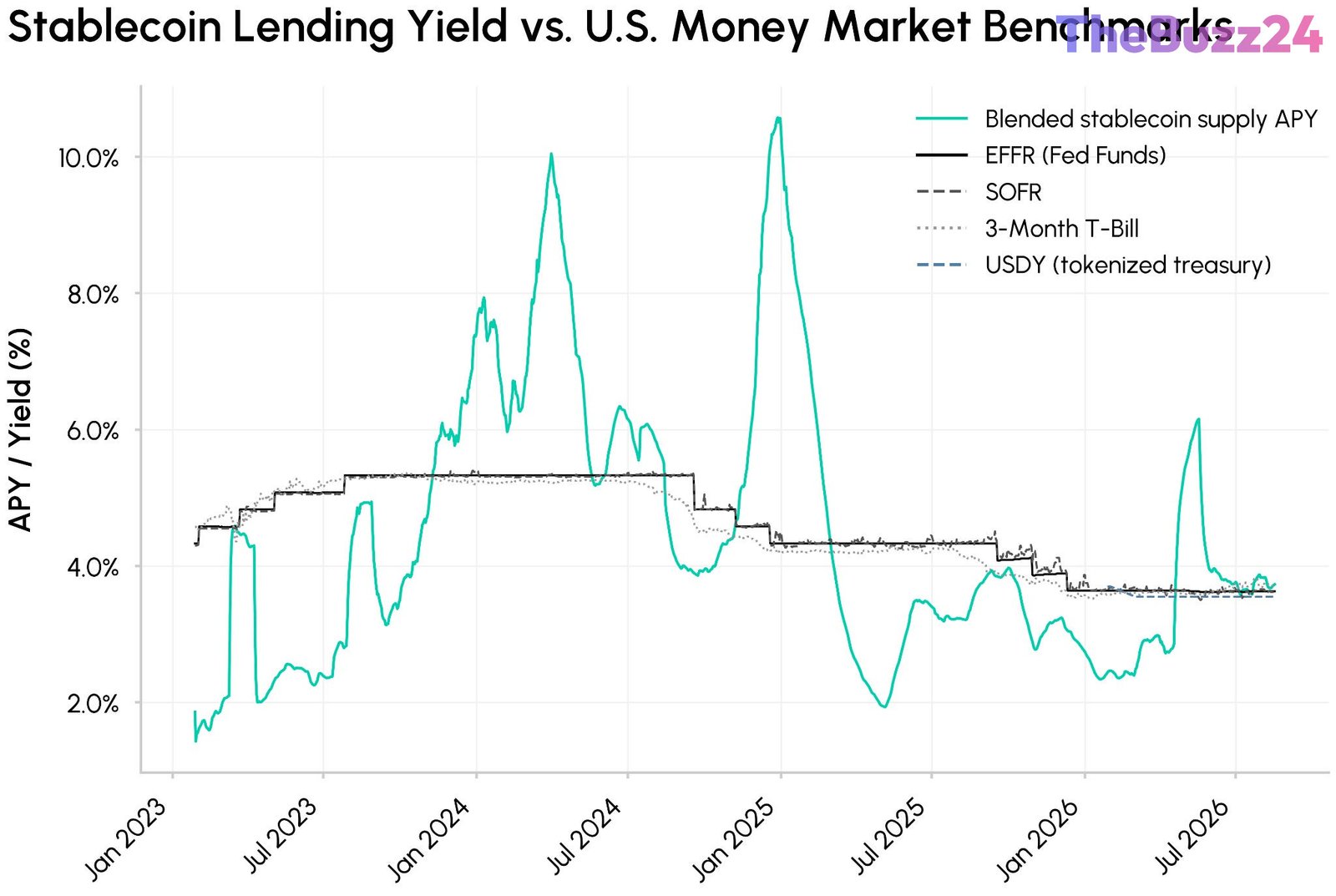
While traditional investors have long relied on short-term U.S. treasuries and money market funds for low-risk returns, the emergence of tokenized assets and decentralized lending protocols offers compelling alternatives. However, earning yields on-chain introduces distinct structural complexities. Unlike traditional financial products backed by deep institutional safeguards, decentralized options carry inherent smart contract risks, potential oracle manipulations, and the constant threat of a stablecoin depegging from its underlying fiat currency.
Interestingly, identical stablecoins can yield drastically different returns depending on the protocol utilized. For instance, the average lending rate for USDC on Aave and Morpho has historically demonstrated significant variance, driven by fundamental differences in protocol architecture. While Aave utilizes shared liquidity pools that establish uniform borrow and supply rates, Morpho relies on isolated lending markets for specific collateral pairs. Furthermore, individual stablecoin utilization rates—such as the distinct activity levels observed between USDT, USDC, and newer protocol-native assets—further fragment the yield landscape, leading to diverse performance expectations across the broader decentralized finance economy.
Beyond protocol architecture, active management plays a critical role in shaping on-chain returns. Vault curators function similarly to traditional investment managers, strategically allocating capital across various lending markets to optimize yield while managing risk tolerances. When compared directly to volatile cryptoassets like Ethereum or Wrapped Bitcoin, stablecoins consistently prove to be a more dependable source of baseline yield, shielding lenders from dramatic price depreciation while capturing steady, predictable returns in an otherwise volatile market environment.
Key Takeaways
- The total stablecoin market has surpassed $290 billion, with over $8.6 billion deposited across lending protocols like Aave and Morpho to earn interest.
- Yields for the exact same stablecoin can vary significantly between protocols due to architectural differences, such as shared liquidity pools versus isolated markets.
- Stablecoins offer more consistent and reliable returns compared to lending volatile cryptoassets like Ethereum, which are heavily susceptible to price fluctuations.
Editor’s Analysis & Impact
The maturation of decentralized finance has created a complex interplay between traditional fixed-income markets and on-chain yield opportunities. As the stablecoin market continues its aggressive expansion, investors are no longer viewing digital assets merely as speculative vehicles, but as productive capital instruments capable of generating steady cash flows. However, the lack of uniformity across different lending protocols highlights a fragmented ecosystem where risk assessment and capital allocation require sophisticated strategies. In the future, as tokenized traditional assets and advanced vault curation continue to evolve, the boundaries between centralized and decentralized finance will blur further. This integration will likely attract deeper institutional participation, provided that systemic risks like smart contract vulnerabilities and regulatory uncertainties are effectively mitigated.
Frequently Asked Questions
Q: What is the primary driver of stablecoin yield in decentralized finance?
A: Stablecoin yield is primarily driven by supply and demand dynamics within lending protocols, where borrowers pay interest to access capital and lenders earn a percentage of that interest based on pool utilization.
Q: Why do different lending protocols offer varying rates for the same stablecoin?
A: Different protocols use distinct architectural designs. For example, shared pool models like Aave offer uniform rates for an asset, whereas isolated market structures like Morpho create individualized supply and demand parameters that result in varied returns.
Q: How do stablecoin yields compare to volatile cryptoasset lending?
A: Stablecoins generally provide much steadier, predictable returns compared to volatile assets like Ethereum, whose overall profitability is heavily dictated by underlying price appreciation or loss rather than protocol yield alone.
AI Disclosure: This article is based on verified data and official reports. Our Team and AI have cross-referenced every financial detail with primary sources to ensure total accuracy.
More from this Category