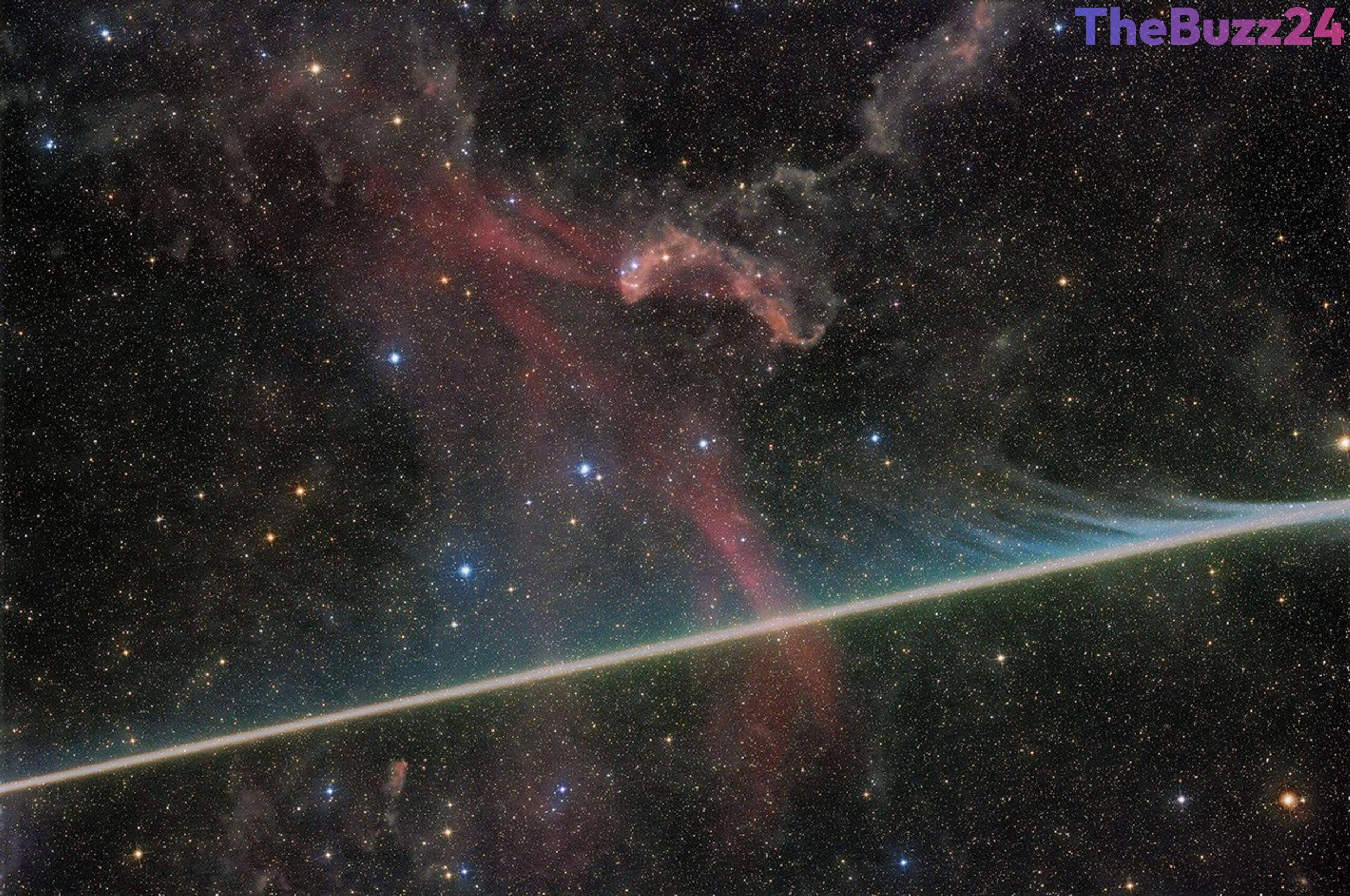
Nevada Sky Reveals Dazzling Meteor Amidst Lacerta Nebula
A breathtaking astronomical event was recently captured from the Death Valley Observatories in Nevada, USA, showcasing a brilliant meteor streaking across the faint, reddish expanse of the Great Lacerta Nebula. The fleeting celestial visitor, appearing and vanishing in an instant during a long-exposure photograph, offered a rare glimpse into the dynamic interplay of our solar system and distant cosmic structures.
The luminous trail left by the meteor is a result of a small pebble-sized meteoroid entering Earth’s atmosphere. As it hurtles through the air, intense friction causes it to heat up and excite the surrounding atmospheric gases, creating the visible glow. The meteoroid itself rapidly vaporizes, leaving behind a trail of wind-blown gas and dust. The distinct colors observed within this ephemeral wake can provide valuable clues about the meteor’s chemical composition, offering insights into the materials that comprise these interstellar travelers.
This captivating observation comes at a particularly active time for skywatchers. The current month is proving to be excellent for meteor sightings, with three distinct meteor showers presently underway. However, their visibility is somewhat challenged by the bright glow of a gibbous Moon. Enthusiasts are eagerly anticipating the peak of the Perseids, arguably the most spectacular of these showers, which is expected in approximately ten days, coinciding with a period when the Moon’s illumination will have significantly diminished.
Adding to the excitement, this year’s Perseids peak is set to align not only with a new Moon but also, for observers in certain locations, with a total solar eclipse. This rare cosmic alignment promises an exceptional opportunity for stargazers to witness the Perseids at their most brilliant, unhindered by moonlight, and potentially alongside another awe-inspiring celestial phenomenon.
Key Takeaways
- A rare photograph captured a bright meteor streaking across the Great Lacerta Nebula from Death Valley Observatories in Nevada.
- The meteor's luminous trail provides scientific data on its composition and interaction with Earth's atmosphere as it vaporizes.
- The observation coincides with an active meteor season, with the Perseids shower set to peak in about ten days, aligning with a new Moon and a total solar eclipse in some regions.
Editor’s Analysis & Impact
This event highlights the ongoing beauty and scientific value of astronomical observations. Such captures, combining transient phenomena like meteors with distant deep-sky objects, inspire public interest in space and underscore the capabilities of modern astrophotography. The timing with the Perseids peak and a solar eclipse creates a unique convergence of celestial events, potentially boosting engagement in amateur astronomy and scientific outreach. From an industry perspective, advancements in imaging technology and observatory infrastructure continue to push the boundaries of what can be observed and documented, contributing to our understanding of cosmic processes and the composition of space debris. This kind of visual content is invaluable for science communication, making complex phenomena accessible and awe-inspiring to a broader audience.
Frequently Asked Questions
Q: What is the Great Lacerta Nebula?
A: The Great Lacerta Nebula is a faint, reddish emission nebula located in the constellation Lacerta, known for its diffuse glow and intricate gas structures, composed primarily of ionized hydrogen gas.
Q: How do meteors create light?
A: Meteors glow when meteoroids enter Earth's atmosphere at high speeds, causing intense friction that heats and excites the surrounding air molecules, which then emit light. The meteoroid itself also heats up and vaporizes, contributing to the luminous trail.
Q: What are the Perseids meteor shower?
A: The Perseids are one of the most prolific and popular meteor showers of the year, occurring annually in August. They are caused by debris left behind by the Swift-Tuttle comet, which Earth passes through each year, resulting in numerous bright streaks across the night sky.
AI Disclosure: This article is based on verified data and official reports. Our Team and AI have cross-referenced every financial detail with primary sources to ensure total accuracy.
More from this Category