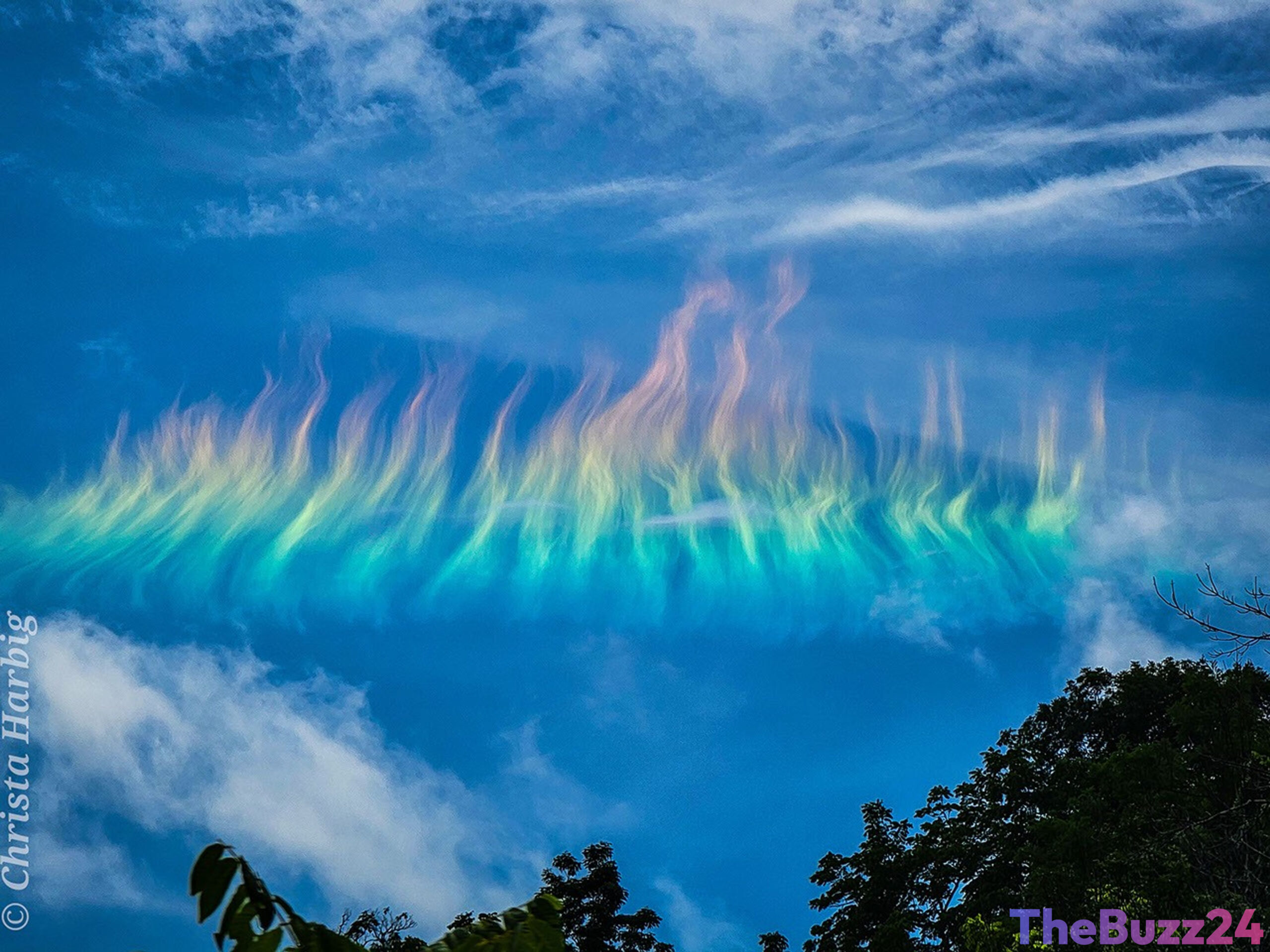
Spectacular ‘Fire Rainbow’ Illuminates West Virginia Skies
A breathtaking atmospheric phenomenon, informally known as a “fire rainbow,” recently captivated observers near North Fork Mountain in West Virginia. This vibrant display, scientifically termed a circumhorizontal arc, presents as a brilliant, flame-like spectrum of colors stretching parallel to the horizon, creating an illusion of fire in the sky.
The formation of a circumhorizontal arc is a precise dance of light and ice crystals. It requires the sun to be positioned exceptionally high in the sky, specifically at an elevation of at least 58 degrees. Simultaneously, cirrus clouds, particularly the wispy cirrus fibratus type, must be present at a lower altitude. Within these clouds, numerous flat, hexagonal ice crystals act as tiny prisms. For the arc to become visible, these microscopic crystals must be perfectly aligned horizontally, allowing them to collectively refract sunlight in a uniform manner, splitting it into its constituent colors much like a prism.
Due to the stringent conditions required for its appearance—the specific solar angle, the presence of the right type of cirrus clouds, and the precise orientation of their ice crystals—circumhorizontal arcs are considered relatively unusual and a rare treat for sky-watchers. The stunning photograph captured in 2021 over West Virginia serves as a vivid reminder of the intricate and beautiful optical phenomena that can occur in Earth’s atmosphere.
Key Takeaways
- A "fire rainbow," or circumhorizontal arc, is a rare atmospheric optical phenomenon appearing as a colorful arc parallel to the horizon.
- Its formation requires specific conditions: the sun must be at least 58 degrees high, and horizontally aligned hexagonal ice crystals must be present in cirrus clouds.
- A notable instance of this phenomenon was observed and photographed in 2021 near North Fork Mountain in West Virginia.
Editor’s Analysis & Impact
This captivating display of a circumhorizontal arc underscores the profound beauty and complexity inherent in atmospheric optics. Such phenomena, while rare, serve as powerful reminders of the natural wonders constantly unfolding above us, often unnoticed. From a scientific perspective, observations like these contribute to our understanding of light refraction, ice crystal formation, and atmospheric conditions. For the public, witnessing or learning about a “fire rainbow” can ignite curiosity about meteorology, physics, and environmental science, potentially inspiring future generations of scientists. As climate patterns shift, the frequency or visibility of certain atmospheric phenomena might change, making continued observation and documentation increasingly valuable for long-term atmospheric studies and public engagement with science.
Frequently Asked Questions
Q: What is a "fire rainbow"?
A: A "fire rainbow" is the informal name for a circumhorizontal arc, a rare optical phenomenon where a colorful, rainbow-like band appears parallel to the horizon, resembling flames.
Q: What causes a circumhorizontal arc to form?
A: It forms when sunlight passes through horizontally aligned, hexagonal ice crystals within cirrus clouds, refracting the light and splitting it into its spectrum of colors. This requires the sun to be at a high angle (at least 58 degrees above the horizon).
Q: How rare is it to see a "fire rainbow"?
A: Circumhorizontal arcs are considered relatively rare because they require a very specific combination of conditions: a high sun angle, the presence of cirrus clouds, and the precise horizontal alignment of ice crystals within those clouds.
AI Disclosure: This article is based on verified data and official reports. Our Team and AI have cross-referenced every financial detail with primary sources to ensure total accuracy.
More from this Category