New Fire-Resistant Webbing Materials Cleared for Lunar and Martian Exploration
As space agencies prepare for long-term crewed missions to the Moon and Mars, engineers are addressing the critical challenge of fire safety in elevated oxygen environments. Future missions plan to utilize higher oxygen concentrations to reduce the prebreathe time required for astronauts before conducting extravehicular activities. However, this enriched atmosphere significantly increases flammability risks, necessitating the development of new, high-performance textile materials for use in softgoods such as restraint nets, mobility aids, and storage equipment.
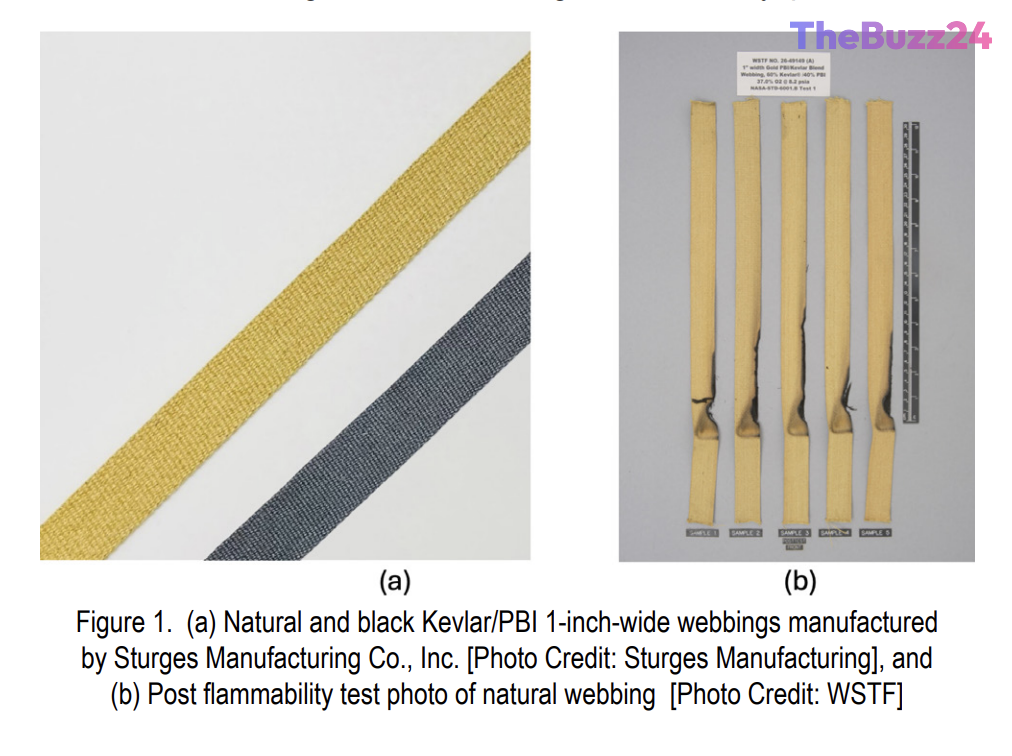
Recent testing has identified a promising solution in a specialized webbing manufactured by Sturges Manufacturing Company, Inc. The material, a blend of 60% Kevlar and 40% polybenzimidazole (PBI), was subjected to rigorous flammability assessments under NASA-STD-6001B standards. The natural-colored version of this webbing successfully passed ignition tests at 37% oxygen and 8.2 psia, marking it as a viable candidate for flight hardware. Offgassing data for the material also met safety requirements, further validating its potential for use in confined spacecraft environments.
While these results offer a significant step forward, experts emphasize that individual material performance does not guarantee the safety of a finished assembly. The final flammability profile of any softgood depends on its specific configuration, including weave density, dimensions, and the integration of additional components like fasteners. Consequently, while this Kevlar/PBI blend provides a robust foundation, engineers must continue to conduct full-scale configuration testing to ensure total system safety before these materials are deployed in deep-space missions.
Key Takeaways
- A 60% Kevlar/40% PBI webbing blend has been identified as fire-resistant enough for use in high-oxygen lunar and Martian mission environments.
- The material successfully passed NASA-STD-6001B flammability and offgassing tests at 37% oxygen and 8.2 psia.
- Final safety validation requires testing the material in its full, finished configuration, as assembly components can alter flammability characteristics.
Editor’s Analysis & Impact
The identification of fire-resistant materials capable of withstanding high-oxygen environments is a foundational requirement for the next generation of space exploration. As mission profiles shift toward longer durations on the lunar surface and eventual transit to Mars, the reliance on ‘softgoods’—textile-based hardware—will increase. This development highlights a broader industry trend of leveraging commercial-off-the-shelf (COTS) products to accelerate aerospace innovation. By validating existing industrial textiles rather than developing entirely new materials from scratch, agencies can significantly reduce development timelines and costs. However, the industry must remain cautious; the transition from raw material testing to integrated flight hardware remains a complex engineering hurdle. Future implications include a standardized catalog of ‘flight-ready’ textiles that will simplify the supply chain for private and public space contractors alike.
Frequently Asked Questions
Q: Why is an elevated oxygen environment necessary for future space missions?
A: Elevated oxygen environments are planned for lunar and Martian missions to reduce the prebreathe time required for astronauts before they perform extravehicular activities (spacewalks).
Q: Does passing the flammability test guarantee the material is safe for use in a spacecraft?
A: No. While the material itself meets safety standards, the final flammability result depends on the entire assembly, including weave type, dimensions, and added components like fasteners. Full-configuration testing is required for final validation.
AI Disclosure: This article is based on verified data and official reports. Our Team and AI have cross-referenced every financial detail with primary sources to ensure total accuracy.
More from this Category