Next-Gen Cargo Mission Set to Advance Space-Based Medicine and Manufacturing
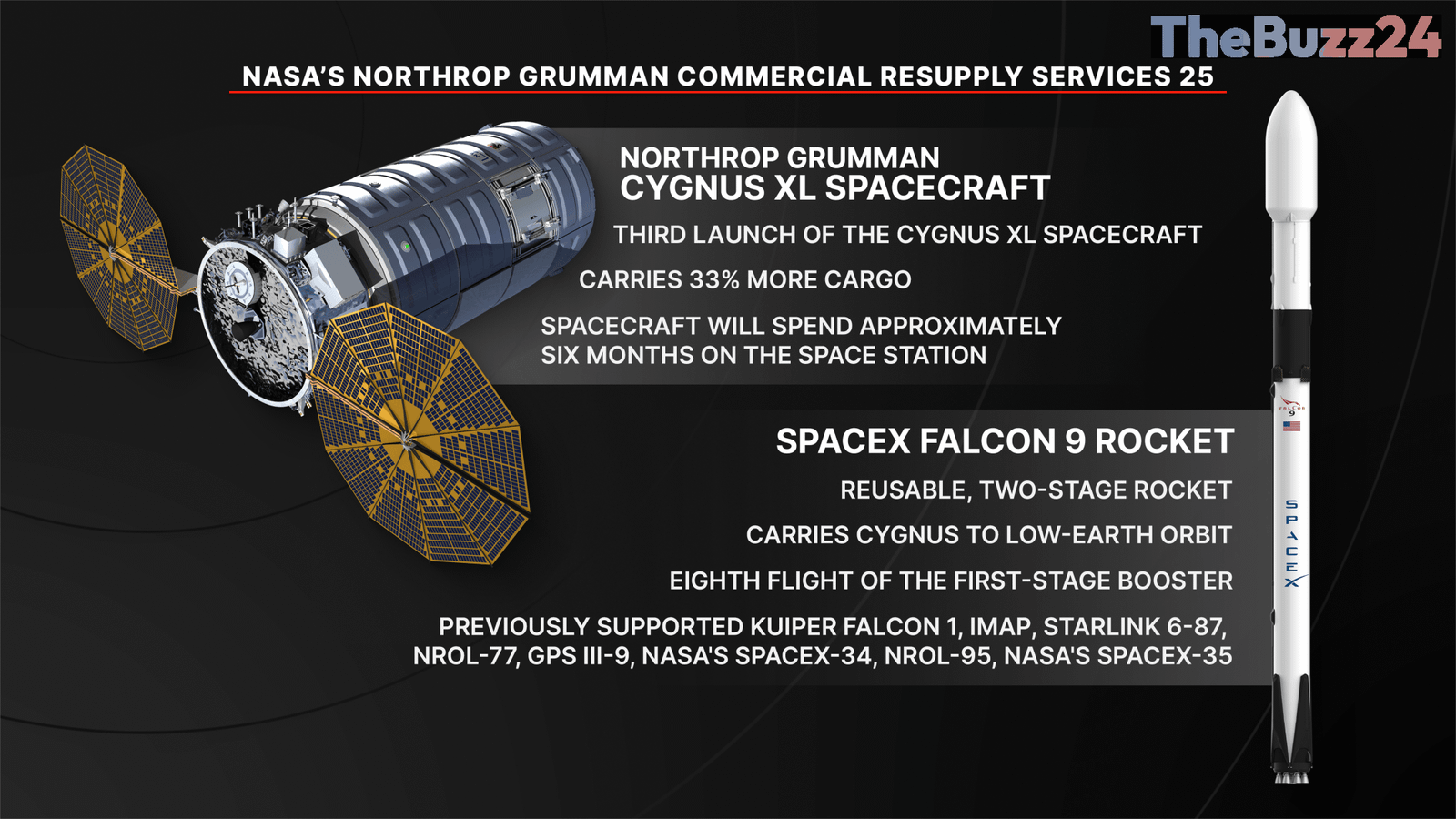
A critical resupply mission is set to launch, carrying approximately 11,000 pounds of essential equipment, food, and groundbreaking scientific experiments to the International Space Station. Utilizing the Cygnus XL spacecraft, this mission represents a significant logistical effort to sustain the orbiting laboratory while pushing the boundaries of research in microgravity. The spacecraft, named in honor of legendary astronaut James “Jim” A. Lovell Jr., will be launched aboard a SpaceX Falcon 9 rocket from Cape Canaveral Space Force Station.
Upon reaching the station, the spacecraft will be captured by the Canadarm2 robotic arm, operated by station crew members, and docked to the Unity module. This mission is particularly notable for its diverse scientific payload, which includes experiments aimed at revolutionizing healthcare on Earth. Projects like Cardinal Muscle 2.0 and Encapsulate-1 are designed to study muscle atrophy and cancer metastasis, respectively, leveraging the unique environment of space to gain insights that are difficult to replicate in terrestrial laboratories.
Beyond medical research, the mission serves as a testbed for future deep-space exploration technologies. The inclusion of the Active Radiation Environment Sensor (ARES) and the JOINS robotic welding demonstration highlights a strategic shift toward long-duration missions. By testing autonomous welding techniques and advanced radiation monitoring, researchers are laying the groundwork for the construction and maintenance of large-scale infrastructure on the Moon and beyond, ensuring that future crews remain safe and self-sufficient during extended voyages.
In addition to high-tech experiments, the mission delivers vital maintenance hardware, including updated crew quarters, hatch seal covers, and specialized tools for upcoming spacewalks. These logistical components are essential for the continued operational integrity of the station, ensuring that the facility remains a viable platform for international scientific collaboration and technological innovation for years to come.
Key Takeaways
- The mission will deliver 11,000 pounds of cargo, including critical medical research and station maintenance hardware.
- New experiments focus on advanced drug delivery for cancer, osteoarthritis treatments, and autonomous robotic welding for future space construction.
- The mission utilizes the Cygnus XL spacecraft, launched via a SpaceX Falcon 9, to support long-duration exploration goals like the Artemis program.
Editor’s Analysis & Impact
This mission underscores the transition of the International Space Station from a purely observational platform to a sophisticated manufacturing and medical research hub. By testing technologies like robotic welding and DNA-inspired nanomedicine, the aerospace industry is effectively de-risking the infrastructure required for a permanent lunar presence and eventual Mars missions. The ability to manufacture materials and conduct complex biological assays in microgravity offers a unique value proposition that could disrupt pharmaceutical and material science industries on Earth. As private-public partnerships continue to mature, the focus on ‘in-space’ assembly and autonomous maintenance will be the primary driver for reducing the cost and complexity of deep-space exploration, signaling a new era of commercial viability in low Earth orbit.
Frequently Asked Questions
Q: What is the primary purpose of the Cygnus XL spacecraft in this mission?
A: The Cygnus XL is a cargo-capable spacecraft designed to deliver essential supplies, food, and scientific research equipment to the International Space Station.
Q: How does microgravity assist in cancer and muscle loss research?
A: Microgravity allows researchers to observe biological processes, such as tumor cell movement and muscle atrophy, in ways that are accelerated or more uniform than on Earth, helping to identify new treatment pathways.
Q: What is the significance of the JOINS demonstration?
A: JOINS tests autonomous robotic welding in space, which is a critical capability for assembling and repairing large structures in orbit or on the Moon without needing to launch pre-assembled, bulky components.
AI Disclosure: This article is based on verified data and official reports. Our Team and AI have cross-referenced every financial detail with primary sources to ensure total accuracy.
More from this Category