Next-Generation PRTPV Power Systems Could Revolutionize Deep Space Exploration
A groundbreaking energy system proposal aims to redefine power generation for deep space exploration and interstellar missions. The innovative concept, known as the plasmon-enhanced radioisotope thermophotovoltaic (PRTPV) generator, is engineered to drastically outperform traditional radioisotope thermoelectric generators in both overall efficiency and specific power.
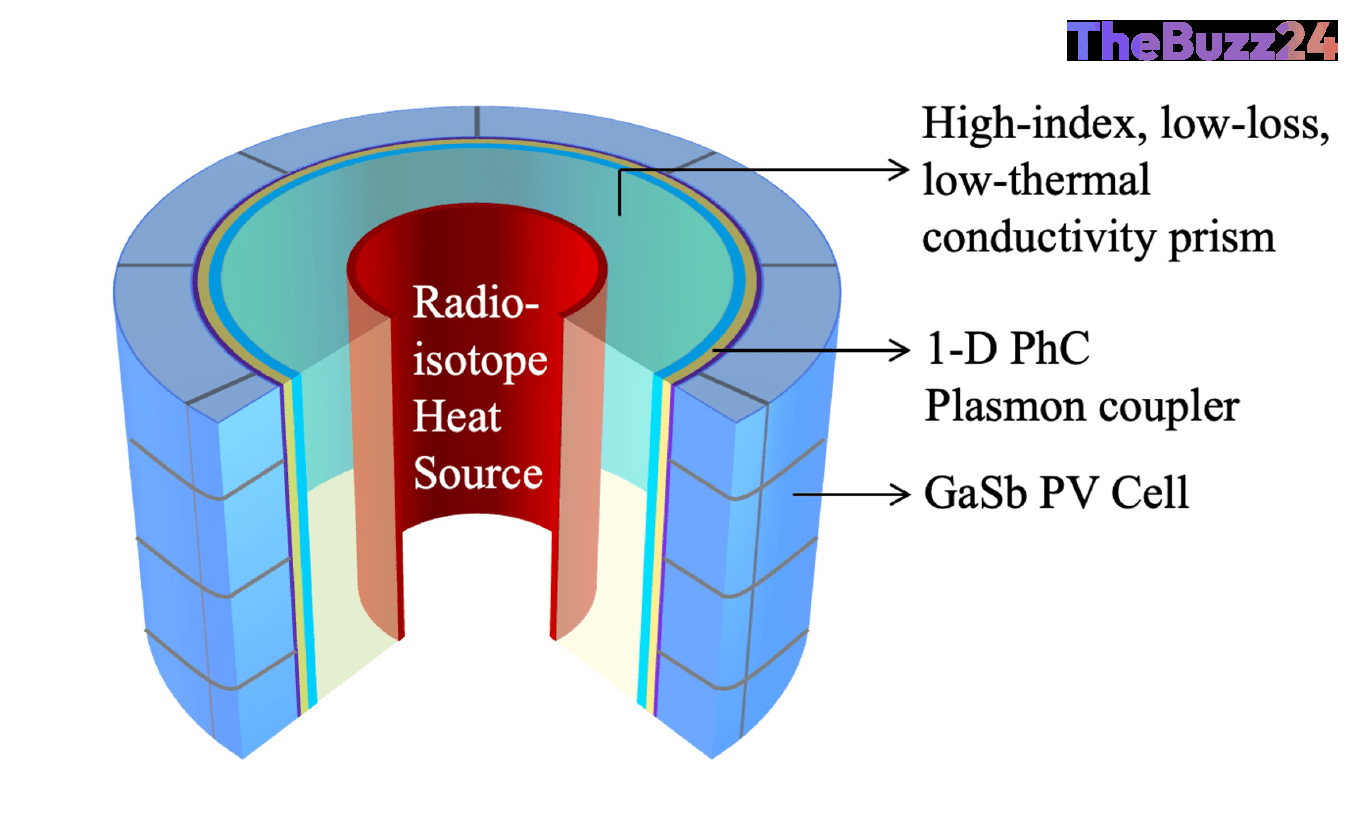
Traditional power sources used in deep space often face limitations in power density and conversion efficiency. The proposed PRTPV system addresses these challenges by integrating advanced material science and photonics. Specifically, it utilizes a high-refractive-index, low-thermal-conductivity material to replace the conventional vacuum gap between the heat source and the photovoltaic cell, which significantly boosts thermal radiation power density. Furthermore, a multilayered photonic crystal plasmon coupler is incorporated to spectrally tune thermal radiation, ensuring it matches the photovoltaic cell’s bandgap for maximum conversion efficiency.
By achieving a targeted specific power of 17 W/kg and a thermal-to-electric conversion efficiency exceeding 40%, this technology promises a nearly sevenfold improvement in efficiency compared to current systems. These compact and scalable power generators could soon enable unprecedented mission profiles, including prolonged surface operations in permanently shadowed lunar regions and ambitious interstellar travel where solar energy remains entirely unviable.
Key Takeaways
- The PRTPV generator aims to deliver a specific power of 17 W/kg and over 40% thermal-to-electric conversion efficiency.
- The system uses a high-refractive-index material instead of a vacuum gap to enhance thermal radiation power density.
- A multilayered photonic crystal plasmon coupler spectrally tunes thermal radiation to match the photovoltaic cell's bandgap.
Editor’s Analysis & Impact
The introduction of the plasmon-enhanced radioisotope thermophotovoltaic (PRTPV) system represents a monumental leap forward for aerospace engineering and deep space missions. As space agencies and private aerospace firms alike push toward more distant and demanding environments—such as permanently shadowed lunar craters and interstellar space—traditional power sources like standard RTGs are rapidly approaching their technical limits. By dramatically increasing specific power and thermal-to-electric efficiency, PRTPV technology removes a critical bottleneck in spacecraft design. This innovation not only expands the operational window for planetary rovers and orbiters but also makes previously unfeasible interstellar trajectories technologically achievable, signaling a new era for long-duration extraterrestrial exploration.
Frequently Asked Questions
Q: What does PRTPV stand for?
A: PRTPV stands for plasmon-enhanced radioisotope thermophotovoltaic generator.
Q: How much more efficient is the PRTPV system compared to traditional RTGs?
A: The PRTPV system offers a nearly sevenfold improvement in efficiency and an order-of-magnitude increase in specific power compared to state-of-the-art radioisotope thermoelectric generators.
Q: What mission types will benefit most from this technology?
A: Long-duration surface operations in permanently shadowed lunar regions and deep space interstellar missions where solar power is impractical will benefit the most.
AI Disclosure: This article is based on verified data and official reports. Our Team and AI have cross-referenced every financial detail with primary sources to ensure total accuracy.
More from this Category