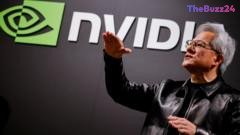
Nvidia Mobilizes $500 Billion Wall Street Consortium to Treat AI Compute as New Asset Class
Semiconductor powerhouse Nvidia has established a groundbreaking $500 billion funding initiative in collaboration with premier Wall Street investment firms and banks to accelerate global artificial intelligence infrastructure. Financial heavyweights including BlackRock, Blackstone, Apollo, Brookfield, Goldman Sachs, and KKR are participating in the endeavor, marking a pivotal moment where high-performance computing hardware and data facilities are officially recognized as a distinct, long-term asset class.
The capital injection will be deployed across both Nvidia’s proprietary initiatives and joint ventures with its industry partners. Primary targets for the capital deployment include expanding next-generation data center networks equipped with specialized liquid cooling systems to support dense chip stacks, as well as constructing advanced fabrication facilities to scale up chip manufacturing. This surge in production aims to satisfy the relentless global appetite for high-performance processing hardware.
Demand for Nvidia’s specialized graphics processing units continues to skyrocket as hyperscalers and frontier AI firms—such as Microsoft, Google, Meta, OpenAI, Anthropic, and Tesla—integrate deep-learning capabilities across their platforms. Over the past three years, cumulative industry investment in AI infrastructure has eclipsed $1 trillion. Jensen Huang, chief executive of Nvidia, emphasized that this newly mobilized capital framework transitions the company beyond traditional chip design into establishing full-scale ‘AI factories’ designed to drive persistent economic growth.
Despite the record commitment of institutional capital, financial market observers remain watchful regarding long-term yields. While executives from participating investment firms view digital compute as an indispensable infrastructure pillar essential for future productivity, market analysts urge caution over whether these capital-intensive deployment strategies will yield proportionate revenues across the extended technology ecosystem.
Key Takeaways
- Nvidia has secured a $500 billion capital pool from major financial institutions including BlackRock, Apollo, and Goldman Sachs.
- The massive capital deployment will target advanced AI data centers, cooling systems, and specialized chip fabrication facilities.
- Major institutional investors now officially categorize high-performance computing ('compute') as a primary, long-term asset class.
Editor’s Analysis & Impact
Nvidia’s $500 billion coalition with private equity and asset management giants marks a structural evolution in corporate finance, transforming AI processing infrastructure into an institutionalized asset class akin to real estate or energy grids. By securing private capital directly rather than relying solely on corporate balance sheets, Nvidia effectively de-risks its growth trajectory while guaranteeing capital flow into the data center pipeline. However, this level of capital intensity sets a high bar for return on investment. If software providers and enterprise AI implementations fail to generate proportional end-user revenues over the next 3 to 5 years, the risk of structural overcapacity could weigh heavily on financial sponsors. Nevertheless, in the short to medium term, this initiative cements Nvidia’s dominance over the hardware landscape.
Frequently Asked Questions
Q: What is the primary purpose of the $500 billion investment?
A: The fund will finance large-scale artificial intelligence infrastructure, including specialized data centers, advanced chip cooling systems, and chip manufacturing plants.
Q: Which financial institutions are participating in this financing push?
A: Major financial and private equity firms involved include BlackRock, Blackstone, Apollo, Brookfield, Goldman Sachs, and KKR.
Q: Why is 'compute' being classified as a new asset class?
A: Leading institutional investors view high-performance computing hardware and AI facilities as essential digital infrastructure that directly drives revenue and long-term economic productivity.
AI Disclosure: This article is based on verified data and official reports. Our Team and AI have cross-referenced every financial detail with primary sources to ensure total accuracy.
More from this Category