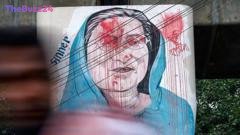
Ousted Bangladeshi Leader Sheikh Hasina Vows Return Amidst Death Sentence
Former Bangladeshi Prime Minister Sheikh Hasina has declared her intention to return to Bangladesh in December, despite facing a death penalty in her home country. Hasina, who has consistently denied the charges leveled against her, was tried and convicted in absentia following her departure to India during a period of significant political upheaval in 2024.
Speaking via an audio broadcast from Delhi on the second anniversary of her ousting, Hasina stated her “necessity to go back,” though she withheld specific details regarding her travel plans or dates. Her party, the Awami League, has reportedly faced internal challenges, and Indian authorities have been under pressure to extradite her. The conviction stems from a special tribunal in Dhaka sentencing her to death for allegedly ordering the use of lethal force against protesters.
This address to the Foreign Correspondents’ Club in Delhi marked Hasina’s first media engagement since losing power after 15 years. She asserted that while she anticipates potential imprisonment or even death upon her return, the decision to go back is firm. Hasina also alleged that external organizations manipulated the 2024 student protests, transforming them into a violent movement, though she did not present evidence to support this claim. Her conviction relied heavily on evidence, including a verified audio recording where she appeared to authorize a crackdown on demonstrators, a move that UN investigators found was part of a pattern of systematic, deadly violence employed by her government to retain power.
The UN estimates that up to 1,400 individuals perished during the protests, primarily from security forces’ gunfire. These demonstrations, initially a student-led movement against government job quota policies, escalated into a widespread national uprising. Hasina, 78, fled Dhaka as the crisis deepened, with protesters storming government buildings and her official residence. An interim government assumed control, followed by the Bangladesh Nationalist Party winning elections in February of this year, with Tarique Rahman now serving as prime minister. The current government expressed outrage over India permitting Hasina’s media interaction and reiterated its commitment to preventing a return to what it termed “dark days of fascism.”
Key Takeaways
- Former Bangladeshi PM Sheikh Hasina plans to return to Bangladesh in December, despite a death sentence.
- Hasina denies charges of ordering lethal force against protesters, which led to her conviction in absentia.
- Her return could lead to significant political unrest and legal repercussions in Bangladesh.
Editor’s Analysis & Impact
Sheikh Hasina’s defiant announcement to return to Bangladesh, even with a death sentence hanging over her, signals a high-stakes gamble with potentially explosive consequences. This move directly challenges the current government and could reignite widespread political instability, particularly given the violent history of the protests for which she was convicted. For the Awami League, her return is crucial for political relevance, but it also exposes supporters to further risks. The situation strains relations between Bangladesh and India, which is now tasked with navigating a complex extradition request. The broader implication is a potential resurgence of political turmoil in a nation still recovering from recent upheaval, with significant implications for regional stability.
Frequently Asked Questions
Q: Why was Sheikh Hasina sentenced to death?
A: Sheikh Hasina was sentenced to death in absentia by a special tribunal in Dhaka for allegedly ordering the use of lethal force against protesters during the 2024 uprising. UN investigators found evidence suggesting her government used systematic, deadly violence to cling to power.
Q: What is the current political situation in Bangladesh?
A: Following Sheikh Hasina's ousting in 2024, an interim government took charge. The Bangladesh Nationalist Party (BNP) came to power after elections in February of this year, with Tarique Rahman as prime minister. Hasina's party, the Awami League, was banned and unable to contest the recent elections.
Q: What are the potential consequences of Hasina's return?
A: Her return is expected to lead to significant political unrest, with supporters of the ruling BNP and other groups potentially demanding her sentence be carried out. It also poses personal risks to Hasina, who would likely be arrested immediately upon arrival. The situation could also exacerbate diplomatic tensions between Bangladesh and India.
AI Disclosure: This article is based on verified data and official reports. Our Team and AI have cross-referenced every financial detail with primary sources to ensure total accuracy.
More from this Category