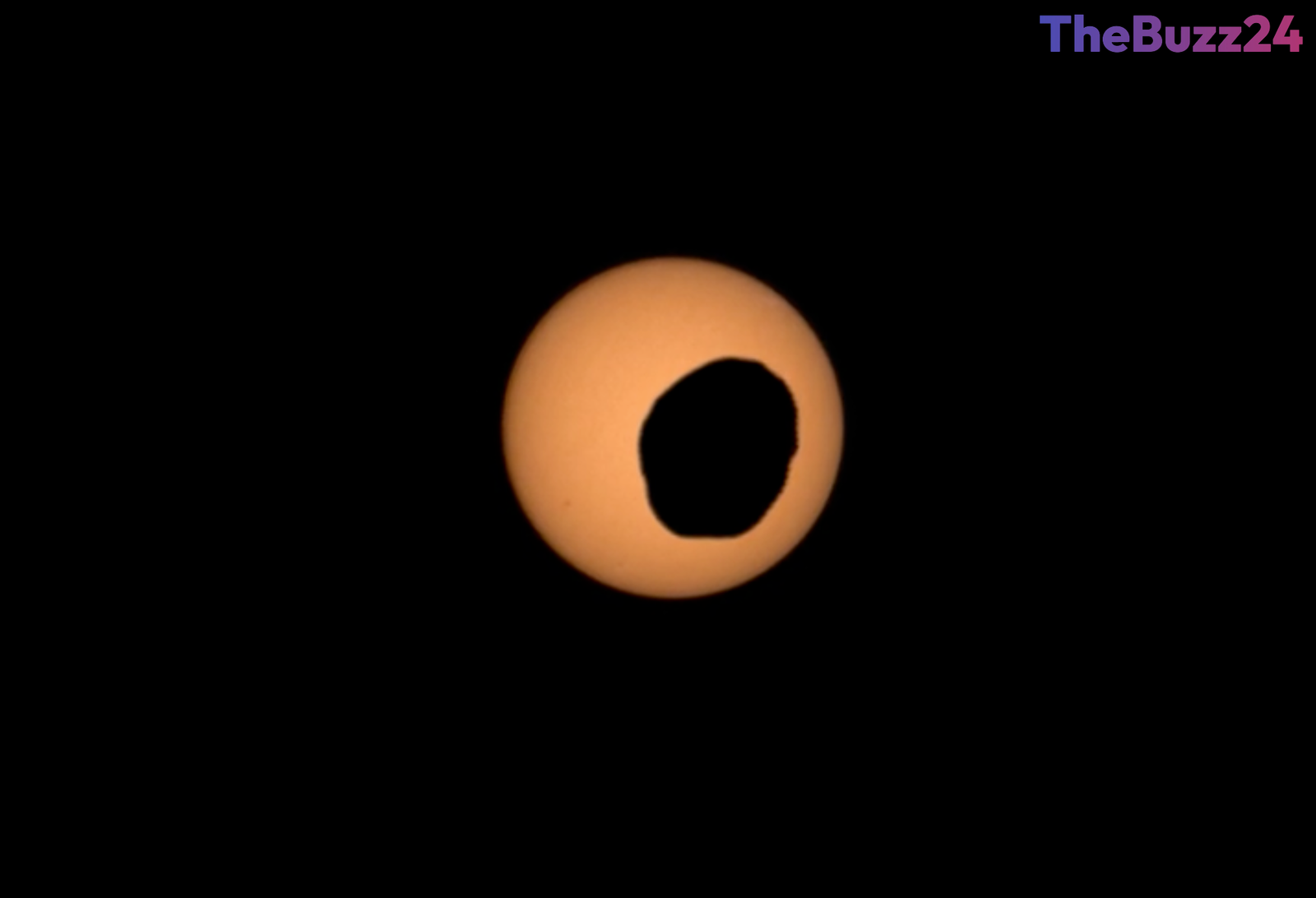
Perseverance Rover Records Latest Solar Transit of Martian Moon Phobos
The Perseverance rover has successfully captured a new series of images documenting the transit of Phobos, one of Mars’ two moons, as it passed directly in front of the Sun. The event, which occurred on August 12, 2026, during the 1,948th sol of the mission, was recorded using the rover’s advanced Mastcam-Z camera system. The resulting footage has been processed to simulate the visual experience of observing the eclipse from the Martian surface through protective solar filters.
Since touching down in the Jezero Crater in early 2021, the Perseverance rover has become a vital tool for monitoring the orbital mechanics of Phobos. These recurring observations are not merely for aesthetic purposes; they provide researchers with critical data to track the moon’s irregular, potato-like trajectory. By analyzing these transits over time, scientists can better understand the gravitational forces at play and the gradual orbital decay of the moon.
Current scientific models suggest that Phobos is slowly spiraling toward Mars. While this process will take eons to complete, the consistent monitoring provided by the Perseverance mission allows for more precise predictions regarding the moon’s ultimate fate. The data gathered from these transits continues to refine our knowledge of the Martian environment and the long-term evolution of its satellite system.
Key Takeaways
- The Perseverance rover captured a clear silhouette of the Martian moon Phobos crossing the Sun on August 12, 2026.
- Data from these transits are used by scientists to track the moon's orbital decay and changing path around Mars.
- Phobos is expected to eventually collide with the Martian surface, a process that researchers are monitoring through long-term mission observations.
Editor’s Analysis & Impact
The continued observation of Phobos by the Perseverance rover highlights the importance of long-duration planetary missions in understanding orbital dynamics. While Phobos may seem like a minor satellite, its gradual orbital decay provides a unique case study for planetary science, offering insights into the gravitational interactions between moons and their host planets. From an industry perspective, the success of the Mastcam-Z instrument demonstrates the value of high-resolution, multi-purpose imaging technology in deep-space exploration. As we look toward future human exploration of Mars, these observations are essential for mapping the Martian environment and understanding the celestial mechanics that future astronauts will encounter. The ability to refine orbital models through simple transit observations proves that even legacy mission hardware continues to yield high-value scientific returns.
Frequently Asked Questions
Q: Why does Phobos look like a potato?
A: Phobos is not massive enough for its own gravity to pull it into a spherical shape, resulting in its irregular, lumpy appearance.
Q: Will Phobos eventually crash into Mars?
A: Yes, scientific models indicate that Phobos' orbit is decaying, and it is expected to eventually spiral into the Martian surface, though this will not happen for millions of years.
AI Disclosure: This article is based on verified data and official reports. Our Team and AI have cross-referenced every financial detail with primary sources to ensure total accuracy.
More from this Category