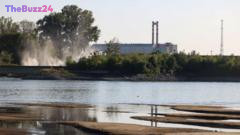
Record Danube Drought Forces Hungary’s Sole Nuclear Plant Offline
Hungary’s sole nuclear power plant, the Paks facility, is set to cease operations entirely for the first time due to critically low water levels in the River Danube. Prime Minister Péter Magyar announced the shutdown, citing that the Soviet-era plant’s cooling system requires sufficient water from the Danube, which is currently too shallow for the suction nozzles to reach.
This unprecedented halt in nuclear energy production, coupled with an ongoing severe heatwave expected to bring temperatures around 37°C for a week, has raised concerns about Hungary’s energy security. The nation, like much of Europe, has experienced a summer marked by minimal rainfall and extreme heat, leading to the Danube reaching its lowest levels in three decades across several countries, including neighboring Serbia and Romania.
In response to the potential energy crisis, Prime Minister Magyar has urged citizens to conserve energy, particularly between 5 PM and 10 PM, by limiting activities such as charging electric vehicles and using air conditioning. He also indicated that a “rotational shutdown regime” might be implemented if these measures are insufficient to balance the national grid, with the government preparing a list of consumers whose usage could be restricted.
This situation mirrors challenges faced by other nations along the Danube. Romania’s Cernavoda nuclear power plant has already shut down one of its two reactors due to low Danube levels, with fears that the second reactor may also be forced offline. The extreme weather conditions are a stark reminder of Europe’s vulnerability to climate change, which is causing more frequent and intense heatwaves and droughts across the continent.
Key Takeaways
- Hungary's Paks nuclear power plant is shutting down due to record low Danube water levels, impacting national energy supply.
- The shutdown, combined with a severe heatwave, raises concerns about Hungary's energy security and prompts calls for public energy conservation.
- Similar low water levels are affecting other European countries and nuclear plants, highlighting the broader impact of climate change on critical infrastructure.
Editor’s Analysis & Impact
The forced shutdown of Hungary’s Paks nuclear plant due to the Danube’s record low levels underscores the growing vulnerability of critical energy infrastructure to climate change impacts. This event, occurring amidst a European heatwave, highlights the interconnectedness of water resources, energy production, and extreme weather. The reliance on river water for cooling nuclear reactors, a common practice, now presents a significant risk. This situation will likely accelerate discussions around diversifying energy sources, improving water management strategies for industrial use, and potentially investing in more resilient cooling technologies for power plants. The broader implication is a heightened awareness of climate-related risks to energy security across the continent, potentially influencing future energy policy and infrastructure development.
Frequently Asked Questions
Q: Why is the Paks nuclear power plant shutting down?
A: The Paks nuclear power plant is shutting down because the water level in the River Danube has fallen to a record low. The plant uses Danube water for cooling, and the current low levels prevent the suction nozzles from drawing enough water.
Q: What are the potential consequences of this shutdown?
A: The shutdown, combined with an ongoing heatwave, could lead to a critical energy supply situation in Hungary. The government is urging citizens to conserve energy and is considering rotational shutdowns of other consumers if necessary to maintain the national grid's balance.
Q: Is this an isolated incident in Europe?
A: No, this is not an isolated incident. Several countries along the Danube are experiencing record low water levels. Romania's Cernavoda nuclear plant has already shut down one reactor due to similar issues, indicating a broader challenge for nuclear power generation in Europe facing extreme weather conditions.
AI Disclosure: This article is based on verified data and official reports. Our Team and AI have cross-referenced every financial detail with primary sources to ensure total accuracy.
More from this Category