Revolutionary AI Robotic Concept Aims to Sample Planetary Rings for the First Time
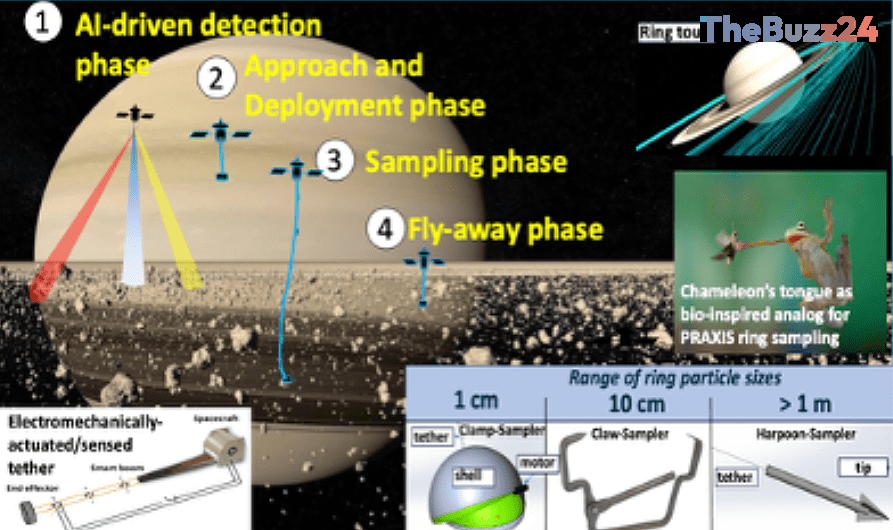
Scientists and engineers are actively developing an innovative robotic exploration concept designed to physically sample the elusive particles making up planetary rings across the solar system. While previous missions like Cassini provided extraordinary imagery and data, humanity has never directly touched or analyzed the actual material comprising the rings of Saturn, Uranus, or Neptune. To bridge this critical scientific gap, researchers are advancing a specialized system known as PRAXIS, which stands for Planetary Rings Autonomous EXploration with In-situ Sampling.
Planetary rings represent highly dynamic, constantly moving environments composed of countless fragments ranging from microscopic grains to massive boulders primarily made of water ice. Because these particles are perpetually in motion, traditional spacecraft maneuvers pose extreme collision risks. The newly proposed robotic system overcomes this obstacle by integrating advanced artificial intelligence, collision-avoidance algorithms, and a long, flexible deployable sampling boom. This configuration allows a spacecraft to hover safely at a distance while executing precise touch-and-go sampling operations on individual ring particles.
The framework adapts modern engineering techniques, such as innovations used in sport casting, combined with heavily miniaturized scientific instruments for real-time in situ analysis. By autonomously capturing free-floating debris, the exploration system aims to directly measure crucial physical characteristics including particle size, porosity, and exact chemical composition. Successfully achieving this milestone would unlock unprecedented insights into the origins, dynamics, and evolution of ring structures, while also laying foundational technology for future outer solar system missions.
Key Takeaways
- The PRAXIS initiative aims to achieve the first-ever physical sampling of planetary ring particles.
- The system utilizes advanced artificial intelligence and agile robotic booms to safely collect samples without risking spacecraft collisions.
- Data gathered from the mission could revolutionize our understanding of ring origins in Saturn, Uranus, and Neptune.
Editor’s Analysis & Impact
The development of autonomous, AI-driven sampling technologies marks a significant paradigm shift in deep space exploration. As space agencies look beyond mere observation toward physical interaction with distant celestial bodies, missions targeting planetary rings could redefine planetary science. The ability to autonomously navigate high-risk, dynamic environments like Saturn’s rings not only answers fundamental cosmological questions about planetary formation and circumstellar disks but also paves the way for advanced robotics in future missions to Uranus, Neptune, and Centaur objects. Over the coming decade, the successful prototyping and deployment of such technologies will likely establish a new benchmark for robotic agility and in situ analysis in deep space.
Frequently Asked Questions
Q: What does the acronym PRAXIS stand for?
A: PRAXIS stands for Planetary Rings Autonomous EXploration with In-situ Sampling.
Q: Why is sampling planetary rings so difficult?
A: Planetary rings are highly dynamic environments where micron-sized grains to house-sized boulders are constantly in motion, creating high collision risks for spacecraft that attempt traditional landing or close-proximity maneuvers.
Q: How does the spacecraft collect samples without crashing into the rings?
A: The spacecraft remains at a safe distance and utilizes a long, soft deployable boom combined with AI-driven precision controls to execute quick touch-and-go sampling operations.
AI Disclosure: This article is based on verified data and official reports. Our Team and AI have cross-referenced every financial detail with primary sources to ensure total accuracy.
More from this Category