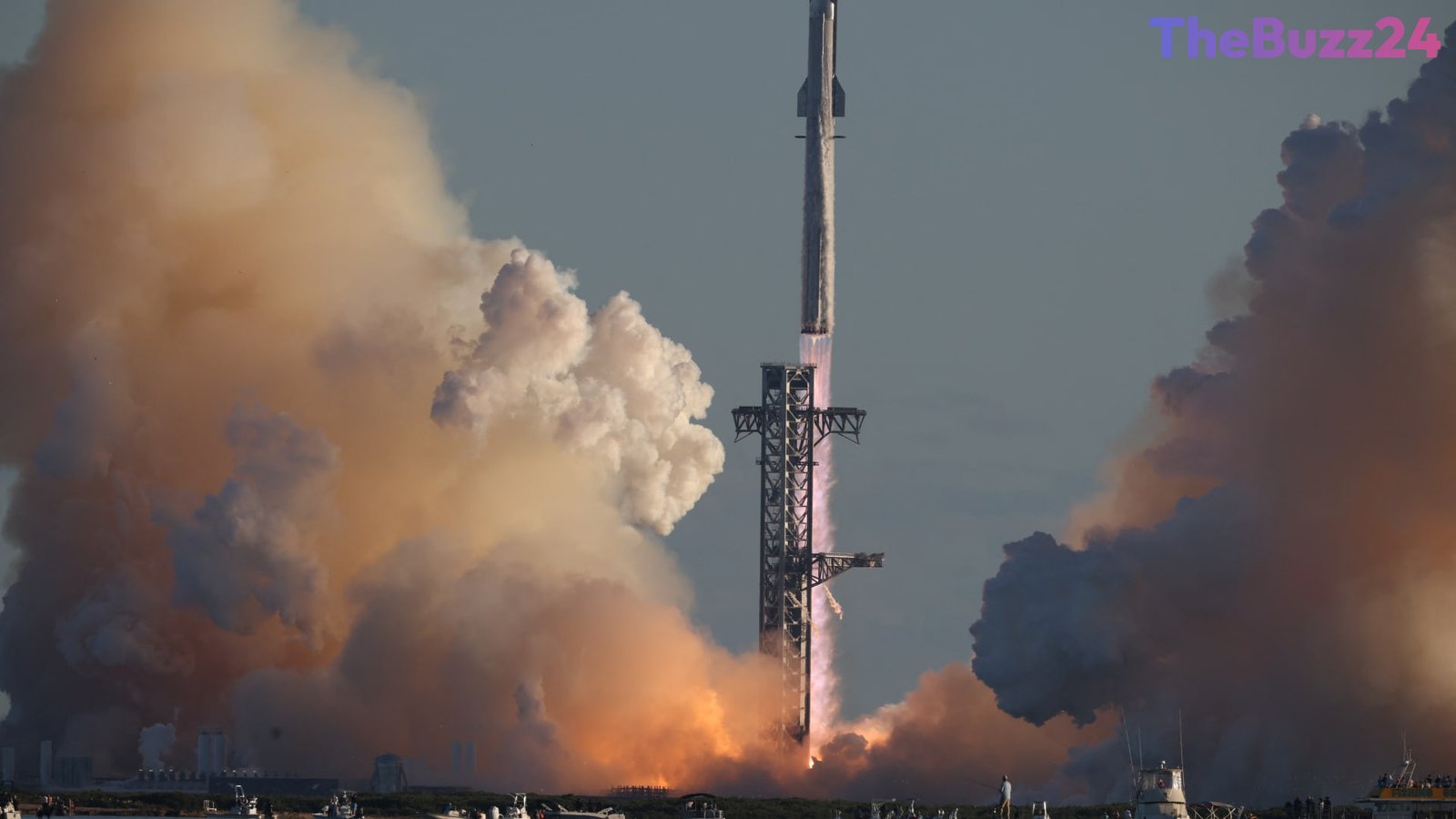
SpaceX Starship Completes Ambitious Test Flight Despite Booster Recovery Setback
SpaceX conducted its fifteenth test flight of the massive Starship rocket on Friday, lifting off from the South Texas launch facility. While the mission marked a significant step forward in testing the ambitious spacecraft’s capabilities, the company ultimately fell short of its goal to recover both stages of the heavy-lift vehicle. The booster was forced to bypass its planned mechanical catch, instead splashing down in the Gulf of Mexico where it subsequently burst into flames.
Despite the booster’s explosive end, the upper stage of Starship successfully achieved orbit to continue its scheduled trajectory. The mission represents a crucial milestone for Elon Musk’s aerospace enterprise as it pushes the boundaries of rapid reusability. Starship’s ultimate operational success is foundational to scaling up the Starlink satellite internet constellation, which currently serves as a primary financial engine for the company by leveraging massive payload capacities to deploy next-generation satellites into low Earth orbit.
Beyond technical hurdles, the aerospace giant continues to navigate external pressures, including recent scrutiny regarding military-tier satellite communications in active conflict zones. Nonetheless, industry analysts maintain that the company commands a substantial technological lead over competitors, ensuring that developmental setbacks remain minor hurdles in a long-term roadmap that ultimately envisions crewed missions to the Moon and Mars.
Key Takeaways
- SpaceX launched its 15th Starship test flight from its South Texas facility, attempting to catch both stages of the rocket.
- The booster recovery failed, resulting in a controlled splashdown and explosion in the Gulf of Mexico, while the upper stage successfully reached orbit.
- The Starship program is vital for expanding the Starlink satellite internet network and future missions to the Moon and Mars.
Editor’s Analysis & Impact
The latest Starship test flight underscores the iterative development philosophy that has driven SpaceX’s dominance in the aerospace sector. While the failure to recover the booster highlights the immense engineering challenges of catching a heavy-lift rocket, the successful orbital insertion of the upper stage demonstrates fundamental progress. Reusability is the economic cornerstone of Starship, directly influencing the deployment scale of Starlink and future interplanetary logistics. Despite high-profile setbacks and parallel geopolitical controversies regarding military communications, industry consensus suggests that SpaceX’s operational lead over competitors remains robust. Short-term anomalies are priced into their aggressive testing schedule, meaning market momentum and long-term valuation will likely continue to hinge on achieving full and rapid system reusability.
Frequently Asked Questions
Q: What happened during the 15th Starship test flight?
A: SpaceX launched the Starship rocket from South Texas. While the upper stage successfully reached orbit, the company had to abort plans to catch the booster, which splashed down in the Gulf of Mexico and exploded.
Q: Why is the Starship rocket important for SpaceX?
A: Starship is crucial for deploying next-generation Starlink satellites in larger batches, significantly increasing orbital capacity, and is ultimately required for future crewed and cargo missions to the Moon and Mars.
Q: How does the Starship payload capacity compare to older rockets?
A: A single Starship rocket has the capacity to carry up to 60 Starlink v3 satellites into orbit, which is about twenty times the capacity of older Falcon 9 rockets.
AI Disclosure: This article is based on verified data and official reports. Our Team and AI have cross-referenced every financial detail with primary sources to ensure total accuracy.
More from this Category