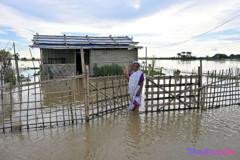
Survival on a Banana Raft: How an Assam Family Saved Their 97-Year-Old Matriarch from Unprecedented Floods
In the dead of night on July 19, the village of Charing in Assam’s Sivasagar district faced an unprecedented crisis as rapid floodwaters inundated homes. Among those caught in the sudden deluge was 97-year-old Lokada Duarah, who is nearly bedridden and unable to walk. With no rescue teams or boats in sight, her daughter-in-law, Bornali Baruah, and her husband took desperate measures. They constructed a makeshift raft out of banana tree trunks, carefully placed the elderly matriarch on it, and waded through chest-deep, fast-moving waters to reach safety at a temporary shelter on a nearby national highway.
The disaster has dealt a devastating blow to Baruah, a former journalist who transitioned to animal husbandry in 2016 and was previously recognized as Assam’s ‘Best Livestock Farmer.’ Her thriving farm, which housed hundreds of goats, ducks, and chickens, was largely wiped out by the rising waters. Because livestock insurance is virtually non-existent in the region, the financial loss is catastrophic, destroying not only her animals but also essential farming machinery, vehicles, and personal belongings. The floodwaters eventually rose to five feet inside her eight-room home, a structure located in an area that historically had never experienced flooding in living memory.
This localized tragedy is part of a massive humanitarian crisis across Assam, where seasonal flooding has escalated dramatically. Recent figures indicate that the floods have claimed at least 100 lives, displaced over 1.2 million people across 25 districts, and damaged tens of thousands of homes. Environmental experts, including Dhrubajyoti Sahariah from Gauhati University, point out that while flooding is natural to the Brahmaputra Valley, the frequency and severity have intensified. Factors such as rapid deforestation, unplanned infrastructure development, hill-cutting, and increased siltation from neighboring regions have disrupted natural drainage systems, pushing floodwaters into previously safe zones.
Despite the immense loss, Baruah and her family are determined to rebuild rather than relocate. Currently staying with neighbors, they plan to return to their damaged home and adapt to this new reality. To prepare for future environmental challenges, Baruah is considering raising her home’s foundation and constructing elevated safety platforms. Her resolve highlights a growing sentiment among residents of the region: the necessity of learning to coexist with increasingly unpredictable climate patterns through localized adaptation and resilience.
Key Takeaways
- A 97-year-old bedridden woman was rescued from rising floodwaters in Assam using a makeshift raft made of banana tree trunks.
- The floods have caused massive economic damage, particularly to local agriculturalists like award-winning farmer Bornali Baruah, who lost most of her uninsured livestock.
- Experts attribute the unprecedented flooding in historically safe areas to a combination of heavy rainfall, deforestation, and infrastructure development that ignores regional hydrology.
Editor’s Analysis & Impact
The devastating floods in Assam underscore a critical inflection point for regional climate adaptation and infrastructure planning in South Asia. The Brahmaputra basin, shared across international and state borders, requires a shift from localized disaster response to comprehensive, basin-scale environmental management. As climate change accelerates weather volatility, traditional agricultural practices and rural livelihoods are facing existential threats. The lack of financial safety nets, such as livestock insurance, exacerbates the vulnerability of rural entrepreneurs who drive the local economy. Moving forward, governments must integrate hydrological science into infrastructure development, halt unsustainable land-use practices like hill-cutting, and establish robust climate-risk insurance frameworks. Without these systemic changes, the human and economic toll of annual flooding will continue to escalate, forcing communities into costly, self-funded adaptation measures.
Frequently Asked Questions
Q: Why did the flooding affect areas in Assam that historically do not flood?
A: Environmental experts attribute this to increased siltation in rivers, deforestation, and rapid infrastructure development (like roads and bridges) built without proper hydrological planning, which blocks natural water flow and forces rivers to breach their banks into new areas.
Q: What challenges do local farmers face in recovering from these floods?
A: Aside from physical destruction, farmers face severe financial ruin due to a lack of insurance options for livestock, meaning they must bear the entire cost of rebuilding their livelihoods from scratch.
Q: How are residents planning to adapt to future flood risks?
A: Many residents, unable to relocate due to economic constraints, are planning localized adaptations, such as raising the foundations of their homes, building elevated safety platforms, and stocking emergency provisions in advance.
AI Disclosure: This article is based on verified data and official reports. Our Team and AI have cross-referenced every financial detail with primary sources to ensure total accuracy.
More from this Category