Swarm Intelligence: The Future of Saturn Exploration Using Femtosat Constellations
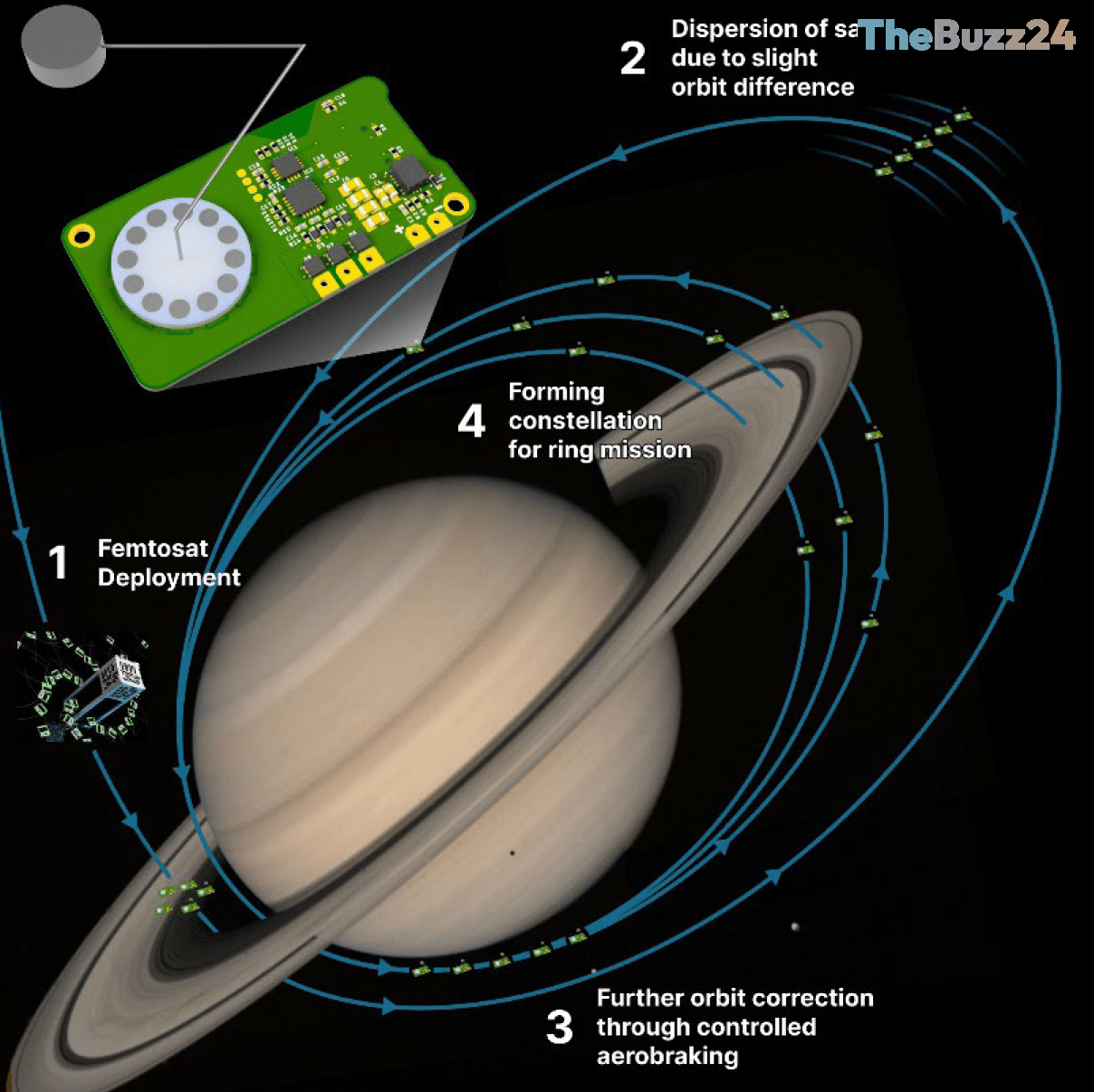
Researchers at Northwestern University have unveiled a bold proposal to explore Saturn using a massive constellation of approximately 10,000 actively steerable femtosats. This innovative mission concept aims to conduct comprehensive in-situ surveys of the planet’s complex ring systems, atmospheric density, and magnetic field distribution, areas that have historically proven difficult to study with traditional, singular spacecraft.
Traditional flagship missions, such as the Cassini probe, faced significant operational risks when navigating Saturn’s rings due to the high probability of catastrophic particle collisions. By shifting to a distributed architecture, the proposed mission design effectively mitigates this danger. Because the constellation consists of thousands of independent, low-cost units, the loss of individual femtosats due to debris impacts is an acceptable operational trade-off that does not compromise the overall mission objectives.
This approach represents a paradigm shift in deep space exploration, moving away from monolithic, high-cost probes toward resilient, swarm-based technologies. By deploying a vast network of sensors, scientists hope to gather unprecedented granular data on the composition and dynamics of Saturn’s environment, providing a clearer picture of the gas giant’s evolution and its surrounding celestial architecture.
Key Takeaways
- A new mission concept proposes deploying 10,000 steerable femtosats to map Saturn's rings and atmosphere.
- The swarm-based approach allows for high-risk exploration that would be impossible for a single, expensive flagship spacecraft.
- The distributed nature of the constellation ensures mission success even if a significant number of individual units are destroyed by ring particles.
Editor’s Analysis & Impact
The proposal to utilize femtosat swarms for planetary exploration marks a critical evolution in aerospace engineering. By prioritizing redundancy over individual unit durability, this mission architecture drastically lowers the barrier to entry for high-risk, high-reward scientific data collection. If successful, this model could redefine how space agencies approach the exploration of hazardous environments, such as the rings of Saturn or the debris fields of other gas giants. The broader implication is a shift toward ‘disposable’ but highly effective sensor networks, which could accelerate the pace of discovery in our solar system. As miniaturization technology continues to advance, we expect to see more mission profiles that favor distributed intelligence, potentially reducing the reliance on multi-billion dollar, single-point-of-failure spacecraft in favor of more agile, resilient swarms.
Frequently Asked Questions
Q: What is a femtosat?
A: A femtosat is an extremely small satellite, typically weighing only a few grams, designed to perform specific, localized tasks within a larger network or constellation.
Q: Why is it safer to use 10,000 femtosats instead of one large probe?
A: A single large probe is a 'single point of failure'; if it is hit by a particle in Saturn's rings, the entire mission is lost. A swarm of 10,000 units can sustain multiple losses while still providing enough collective data to complete the mission objectives.
AI Disclosure: This article is based on verified data and official reports. Our Team and AI have cross-referenced every financial detail with primary sources to ensure total accuracy.
More from this Category