Revolutionizing Deep-Space Surveillance Through Robotic Metamaterial Assembly
As the density of satellites and spacefaring vehicles in orbit continues to rise, the demand for advanced space situational awareness (SSA) has reached a critical juncture. Current ground-based radar systems, such as the U.S. space surveillance network, are highly effective at monitoring low earth orbit (LEO) objects. However, these systems face physical limitations when tracking objects at greater distances, such as in cislunar space. Because the required size of a radar array scales directly with the distance of the target, ground-based infrastructure becomes increasingly impractical for deep-space monitoring.
To overcome these constraints, researchers are shifting their focus toward space-based radar platforms. Traditional deployable antennas, including mesh and inflatable designs, are currently restricted by the size of launch vehicle fairings, preventing the deployment of structures larger than 100 meters. To bypass these launch-related size limitations, a new approach involving in-space robotic assembly is being developed. By constructing large-scale, modular structures directly in orbit, engineers can create apertures far larger than what is currently possible with existing launch technology.
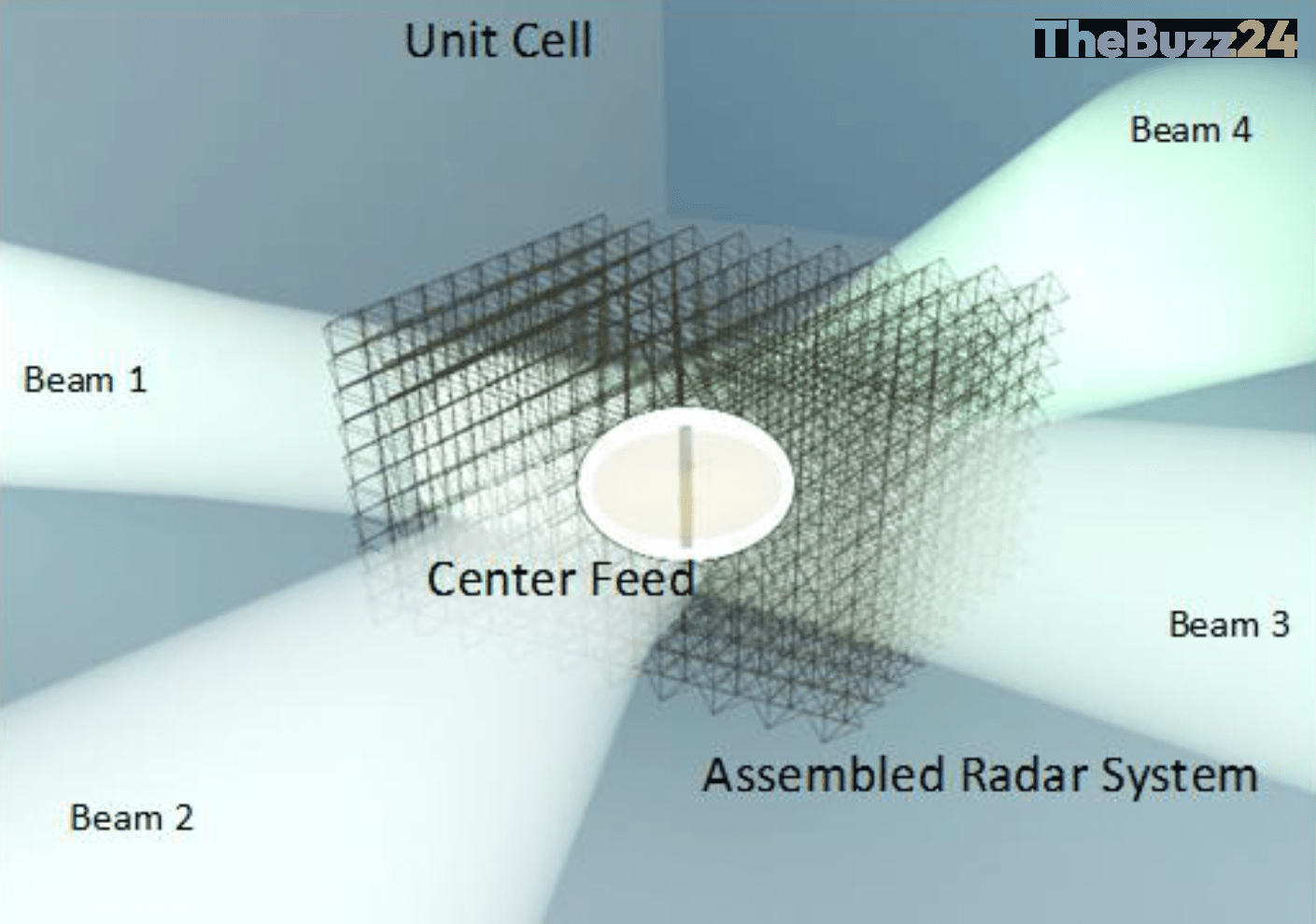
The proposed system utilizes robotically assembled, mechanically stable structures integrated with reconfigurable, volumetric electromagnetic metamaterials. This modular design allows for the creation of robust antenna platforms that can be scaled to meet the specific needs of long-range surveillance. By utilizing unit cell-driven construction, these antennas can achieve sophisticated beam steering capabilities across wide fields of view without the need for slow, mechanical slewing. This technology, inspired by the Automated Reconfigurable Mission Adaptive Digital Assembly Systems (ARMADAS) project, promises to significantly enhance sensitivity and resolution for radar and deep-space communication missions.
Beyond space situational awareness, this modular assembly strategy holds transformative potential for a variety of aerospace applications, including low-frequency radiometry for earth observation and long-range deep-space communications. By reducing the cost, size, weight, and power (CSWaP) requirements of large-aperture systems, this innovation could become a cornerstone for future space exploration and infrastructure development, enabling more precise monitoring of the increasingly crowded space environment.
Key Takeaways
- Ground-based radar is insufficient for deep-space monitoring due to the physical requirement for massive, impractical array sizes.
- In-space robotic assembly allows for the construction of antenna structures that exceed the size constraints of current launch vehicle fairings.
- The integration of reconfigurable electromagnetic metamaterials enables wide-field beam steering and improved sensitivity for radar and communication missions.
Editor’s Analysis & Impact
The transition from ground-based to space-based, robotically assembled radar platforms represents a paradigm shift in aerospace engineering. By decoupling antenna size from launch vehicle fairing dimensions, this technology addresses one of the most significant bottlenecks in space infrastructure. The use of volumetric metamaterials not only enhances performance but also introduces a level of agility in beam steering that was previously unattainable. From a market perspective, this development could drastically reduce the cost of deep-space surveillance and communication, making it a high-value asset for both government and commercial space operators. As cislunar traffic increases, the ability to maintain precise situational awareness will become a prerequisite for safe operations, positioning this modular assembly technology as a critical component of the future space economy.
Frequently Asked Questions
Q: Why can't we just build larger radar arrays on Earth to track deep-space objects?
A: Radar performance is tied to aperture size; as the distance to the target increases, the required size of the radar array grows proportionally. Building arrays large enough to track objects in cislunar space from Earth is physically and economically impractical.
Q: What is the primary benefit of using robotic assembly for space antennas?
A: Robotic assembly allows for the construction of structures that are too large to fit inside a single rocket fairing, enabling the creation of massive, high-performance antennas that would otherwise be impossible to launch.
AI Disclosure: This article is based on verified data and official reports. Our Team and AI have cross-referenced every financial detail with primary sources to ensure total accuracy.
More from this Category