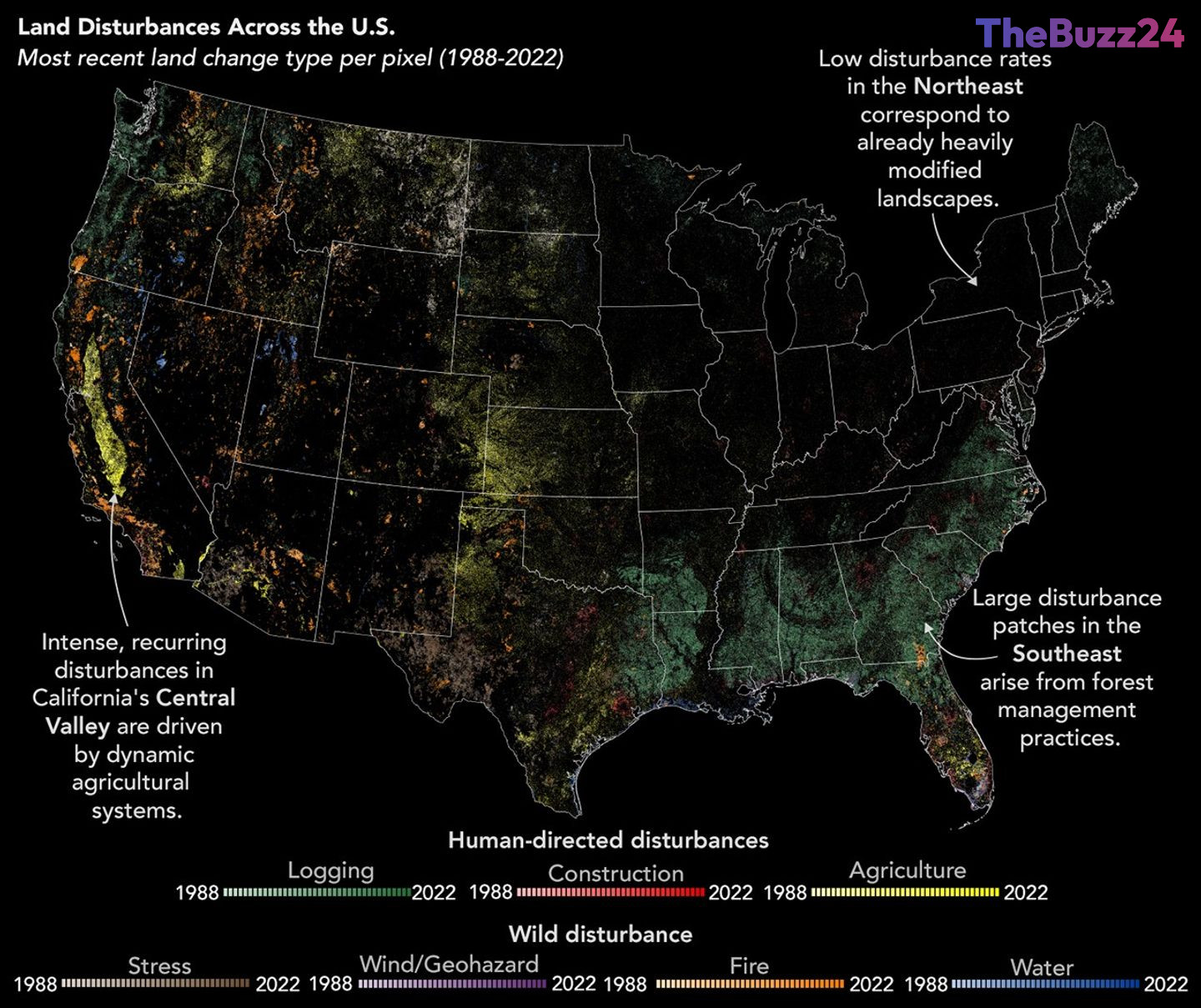
The Great Shift: Natural Disasters Overtaking Human Development as Primary Landscape Driver
A comprehensive analysis of satellite imagery spanning the last 35 years has revealed a fundamental transformation in how the United States landscape is being reshaped. For decades, the primary force altering the nation’s terrain was human expansion, characterized by rapid urban growth, industrial development, and agricultural conversion. However, recent data indicates that this trend is decelerating, while the influence of natural disturbances—such as wildfires, hurricanes, and landslides—is accelerating at a concerning rate.
Between 1988 and 2022, researchers monitored land changes across the continental U.S., finding that roughly one-third of the country’s landmass experienced significant alteration. While human activity remains a major factor, the annual rate of development has dropped by approximately 232 square miles. Analysts attribute this decline to a combination of economic fluctuations, such as the 2008 financial crisis, and more stringent land-use policies that have curtailed aggressive expansion.
Conversely, the footprint of natural disasters has expanded by more than 77 square miles annually. This shift is largely driven by a warming climate, which intensifies the frequency and severity of extreme weather events. By utilizing advanced machine-learning algorithms to categorize these disturbances, scientists have provided a clear picture of an environment becoming increasingly volatile. This data suggests that the era of prioritizing total land control is coming to an end, necessitating a new approach focused on environmental resilience and adaptive infrastructure.
As the nation faces this new reality, the focus for policymakers and urban planners is shifting toward mitigation. Rather than focusing solely on expansion, the priority is moving toward building structures and systems capable of withstanding the unpredictable nature of a changing climate. This transition marks a departure from traditional development models, emphasizing the need for long-term strategies that prioritize coexistence with an increasingly unstable natural environment.
Key Takeaways
- Human-led land development in the U.S. has seen a decline of roughly 232 square miles per year over the last three decades.
- Land impacted by natural disasters is growing by over 77 square miles annually, fueled by climate change and environmental instability.
- Advanced machine learning analysis of 35 years of satellite data confirms a major shift in the primary drivers of landscape change.
Editor’s Analysis & Impact
This data signals a pivotal transition in land-use management, moving from an era dominated by human expansion to one defined by climatic volatility. The economic implications are significant, as insurance markets, real estate valuations, and municipal zoning must now account for a landscape that is increasingly prone to destruction. This shift necessitates a move toward ‘resilience-first’ engineering, creating a burgeoning market for disaster-mitigation technologies and climate-adaptive urban planning. While this presents new opportunities for firms specializing in resilient materials and environmental defense, it simultaneously introduces long-term risks for traditional real estate assets located in high-exposure zones. Ultimately, the findings suggest that future infrastructure investment must prioritize durability and adaptability over mere growth to survive the changing environmental landscape.
Frequently Asked Questions
Q: What is driving the increase in natural land disturbances?
A: The rise in natural disturbances is primarily attributed to a warming climate, which increases the frequency and intensity of events like wildfires, hurricanes, and landslides.
Q: Why has human-led land development slowed down in recent years?
A: The slowdown is linked to a mix of economic factors, including the impact of the 2008 financial crisis, as well as evolving land-use policies and shifts in development strategies.
AI Disclosure: This article is based on verified data and official reports. Our Team and AI have cross-referenced every financial detail with primary sources to ensure total accuracy.
More from this Category