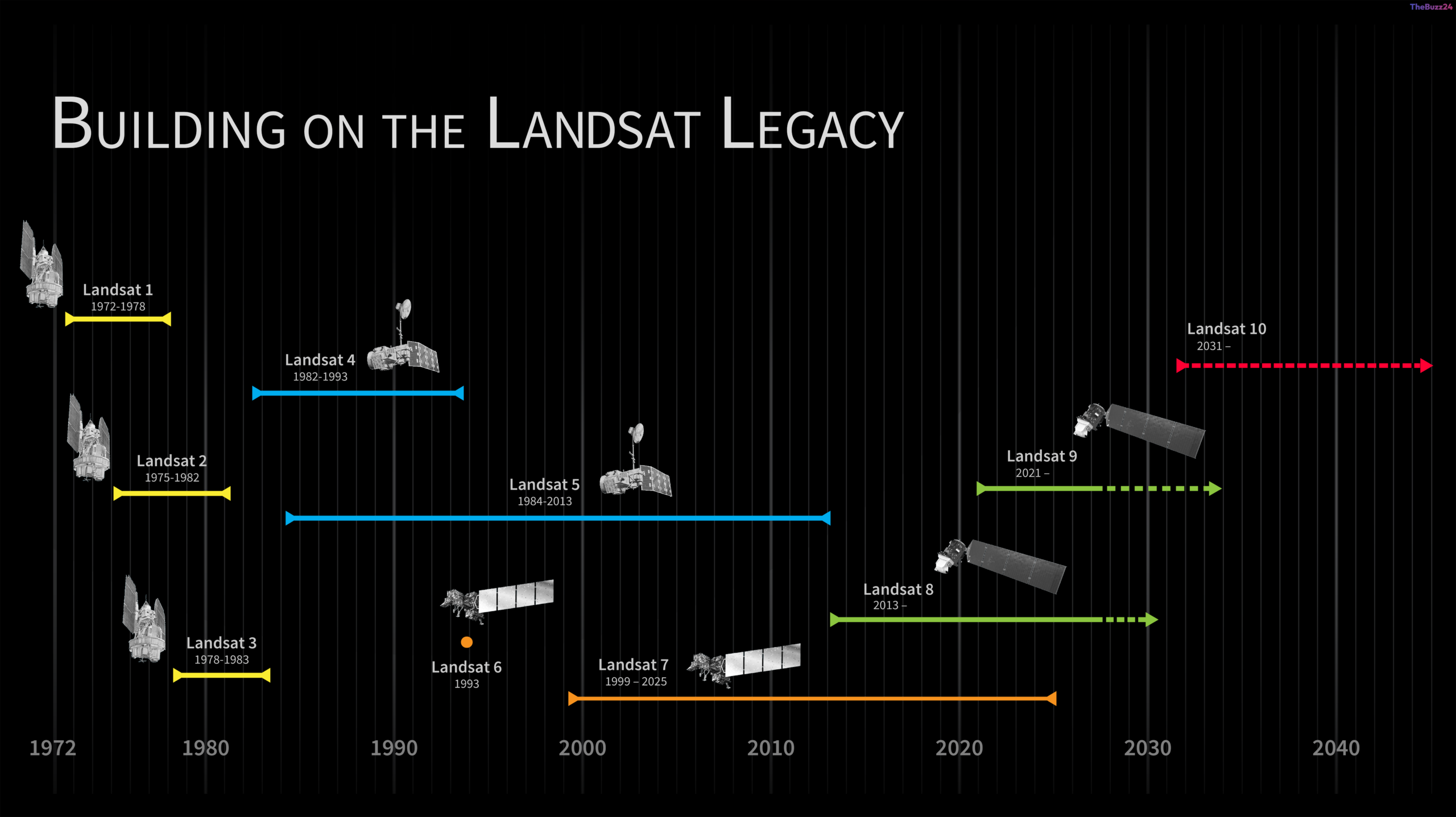
NASA Initiates Procurement Process for Next-Generation Landsat 10 Satellite
NASA has officially launched the procurement phase for the Landsat 10 spacecraft, issuing a Draft Request for Proposal (DRFP) that signals a major advancement in the ongoing partnership between the space agency and the U.S. Geological Survey (USGS). This mission is designed to preserve the integrity of multispectral Earth observation data, a critical resource that has informed global environmental research and policy decisions for decades.
The solicitation details a comprehensive set of requirements for prospective contractors, covering the full lifecycle of the satellite. The chosen vendor will be tasked with the design and construction of the satellite bus, rigorous observatory-level testing, and the integration of the government-provided Landsat Instrument Suite (LandIS). Furthermore, the contract encompasses the creation of advanced simulators and technical support for launch vehicle integration and the initial commissioning phase once the craft reaches orbit.
Engineered for a sun-synchronous, near-polar orbit at an altitude of 653 kilometers, Landsat 10 will maintain a consistent 18-day ground track cycle. The mission is classified as a Class C project, capable of supporting a launch mass of 4,000 kilograms and equipped with sophisticated onboard autonomy to guarantee a minimum operational life of five years. Following successful deployment and checkout, the USGS will assume full operational control of the satellite.
Landsat 10 represents a technological leap forward, offering superior spectral and spatial resolution compared to its predecessors, Landsat 8 and 9. By securing the continuous stream of high-fidelity environmental data, the mission will serve as a vital tool for tracking both natural and anthropogenic changes to Earth’s surface, ultimately bolstering global resource management and environmental science initiatives.
Key Takeaways
- NASA has released the Draft Request for Proposal for the Landsat 10 spacecraft, initiating the contractor selection process.
- The mission aims to ensure the continuity of critical multispectral Earth observation data currently provided by Landsat 8 and 9.
- Landsat 10 will feature enhanced spectral and spatial capabilities and is designed for a minimum five-year operational lifespan in a near-polar orbit.
Editor’s Analysis & Impact
The advancement of the Landsat 10 program underscores the critical importance of long-term Earth observation infrastructure in an era of accelerating climate change. By formalizing the procurement process, NASA and the USGS are ensuring that there is no gap in the data record, which is essential for longitudinal studies on land use, deforestation, and water resource management. From an industry perspective, this contract represents a significant opportunity for aerospace manufacturers to demonstrate capabilities in satellite autonomy and high-fidelity instrument integration. As commercial space sectors grow, the reliance on government-led missions like Landsat remains a cornerstone for public-sector environmental policy. The transition to more advanced spectral capabilities suggests that future data analytics will be even more precise, potentially opening new markets for private firms that specialize in processing and interpreting satellite-derived environmental intelligence.
Frequently Asked Questions
Q: What is the primary purpose of the Landsat 10 mission?
A: The mission is designed to maintain the continuity of multispectral Earth observation data, allowing researchers and policymakers to monitor environmental changes over time.
Q: Who will operate the satellite once it is in orbit?
A: While NASA is responsible for the design, development, and launch of the spacecraft, the U.S. Geological Survey (USGS) will take over operational control once the satellite is commissioned.
AI Disclosure: This article is based on verified data and official reports. Our Team and AI have cross-referenced every financial detail with primary sources to ensure total accuracy.
More from this Category