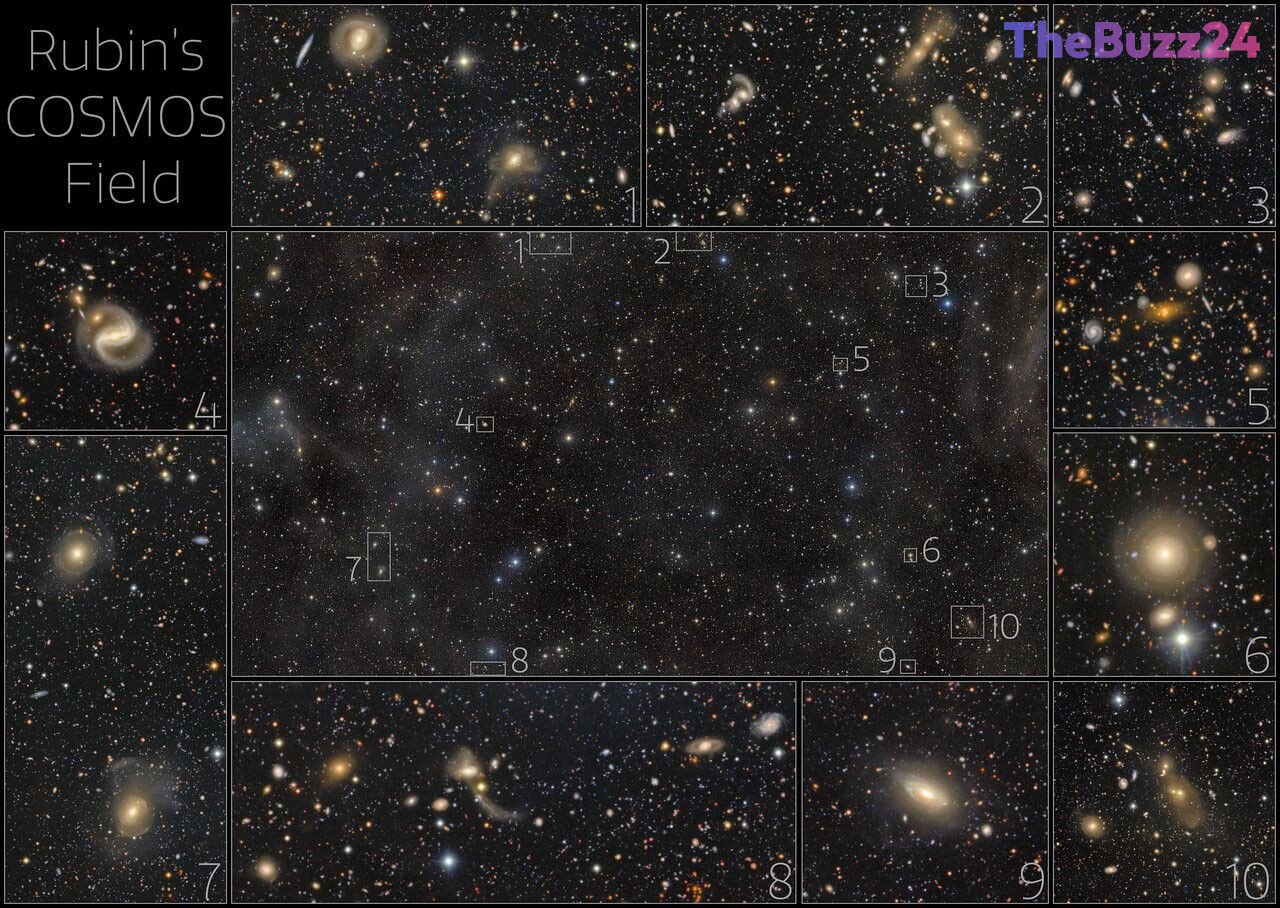
Unveiling the COSMOS Field: Vera C. Rubin Observatory Captures Over Half a Million Distant Galaxies
A stunning deep-space image of the universe has revealed more than 500,000 galaxies packed into a single targeted region of the night sky known as the COSMOS field. Captured by the NSF-DOE Vera C. Rubin Observatory located in Chile, the composite view offers unprecedented depth and clarity into the distant cosmos. This specific sky region, situated away from the dense foreground stars of our own Milky Way, serves as a vital clean window for astronomical research across billions of light-years.
Originally targeted and explored by key space observatories including the Hubble and James Webb space telescopes, the COSMOS field covers an expanse several times larger than the full moon. Because the region is largely unobstructed by nearby galactic dust and bright stars, it offers researchers a remarkably clear line of sight to extreme cosmic depths. Expanded panels accompanying the survey highlight detailed close-ups of specific sub-regions, showcasing a wide variety of galactic geometries, colors, and evolutionary phases.
Light from the most distant galactic systems visible in the image has traveled through space for billions of years before finally reaching Earth. By capturing light emitted during the universe’s formative epochs, the observatory allows scientists to effectively peer backward in time to study how galaxies grew, interacted, and transformed over cosmic history.
This detailed recording represents a critical early phase of the observatory’s decade-long Legacy Survey of Space and Time (LSST). Over the next ten years, the observatory will repeatedly scan the COSMOS field every few days, generating a dynamic time-series record of the sky that will help scientists track changing cosmic phenomena and better understand the hidden forces shaping our universe.
Key Takeaways
- The Vera C. Rubin Observatory captured an expanse containing over 500,000 galaxies in the COSMOS field.
- The COSMOS field provides an unobstructed view of deep space due to a low density of foreground stars from the Milky Way.
- The observation is part of a 10-year sky survey that will repeatedly map the region every few days to monitor dynamic astronomical changes.
Editor’s Analysis & Impact
The full operational rollout of the Vera C. Rubin Observatory represents a massive evolution in observational astronomy, shifting the field from static deep-field snapshots to dynamic, continuous sky monitoring. By capturing vast swathes of the sky at high frequency, the observatory will generate unprecedented volumes of astronomical data. This operational model demands advanced machine learning and automated detection algorithms to identify rapidly changing phenomena, such as supernovae, transient deep-space bursts, and near-Earth asteroids. The technological developments required to process, store, and analyze petabytes of survey data will likely ripple into broader technology sectors, driving advancements in distributed data computing, cloud storage architecture, and automated pattern recognition systems.
Frequently Asked Questions
Q: What is the COSMOS field?
A: The COSMOS field is a designated patch of sky chosen by astronomers because it contains very few bright foreground stars from our own Milky Way, offering an exceptionally clear view into deep space.
Q: What is the primary mission of the Vera C. Rubin Observatory?
A: The observatory is conducting the Legacy Survey of Space and Time (LSST), a 10-year project designed to repeatedly photograph the southern sky to monitor cosmic changes, discover dynamic phenomena, and map dark matter.
Q: How far away are the galaxies shown in the image?
A: Many of the galaxies shown are located billions of light-years away, meaning their light has traveled for billions of years across the universe before reaching the observatory's detectors.
AI Disclosure: This article is based on verified data and official reports. Our Team and AI have cross-referenced every financial detail with primary sources to ensure total accuracy.
More from this Category