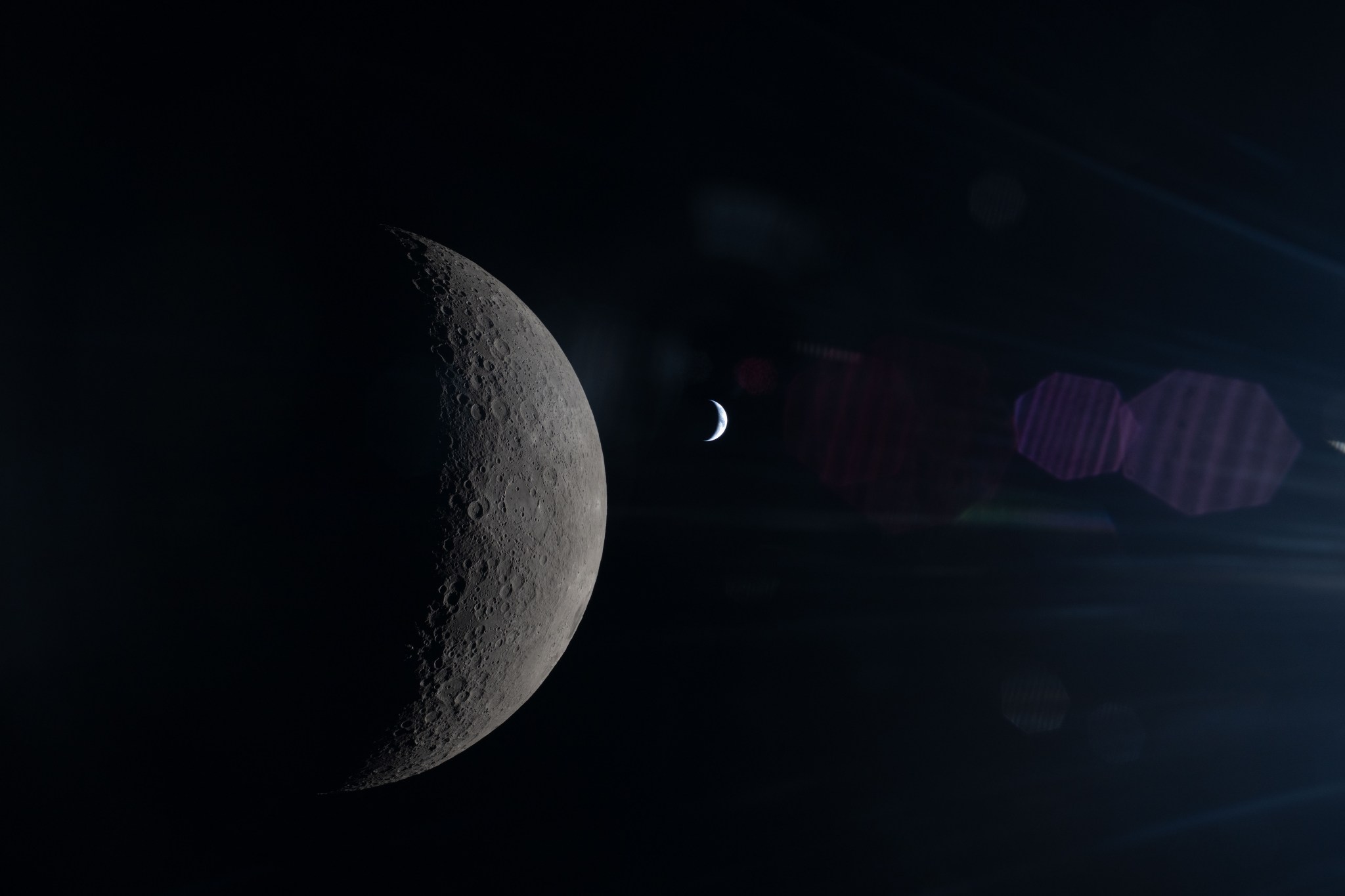
Artemis II Crew Shares Breathtaking View of Earth and Moon Before Final Descent
The Artemis II mission has reached a significant milestone, providing the world with a rare and striking perspective of our cosmic neighborhood. During a lunar flyby conducted on April 6, 2026, the spacecraft’s advanced imaging systems successfully captured both the Moon and Earth within a single frame. The resulting imagery showcases the Moon’s rugged, cratered terrain in the foreground, contrasted against the distant, glowing orb of Earth, offering a vivid demonstration of the complex geometry inherent in the Sun-Earth-Moon system.
Beyond the visual impact, the mission has yielded critical scientific data regarding the orbital dynamics and illumination patterns of our celestial neighbors. By observing how sunlight interacts with both bodies from the unique vantage point of deep space, researchers have gained a clearer understanding of the mechanics that govern our solar system. This data is essential for refining the precision required for future deep-space navigation and underscores the immense scale of human exploration beyond low-Earth orbit.
As the mission enters its final phase, the crew—NASA astronauts Reid Wiseman, Christina Koch, and Victor Glover, alongside Canadian Space Agency astronaut Jeremy Hansen—is finalizing preparations for their return to Earth. The spacecraft is set to re-enter the atmosphere, concluding its historic journey with a scheduled splashdown in the Pacific Ocean at 8:07 p.m. EDT. This successful flight marks a pivotal achievement in human spaceflight, effectively paving the way for upcoming lunar exploration initiatives.
Key Takeaways
- The Artemis II crew captured a rare, simultaneous image of Earth and the Moon during their lunar flyby.
- Scientific data gathered during the mission provides new insights into the orbital mechanics and illumination of the Sun-Earth-Moon system.
- The four-person crew is currently preparing for a scheduled splashdown in the Pacific Ocean to conclude the mission.
Editor’s Analysis & Impact
The successful completion of the Artemis II mission serves as a critical validation of the operational protocols and hardware required for sustainable deep-space exploration. By demonstrating the ability to safely navigate a crew through complex lunar maneuvers, the mission provides a necessary proof-of-concept for the broader Artemis program. The industry impact is profound; this success shifts the focus from initial exploration to the development of long-term lunar infrastructure. The data and experience gained here will directly influence the design of future lunar habitats and the logistical frameworks for interplanetary travel. Ultimately, the success of this mission accelerates the timeline for human exploration of Mars, proving that the technical hurdles of deep-space transit are increasingly manageable for modern aerospace programs.
Frequently Asked Questions
Q: Who are the crew members aboard the Artemis II mission?
A: The crew consists of NASA astronauts Reid Wiseman, Christina Koch, and Victor Glover, as well as Canadian Space Agency astronaut Jeremy Hansen.
Q: Where is the Artemis II spacecraft scheduled to land?
A: The spacecraft is scheduled to conclude its mission with a splashdown in the Pacific Ocean.
AI Disclosure: This article is based on verified data and official reports. Our Team and AI have cross-referenced every financial detail with primary sources to ensure total accuracy.
More from this Category