Voyager 1 Reaches Monumental Milestone at One Light-Day Distance From Earth
Humanity’s most distant space explorer, Voyager 1, has achieved a historic milestone in deep space. On November 18, 2026, at exactly 10:16:07 UTC, the probe crossed the threshold of being precisely one light-day away from Earth. Situated nearly 26 billion kilometers from home, Voyager 1 has reached a distance so vast that any command or light signal transmitted from Earth requires a full 24 hours to reach the spacecraft.
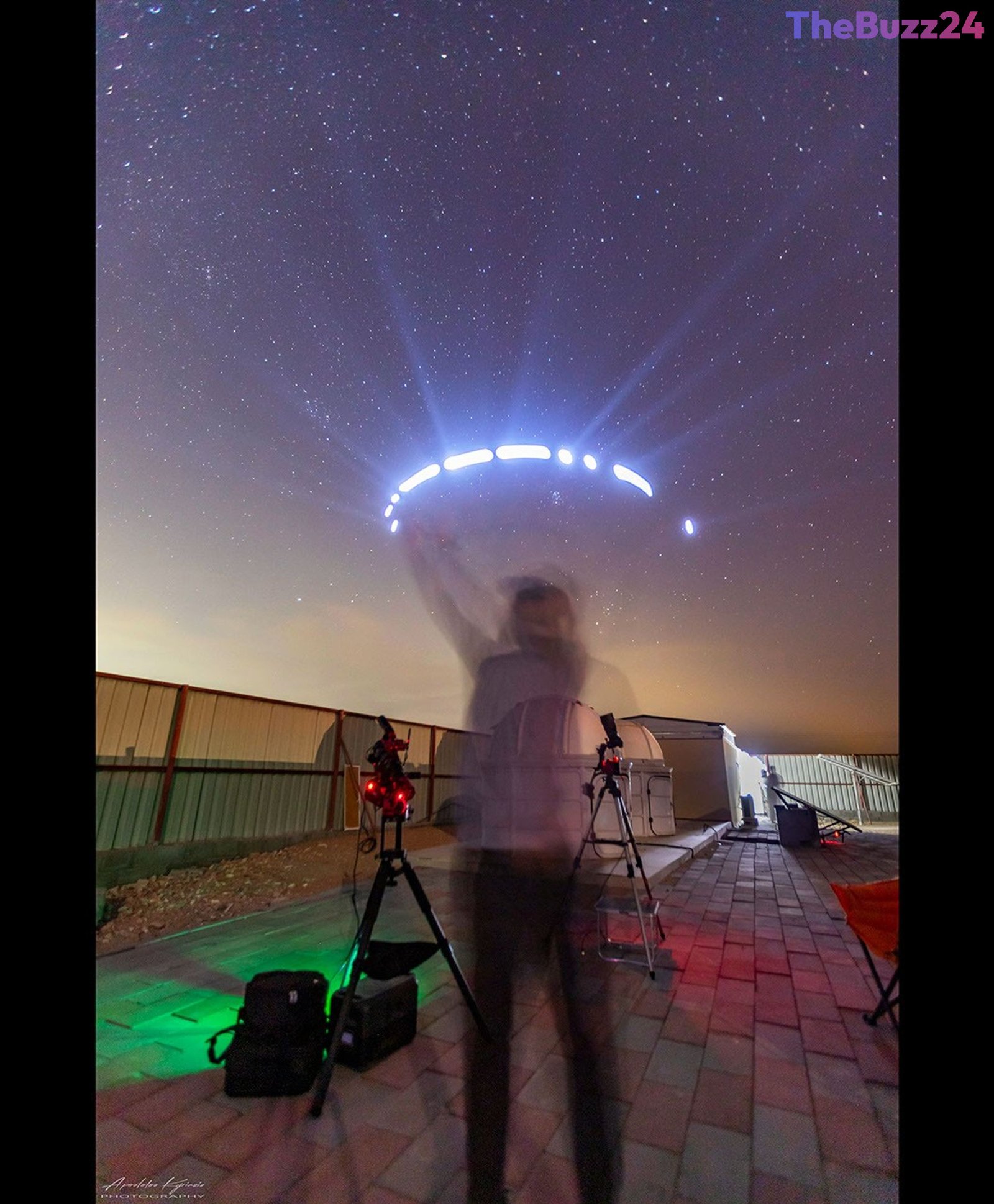
To honor the achievement, astronomy enthusiasts staged a global tribute on November 17 by beaming signals into the night sky. Long-exposure imagery recorded at the Emirates Astronomical Observatory captured flashlight beams pulsing out Morse code patterns spelling “V-G-R,” the official call sign for Voyager 1. The initiative served as a symbolic salute to the farthest human-made object in history.
First launched in 1977, Voyager 1 has been journeying across space for nearly five decades. After completing its primary mission of studying the outer planets, the probe pushed past the boundary of the heliosphere into interstellar space, continuing to transmit scientific data across billions of kilometers back to Earth.
The extraordinary journey illustrates the enormous scales involved in cosmic exploration. At its current velocity—taking nearly 50 years to cover one light-day—calculations indicate that Voyager 1 will require roughly 18,250 years to span a distance of one light-year, underscoring both the immense scope of interstellar space and the astounding durability of human technology.
Key Takeaways
- Voyager 1 reached a historic milestone on November 18, 2026, achieving a distance of one light-day (approximately 26 billion kilometers) from Earth.
- Radio signals traveling at the speed of light now take a full 24 hours to travel from Earth to the probe.
- At its current rate of progress after nearly 50 years of flight, Voyager 1 will take roughly 18,250 years to travel one light-year.
Editor’s Analysis & Impact
Voyager 1 reaching a distance of one light-day serves as a testament to the remarkable longevity of 1970s aerospace engineering. Operating continuously for nearly 50 years, the probe provides unmatched empirical data regarding deep-space signal propagation and autonomous systems endurance under extreme cosmic radiation and extreme temperatures. However, the timeline highlights the inherent constraints of current chemical and radioisotope propulsion technologies. Taking over 18,000 years to reach just one light-year emphasizes the critical necessity for breakthrough interstellar propulsion concepts, such as laser-driven light sails or fusion-based engines, if future missions hope to explore neighboring star systems within human lifespans.
Frequently Asked Questions
Q: What does a 'light-day' distance mean for Voyager 1?
A: A light-day is the distance that light or radio signals travel in a 24-hour period. Reaching this milestone means that any signal sent to Voyager 1 from Earth takes 24 hours to reach it.
Q: How far away is Voyager 1 in kilometers?
A: Voyager 1 is currently located approximately 26 billion kilometers from Earth.
Q: How long will it take Voyager 1 to travel one light-year?
A: Based on its progress of traveling one light-day over 50 years, Voyager 1 is projected to take about 18,250 years to cover a single light-year.
AI Disclosure: This article is based on verified data and official reports. Our Team and AI have cross-referenced every financial detail with primary sources to ensure total accuracy.
More from this Category