The Invisible Lifeline: How NASA Maintains Constant Contact During Artemis II
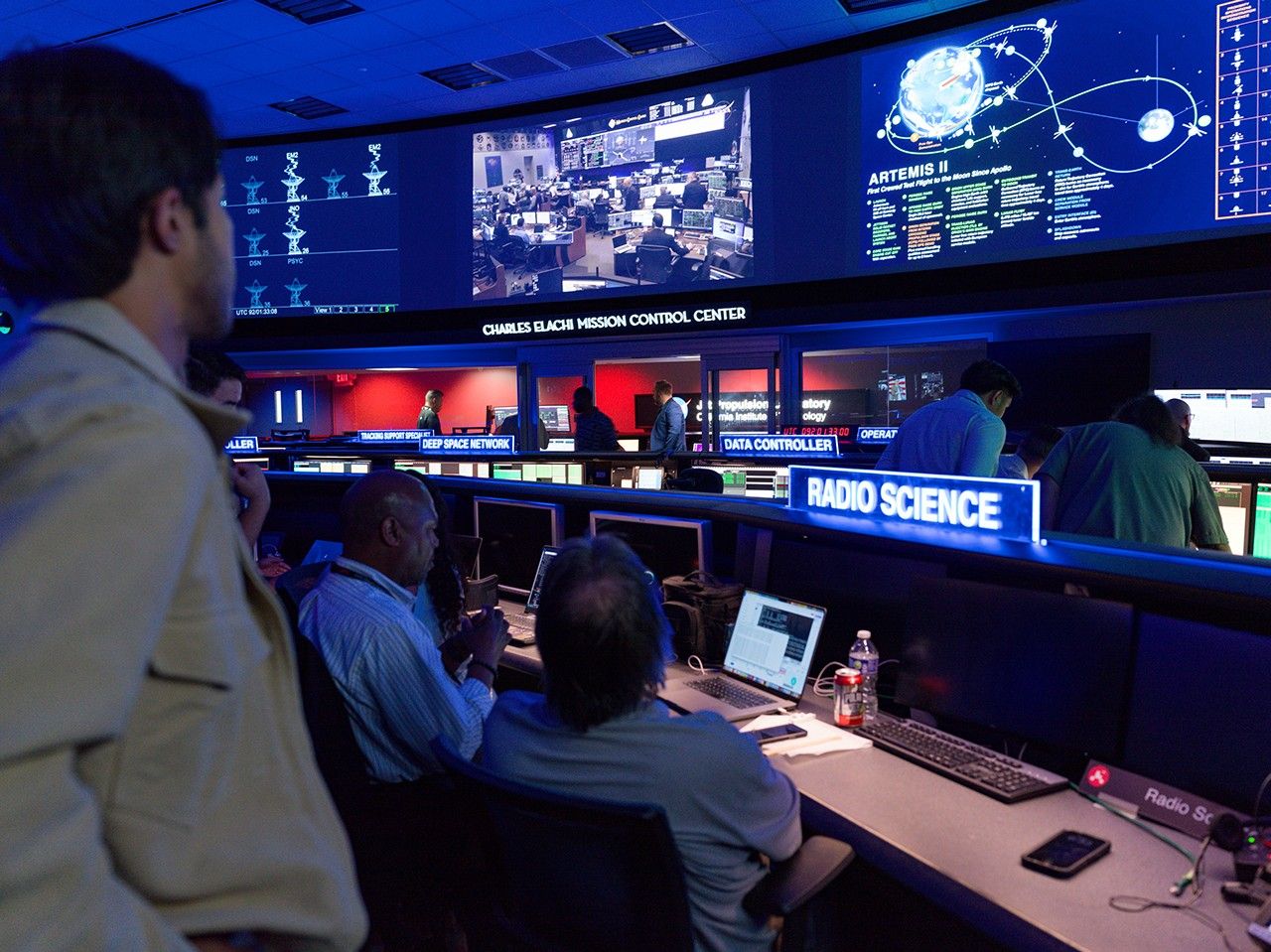
As the Artemis II mission commenced its journey into deep space on April 1, 2026, the atmosphere at NASA’s Jet Propulsion Laboratory (JPL) in Southern California was one of intense focus. Mission controllers worked tirelessly within the Space Flight Operations Facility, overseeing a historic flight that requires unprecedented levels of precision and constant communication to ensure the safety of the crew venturing far beyond Earth’s orbit.
Central to this mission’s success is the Deep Space Network (DSN), a sophisticated global infrastructure designed to prevent any loss of contact. By utilizing massive radio frequency antennas strategically positioned in Goldstone, California; Madrid, Spain; and Canberra, Australia, the network provides continuous coverage. This geographic distribution is vital, as it allows the network to maintain a link with spacecraft regardless of the Earth’s rotation, ensuring that the crew is never left without a connection to ground control.
Managed by JPL on behalf of NASA’s Space Communications and Navigation program, the DSN acts as the essential bridge between Earth and the deep reaches of the solar system. This network does more than just facilitate voice communication; it allows engineers to monitor complex trajectories, transmit critical flight commands, and receive a steady stream of scientific data. This intricate coordination is a cornerstone of modern human spaceflight, proving that the ability to communicate is just as important as the ability to fly.
Key Takeaways
- The Artemis II mission relies on a global communication network to maintain continuous contact with the crew.
- The Deep Space Network (DSN) uses three strategic global locations to ensure uninterrupted signal coverage as Earth rotates.
- JPL manages the DSN to facilitate critical trajectory tracking, command transmission, and scientific data retrieval.
Editor’s Analysis & Impact
The Artemis II mission underscores a fundamental truth in modern space exploration: communication is the ultimate lifeline. As NASA moves from low-Earth orbit to deep space missions, the reliance on the Deep Space Network (DSN) highlights both the brilliance and the vulnerability of our current infrastructure. The ability to maintain a constant data stream is critical not just for mission safety, but for the scientific yield of the mission. Looking forward, as we aim for Mars and beyond, the current DSN framework will likely need significant expansion to handle the increased bandwidth requirements of high-definition telemetry and real-time human interaction. The success of JPL’s management of this network sets the stage for how future interplanetary communication protocols will be established, marking a transition from simple command-and-control to a robust, high-speed deep space internet.
Frequently Asked Questions
Q: Why is the Deep Space Network spread across three different continents?
A: The DSN is located in California, Spain, and Australia so that as the Earth rotates, at least one station is always positioned to have a direct line of sight to the spacecraft, ensuring uninterrupted communication.
Q: What role does the Jet Propulsion Laboratory play in the Artemis II mission?
A: JPL manages the Deep Space Network, which provides the essential communication link between ground control and the Artemis II crew, allowing for command transmission and data reception.
AI Disclosure: This article is based on verified data and official reports. Our Team and AI have cross-referenced every financial detail with primary sources to ensure total accuracy.
More from this Category