Webb Telescope Unveils Pre-Supernova Secrets in Cassiopeia A’s Dusty Remains
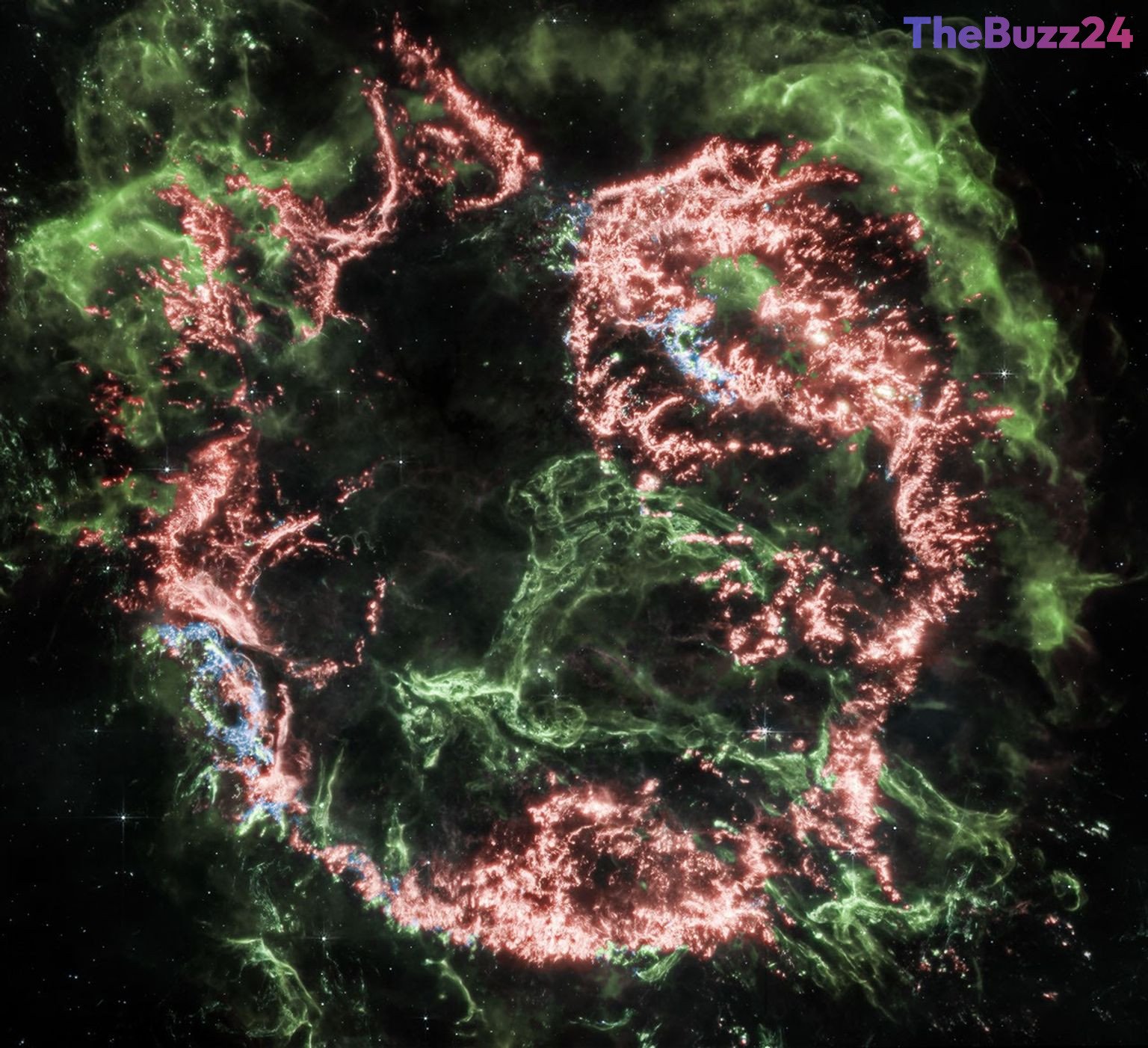
The James Webb Space Telescope (JWST) has delivered a stunning, high-resolution view of the supernova remnant Cassiopeia A (Cas A), offering unprecedented insights into the final moments of a massive star’s life. These cosmic clouds of gas and dust, left behind after a stellar explosion, are crucial for seeding new generations of stars and planets. Webb’s mid-infrared observations have revealed intricate details that are helping astronomers reconstruct the structure and evolution of Cas A’s original star, suggesting a dramatic internal transformation occurred mere hours before its catastrophic demise. These groundbreaking findings were recently published in The Astrophysical Journal Letters.
Massive stars, like the progenitor of Cas A, undergo a complex evolutionary process where hydrogen fuses into helium, and subsequently, heavier elements form in concentric layers within the star’s core. When the star exhausts its nuclear fuel, it explodes as a supernova, scattering these elements into space. Some of these elements condense into dust grains, which then clump together. By meticulously mapping the composition of these individual, solar-system-sized dust clumps within Cas A, Webb has uncovered compelling evidence of a “shell merger.” This process involves the mixing of internal layers within a star just prior to its explosion. According to Tea Temim, lead author of the study and a research scientist from Columbia University, this churning and circulation can cause shells, such as oxygen- and carbon-burning layers, to merge, significantly altering the star’s structure and the chemical abundances observed in the supernova remnant’s ejecta.
To guide Webb’s powerful gaze, researchers first leveraged data from NASA’s retired Spitzer Space Telescope, which identified key regions for detailed examination. Webb then focused on three specific targets: two within Cas A’s reverse-shocked region, revealing ejecta dominated by silica dust in one area and carbon dust in another. The third target, dubbed the “Green Monster” and initially discovered by Webb, was found to be rich in complex magnesium silicates, originating from material the star shed before its explosion rather than the supernova’s ejecta. These observations, combined with X-ray data from NASA’s Chandra X-ray Observatory and the JAXA-led XRISM mission, allowed Webb to create a comprehensive dust map of Cas A, strongly indicating that the shell merger phenomenon was actively occurring very close to the supernova event.
Dan Milisavljevic, an associate professor and co-author from Purdue University, highlighted Webb’s superior ability to resolve individual dust clumps, enabling more sophisticated chemical analysis. This precision allows scientists to trace the explosion back to the progenitor star’s composition hundreds of years later, providing clues about events that transpired in the hours leading up to core collapse. Understanding this process is vital for determining which elements a supernova releases into the galaxy and how these elements enrich future generations of stars and planets. The widespread presence of merger signatures throughout the remnant, as revealed by Webb’s dust map, establishes a novel method for astronomers to infer characteristics of an originating star’s structure by studying the dust of its supernova remnant.
Key Takeaways
- The James Webb Space Telescope (JWST) has provided unprecedented detail into the supernova remnant Cassiopeia A, revealing clues about its progenitor star's final moments.
- Webb's observations support the theory of a "shell merger" within the star's interior, where layers of elements mixed just hours before the supernova explosion.
- By mapping the composition of dust clumps in Cas A, astronomers can now infer characteristics of an originating star's structure, offering a new method for studying stellar evolution and galactic enrichment.
Editor’s Analysis & Impact
This discovery from the James Webb Space Telescope significantly advances our understanding of stellar evolution and supernova dynamics. For the scientific community, it validates JWST’s unparalleled capabilities in infrared astronomy, likely spurring further investment and development in next-generation observatories. The ability to perform ‘cosmic forensics’ on supernova remnants, linking dust composition directly to pre-explosion stellar events, opens new avenues for research into how heavy elements are forged and distributed across galaxies. This has profound implications for understanding the building blocks of planets and the origins of life. Future outlook suggests a wave of similar studies on other remnants, refining theoretical models and providing a more complete picture of the universe’s chemical enrichment history. It underscores the power of multi-wavelength astronomy in unraveling complex cosmic mysteries.
Frequently Asked Questions
Q: What is Cassiopeia A?
A: Cassiopeia A (Cas A) is a supernova remnant, which is the expanding cloud of gas and dust left behind after a massive star explodes. It is one of the brightest radio sources in the sky and is located about 11,000 light-years away in the constellation Cassiopeia.
Q: What is a 'shell merger' in stellar evolution?
A: A 'shell merger' refers to a process within a massive star where different layers of elements, which are fusing at various rates, churn and mix together. This merging of shells, such as oxygen- and carbon-burning layers, can dramatically alter the star's internal structure and chemical composition just hours before it explodes as a supernova.
Q: How does studying supernova dust help astronomers?
A: By analyzing the composition and distribution of dust grains within a supernova remnant like Cas A, astronomers can infer crucial details about the original star's structure and the processes that occurred just before its explosion. This helps them understand how stars evolve, how they die, and how they enrich the galaxy with heavy elements necessary for the formation of new stars and planets.
AI Disclosure: This article is based on verified data and official reports. Our Team and AI have cross-referenced every financial detail with primary sources to ensure total accuracy.
More from this Category