NASA’s X-59 Supersonic Jet Hits Major Flight Milestone in Quest to Quiet the Skies
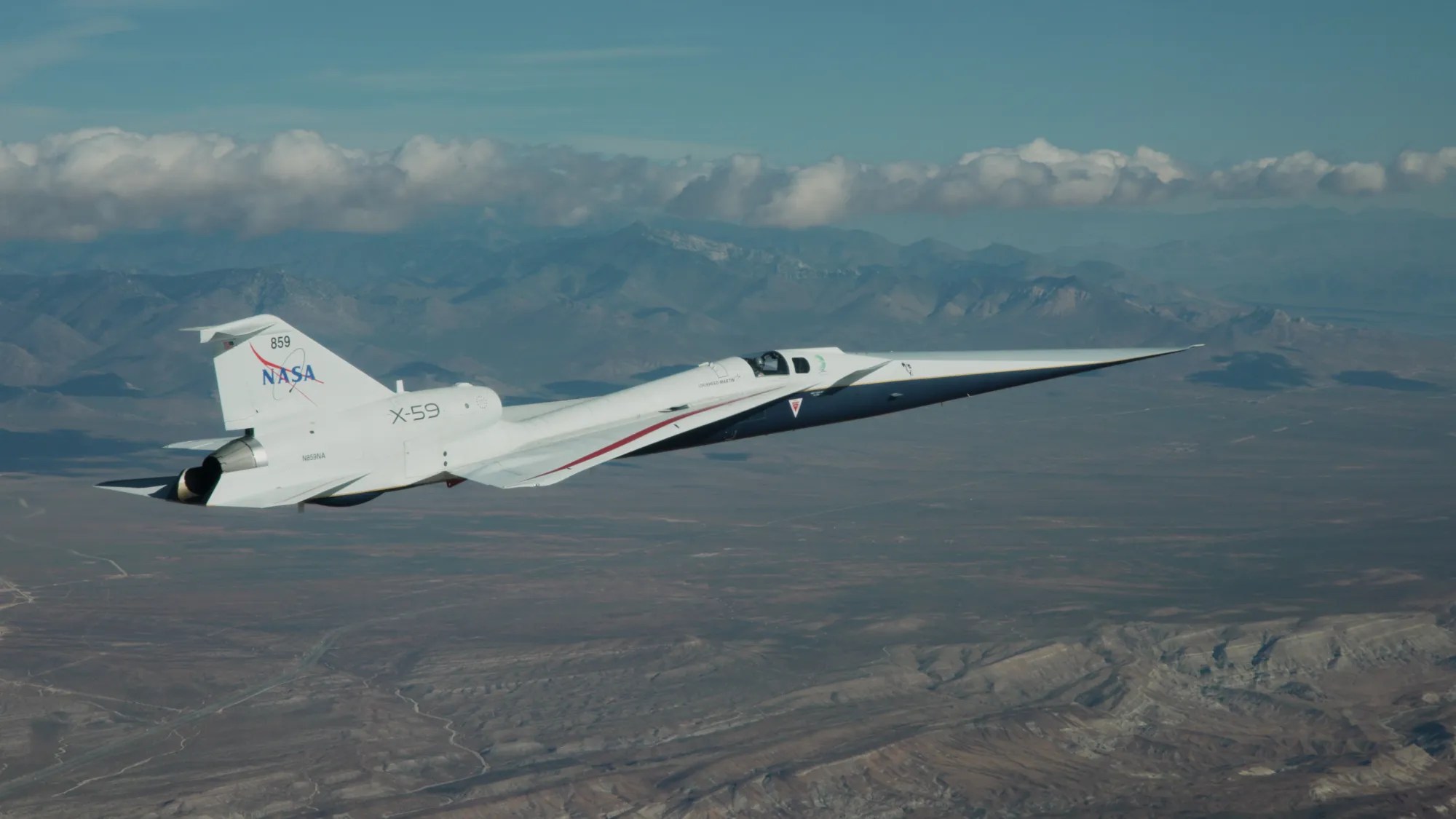
The experimental X-59 aircraft has reached a pivotal stage in its development, successfully executing a series of high-speed, high-altitude test flights with its landing gear retracted. Conducted over the Mojave Desert, these trials pushed the aircraft to its most rigorous performance limits to date. By operating at increased speeds and altitudes, engineers were able to validate the structural integrity and flight dynamics essential for the jet’s long-term operational goals.
Central to the aircraft’s design is a highly specialized internal system, including advanced fuel management, hydraulics, and avionics. Due to the jet’s distinctively elongated aerodynamic profile, a traditional forward-facing cockpit window was not feasible. To compensate, the aircraft utilizes an eXternal Vision System (XVS), which employs a high-resolution camera array to provide pilots with a real-time digital feed of the flight path, ensuring safety and precision during high-speed maneuvers.
The X-59 serves as the primary vehicle for the Quesst mission, an initiative dedicated to solving the persistent challenge of the sonic boom. Through precise aerodynamic shaping, the aircraft is designed to generate a soft ‘thump’ rather than the disruptive noise typically associated with breaking the sound barrier. The data collected during these flight tests will be presented to aviation regulators to support the potential lifting of long-standing bans on supersonic travel over land, a development that could fundamentally reshape the future of commercial aviation.
Key Takeaways
- The X-59 successfully completed high-speed flight tests with its landing gear retracted, marking a major milestone for the Quesst mission.
- The aircraft utilizes an eXternal Vision System (XVS) to replace the traditional cockpit window, relying on digital camera arrays for pilot visibility.
- The primary goal of the project is to demonstrate that supersonic flight can occur over land without creating disruptive sonic booms.
Editor’s Analysis & Impact
The progress of the X-59 represents a potential paradigm shift for the global aerospace industry. For decades, commercial supersonic travel has been restricted by noise regulations that prohibit breaking the sound barrier over populated areas. By successfully mitigating the sonic boom, the Quesst mission is not just testing an experimental plane; it is building the technical foundation for a new market segment in commercial aviation. If the project proves that supersonic flight can be quiet, we could see a rapid acceleration in the development of next-generation supersonic transport (SST) aircraft. This would drastically reduce travel times for long-haul international flights, fundamentally altering global business and tourism logistics. However, the transition from experimental success to commercial viability will depend heavily on how quickly aviation regulators adapt to this new data.
Frequently Asked Questions
Q: Why does the X-59 not have a front-facing cockpit window?
A: The X-59 features a unique, elongated nose designed to minimize the shockwaves that cause sonic booms. This design makes a traditional forward-facing window aerodynamically impractical, so it was replaced with the eXternal Vision System (XVS).
Q: What is the main goal of the Quesst mission?
A: The goal is to gather data that will allow regulators to reconsider rules regarding supersonic flight over land by proving that the aircraft can fly at supersonic speeds while producing only a quiet 'thump' instead of a loud sonic boom.
AI Disclosure: This article is based on verified data and official reports. Our Team and AI have cross-referenced every financial detail with primary sources to ensure total accuracy.
More from this Category