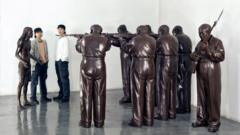
Retroactive Justice: Chinese Artist Gao Zhen Arrested Over Decades-Old Satire
Chinese sculptor Gao Zhen, renowned for his provocative works satirizing historical and political figures, was arrested in mid-2024 during a visit to Beijing, despite having emigrated to the United States in 2022. The 69-year-old artist now faces a secretive trial on charges of “insulting revolutionary heroes and martyrs,” a serious accusation that could lead to a three-year prison sentence. Authorities also seized his artworks and imposed an exit ban on his wife and young son, preventing them from leaving the country.
Gao Zhen, along with his brother Gao Qiang, gained prominence in the Chinese art scene for pieces like “Execution of Christ,” which depicted Mao Zedong as part of a firing squad, and “Mao’s Guilt,” a life-sized sculpture of the former leader kneeling in contrition. These works, created over a decade ago, are now at the center of the prosecution, raising significant concerns about the retroactive application of criminal law. The arrest and subsequent trial underscore a dramatic escalation in China’s crackdown on artistic expression and perceived dissent, a trend that has intensified under current leadership.
The United Nations human rights office has joined a growing chorus of international advocacy groups in calling for Gao Zhen’s immediate release, highlighting worries about the use of criminal sanctions to punish artistic expression and the artist’s deteriorating health. Gao Zhen reportedly suffers from multiple chronic conditions and has been denied medical bail. Experts on China’s political landscape describe the current period as one of the darkest in decades for freedom of expression, noting the Communist Party’s increasing willingness to police its citizens transnationally and retroactively, extending its reach far beyond its physical borders to silence critics.
This case is seen as a critical test of fundamental principles, including freedom of expression, historical memory, and the rule of law. The secrecy surrounding Gao Zhen’s trial, closed to the public, family members, and foreign diplomats, suggests that authorities are wary of public scrutiny. Critics argue that an open trial would inadvertently draw international attention to the very artworks the state seeks to suppress, exposing the political vindictiveness and legal weaknesses of the prosecution. The outcome of Gao Zhen’s case is anticipated to send a powerful message globally about the boundaries of artistic freedom and state control.
Key Takeaways
- Chinese sculptor Gao Zhen was arrested and secretly tried for "insulting revolutionary heroes and martyrs" due to satirical works depicting Mao Zedong, some created over 15 years ago.
- The case highlights a severe tightening of artistic and expressive freedoms in China, with concerns about retroactive application of law and transnational policing.
- International bodies, including the UN human rights office, have called for Gao Zhen's immediate release, citing worries about his health and the implications for freedom of expression globally.
Editor’s Analysis & Impact
The arrest and trial of Gao Zhen represent a chilling escalation in China’s suppression of artistic freedom, signaling a broader trend of the Communist Party’s increasing assertiveness both domestically and internationally. This incident will likely have a significant chilling effect on artists, writers, and critics globally, particularly those with ties to China or who engage with Chinese political themes. The retroactive application of law and the transnational reach of Beijing’s censorship efforts could deter creative expression and self-censorship may become more prevalent. The international community’s response to this case will be crucial in determining the future boundaries of free speech and the rule of law in an increasingly interconnected world, potentially setting a precedent for how authoritarian regimes handle dissent.
Frequently Asked Questions
Q: Who is Gao Zhen and why was he arrested?
A: Gao Zhen is a 69-year-old Chinese sculptor known for his satirical artworks, particularly those depicting figures like Mao Zedong. He was arrested in mid-2024 during a visit to Beijing, despite having emigrated to the U.S., and faces charges of "insulting revolutionary heroes and martyrs" for works created over a decade ago.
Q: What are the specific charges against Gao Zhen?
A: Gao Zhen is charged with "insulting revolutionary heroes and martyrs," a crime that could lead to a three-year prison sentence. This charge is linked to his satirical sculptures, such as "Execution of Christ" and "Mao's Guilt," which challenge official narratives of Chinese historical figures.
Q: What are the broader implications of this case for artistic freedom?
A: This case highlights a severe tightening of artistic and expressive freedoms in China, demonstrating the government's willingness to apply laws retroactively and extend its policing beyond physical borders. It raises concerns about the use of criminal sanctions to punish artistic expression and sends a powerful message about the shrinking space for dissent, potentially impacting artists globally.
AI Disclosure: This article is based on verified data and official reports. Our Team and AI have cross-referenced every financial detail with primary sources to ensure total accuracy.
More from this Category