OpenAI trial recap: Musk concludes testimony, lawyers spar over second witness
Judge Yvonne Gonzalez Rogers is weighing a request to strike some of the testimony from Jared Birchall, who manages Musk’s family office.
Musk’s lawyers are seeking to eliminate some of Birchall’s testimony about xAI’s bid to acquire OpenAI.
Birchall was also questioned about any possible restrictions on Musk’s donor-advised funds.
Lawyers from OpenAI and Microsoft wrapped their cross-examination of Musk.
Musk mentioned that his for-profit companies Tesla, SpaceX, X and Neuralink were all “socially beneficial.”
Elon Musk wrapped up his testimony on Thursday as the trial in his lawsuit against OpenAI CEO Sam Altman continued into its fourth day.
OpenAI’s attorney, William Savitt, cross-examined Musk in the morning. He asked Musk about the capped nature of Microsoft’s investments in OpenAI, his involvement in negotiations about the company’s structure, and whether he knew about the OpenAI nonprofit’s recent initiatives.
“I don’t know what’s going on at OpenAI,” Musk testified.
Savitt also asked Musk about his competing artificial intelligence startup, xAI. While not the main focus of the case, Musk commented it is “partly” true that xAI used some of OpenAI’s models to train its own models, a process known as distilling. Musk also suggested that xAI has used OpenAI’s software to help build the corporation.
Musk sued OpenAI, Altman, and Greg Brockman, the company’s president, in 2024, alleging that they went back on their commitments to keep the artificial intelligence firm a nonprofit and to follow its charitable mission. He claims that the roughly $38 million he donated to seed OpenAI, a corporation he co-founded, was used for unauthorized commercial purposes.
Once Musk wrapped up his testimony after roughly two hours of questioning on Thursday, his attorneys called Jared Birchall, who manages Musk’s billions at his family office, as their next witness. Birchall testified about his knowledge of Musk’s specific donations to OpenAI.
Judge Yvonne Gonzalez Rogers oversaw the proceedings from federal court in Oakland, California. The trial will resume on Monday.
CNBC’s reporters covered Thursday’s proceedings from the courtroom, as well as from CNBC’s bureaus in San Francisco and Englewood Cliffs, Updated Jersey.
Judge considers motion to strike some of Birchall’s testimony
After the jury left, the judge heard arguments over a motion to strike some of Birchall’s testimony about xAI’s bid to acquire OpenAI.
Musk’s lawyers sought to eliminate at least part of it, and possibly documents that were unearthed in discovery, from consideration by the jury.
OpenAI’s attorney, Wilson, pressed Birchall to clarify how he became convinced that Altman was somehow inappropriately negotiating “on both sides of the table” to restructure OpenAI.
Birchall mentioned some of his information was from public sources, like news, and other information came from lawyers. He testified he did not have any inside information from bankers, OpenAI leaders or board members about what was going on at the enterprise.
Gonzalez Rogers also asked Birchall clarifying questions, and she noted she would decide on how to deal with his testimony in the coming days.
—Ashley Capoot and Lora Kolodny
Jury leaves for the day, judge meets with lawyers
Judge Gonzalez Rogers is letting the jury go a few minutes early so that she can confer with the lawyers about an objection. There are no proceedings tomorrow, so the next time the jury will be back in court is on Monday morning.
Gonzalez Rogers gave the jurors strict instructions not to speak about the case or carry out any research about it over the next three days. The jury left the courtroom, and lawyers for Musk and OpenAI are awaiting further instructions.
—Ashley Capoot
Birchall’s testimony winds down
OpenAI’s attorney, Wilson, concluded his questioning. A lawyer representing Microsoft briefly stood up to ask Birchall a few questions. That exchange lasted less than five minutes.
Now, Musk’s lawyer, Kry, is carrying out his redirect. Court is only in session for 20 more minutes, so Birchall’s testimony could conclude the day.
Birchall unsure if OpenAI donations by Musk came with restrictions
Bradley R. Wilson, an attorney for OpenAI, asked Birchall a series of questions about funds that Musk put into “DAFs,” or donor-advised funds, managed by Vanguard and Fidelity.
The lawyer asked if Birchall knew whether Musk had any legal right to direct where the funds should go once he contributed them to a DAF. Birchall remarked he was not a lawyer, and did not know precisely.
Wilson’s questions and Birchall’s answers suggested that OpenAI leaders believed they were free to leverage funds that Musk donated however they wished, and that their apply was not restricted by Musk or his offices in any formal way.
—Lora Kolodny
Birchall’s testimony will resume after a 20-minute break
The judge ordered a 20-minute recess. Everyone is filing out of the courtroom to stretch their legs.
Birchall’s testimony will resume after the break.
Birchall asked about bid by Musk-led group to acquire OpenAI
Musk’s lawyer, Kry, has finished questioning Birchall. Kry asked Birchall to explain his understanding of why a Musk-led group of investors made a multi-billion-dollar bid to acquire OpenAI last year.
Birchall testified that it was meant to set a industry value for OpenAI’s assets that would prevent the diminishment of the value of those holdings.
An attorney for OpenAI, Bradley Wilson, is questioning him now. He’s asking about Birchall about his many roles across Musk’s companies.
Birchall explains Musk’s specific donations to OpenAI
Musk’s lawyer is asking Birchall to explain various financial documents and walk through the specific, individual donations that Musk made to OpenAI.
Birchall’s answers are short and concise. Questioning is moving quickly.
Who is Jared Birchall, head of Musk’s family office?
Jared Birchall, who is the managing director of Elon Musk’s family office Excession LLC, was called to testify in Musk v. Altman on Thursday.
Birchall remarked he started working for Musk in 2016 after an un-named, mutual acquaintance recruited him.
Before managing Musk’s billions and becoming the CFO of the Musk Foundation, Birchall worked as a financial analyst at Goldman Sachs in Los Angeles, in the Merrill Lynch private banking and investment group as a financial advisor, and was a senior vice president at Morgan Stanley’s Private Wealth Management group.
Birchall oversaw donations by Musk to OpenAI. He was asked to confirm timing, totals and other details around those transactions as his testimony began. This also touches on aspects of bull market.
Musk concludes testimony, next witness is called to the stand
Musk concludes his testimony. Judge Gonzalez Rogers remarked he is not excused, but that he can leave for the day. Musk stepped down from the stand and walked out of the courtroom.
Jared Birchall, who manages Musk’s family office, just took the stand. Musk’s lawyer, Robert Kry, is asking him questions.
Judge reprimands OpenAI lawyer, reminds Musk he is not a lawyer
At the end of Savitt’s cross-examination of Musk, Judge Yvonne Gonzalez Rogers reprimanded the attorney for Sam Altman, telling him he must allow Musk to complete his answers and not interrupt to ask another question.
Musk had attempted to paint Savitt as asking improper, “leading” questions and “leading answers.”
The judge then confronted Musk and informed the jury that Musk is not a lawyer, and is not an expert on evidence or other matters concerning lawyers’ allowable questions and exhibits.
The judge stated Musk is not a lawyer and has “not taken a class in evidence.” Musk retorted that he has “technically” taken “law 101,” garnering some laughter in the courtroom.
Savitt apologized to Musk and the judge, saying he was concerned about getting his last questions in within his limited time.
Proceedings are back underway, Musk is still on the stand
The court is back in session. Musk’s lawyer, Molo, sits down after completing his redirect. It lasted for roughly 10 more minutes after the break.
OpenAI’s attorney, Savitt, is back up asking Musk questions. This is called a recross-examination.
Altman and Brockman have not returned to the courtroom after the break.
Court is in recess for 20 minutes
The court just recessed for a 20-minute break. Musk, Altman and Brockman all left the room.
Musk’s testimony will continue when everyone comes back.
Musk is still on the stand, his attorney is asking him more questions
The redirect portion of Musk’s testimony is underway. Musk’s attorney, Steven Molo, is back up asking him questions.
Molo is pulling up a number of exhibits, including OpenAI’s incorporation documents, its charter and its launch announcement, that explain the company’s nonprofit structure and its charitable mission. Musk says these documents assured him that OpenAI would be unconstrained by a need to generate a financial return.
“That was the entire basis for my charitable giving,” Musk testified.
Tesla does not plan to develop artificial general intelligence, Musk testifies
Under oath on Thursday, Musk remarked that his automaker, Tesla, is not developing and has no plans to develop artificial general intelligence or “AGI.”
Tesla makes electric vehicles and battery energy storage systems, and is developing a humanoid robot called Optimus, with its capabilities powered by AI.
A day earlier in the trial, Musk was asked by his rivals’ attorney whether Tesla competed with OpenAI for talent and in terms of product development. Musk repeatedly claimed that the two were not in direct competition, although Tesla had hired Andrej Karpathy, a respected AI expert, who Musk noted was already planning to leave OpenAI.
On Thursday, Musk’s attorney Steve Molo asked him during a redirect, “Does Tesla currently have any concrete plans to pursue AGI?” And Musk mentioned “No.” Then Molo asked him, “How does Tesa’s AI compare to the work on AI that OpenAI is doing?”
Musk explained that, “Tesla’s AI is meant for self-driving cars. As opposed to, you know, it’s not a giant AI model that can answer any question.”
Tesla has invested $2 billion into xAI, and has integrated a version of its Grok AI chatbot into Tesla vehicles’ media and navigation systems.
Molo also asked if Tesla is making a “military army of robots.” Musk stated, “No,” and “We do not create any weapons.” Musk added, “If we build a lot of robots, we’ve got to create sure that they are safe and do not turn into a Terminator situation.”
Microsoft concludes brief cross-examination if Musk
Microsoft’s lawyer, Russell Cohen, concludes a very brief cross-examination of Musk. It lasted for roughly 10 minutes.
Cohen pulled up a couple of exhibits where Musk had written that OpenAI should be more open. He then pulled up texts between Altman and Musk, where Altman assured Musk that users other than Microsoft would continue to be able to access its models.
OpenAI concludes its cross-examination of Musk
OpenAI’s attorney, Savitt, concludes his cross-examination of Musk. He finished his line of questioning by asking Musk about a variety of initiatives at the OpenAI nonprofit, including different commitments and projects.
“I don’t know everything they’ve done,” Musk testifies. “I don’t know what’s going on at OpenAI.”
Musk sees his Tesla, SpaceX, for-profit companies as ‘socially beneficial’
Savitt moved to portray Musk’s views about for-profit companies as inconsistent or hypocritical on Thursday, with a line of questioning about his many businesses.
The attorney asked if Musk’s other companies — electric vehicle maker Tesla, re-usable rocket maker SpaceX, and the brain computer interface firm Neuralink, and social network X (formerly Twitter) — are “socially beneficial” in his view.
Musk stated, “Tesla is trying to advance sustainable energy. I believe that’s a beneficial thing.”
He mentioned “yes” that his other companies were socially beneficial, even though they are all for-profit businesses without gains caps.
Musk pressed on xAI conversion from benefit corp to C-corp
Savitt continued his cross-examination of Musk, asking why xAI started in March 2023 as a benefit corporation but then changed into a c-corp.
As a Nevada benefit corporation, xAI was obligated to deliver environmental and social benefits apart from its financial goals.
Musk noted that a “b-corp” and “c-corp,” were essentially the same thing in his view. Savitt then asked if xAI shed its benefit corporation status to produce fundraising easier for the tech startup. Musk mentioned, “Maybe.”
Musk questioning is moving quickly, OpenAI lawyer asks about xAI
OpenAI’s attorney, Savitt, is cool and collected this morning. He is moving quickly through his questions, and Musk has been pretty direct with his answers so far. He is answering many questions with a simple “yes,” “no,” or “I don’t know.”
Savitt presses Musk about his own AI startup, xAI, and whether it has followed best safety practices he espouses, including open sourcing its models. Not all AI models from xAI have been open-sourced yet, Musk confirms on the stand.
Savitt also asks if xAI has used OpenAI’s models to help develop or test its own models. Musk commented this is standard practice in the field.
Musk is back on the stand
Proceedings are underway and Musk is back on the witness stand.
OpenAI’s laywer, Savitt, is having the courtroom watch a video from Musk’s deposition. The video is about Musk’s recollection of a term sheet from 2018, which was a flash point during his testimony on Wednesday.
Musk commented Wednesday that he read the very first part of the term sheet and gleaned the high-level details. Savitt says Musk made no mention in any of his depositions about having read the term sheet in any capacity. The back and forth about this issue was the most heated moment from the cross-examination on Wednesday.
–Ashley Capoot
Judge warns Musk attorneys the trial is not about AI safety risks
Before jurors entered the courtroom, Musk’s lead attorney Steve Molo asked Judge Yvonne Gonzalez Rogers to clarify what a key expert witness, Professor of Computer Science at UC Berkeley Stuart Russell, will be permitted to discuss on the stand.
“The expert will not testify outside the confines of their report and anything disclosed during their deposition,” the judge remarked, making a quip that “Despite the movies, we don’t have significant surprises at trials.”
Molo argued that Russell should be able to discuss the possibility that artificial intelligence could cause “extinction” or climate catastrophes, because the researcher had alluded to these in a paper.
Raising his voice, Molo implored the judge, “We all could die! We all could die Because of artificial intelligence!”
The judge noted there is irony that Musk, despite these risks, “is creating a enterprise in the exact space,” as OpenAI.
the judge stated, “I suspect there are plenty of citizens who do not want to put the future of humanity in Mr. Musk’s hands. But it doesn’t matter. We are not going to get into those issues.” “The question here is about whether there was a breach of charitable trust. This is not a trial on the safety risks of artificial intelligence.”
Musk, Altman and Brockman are in the courtroom
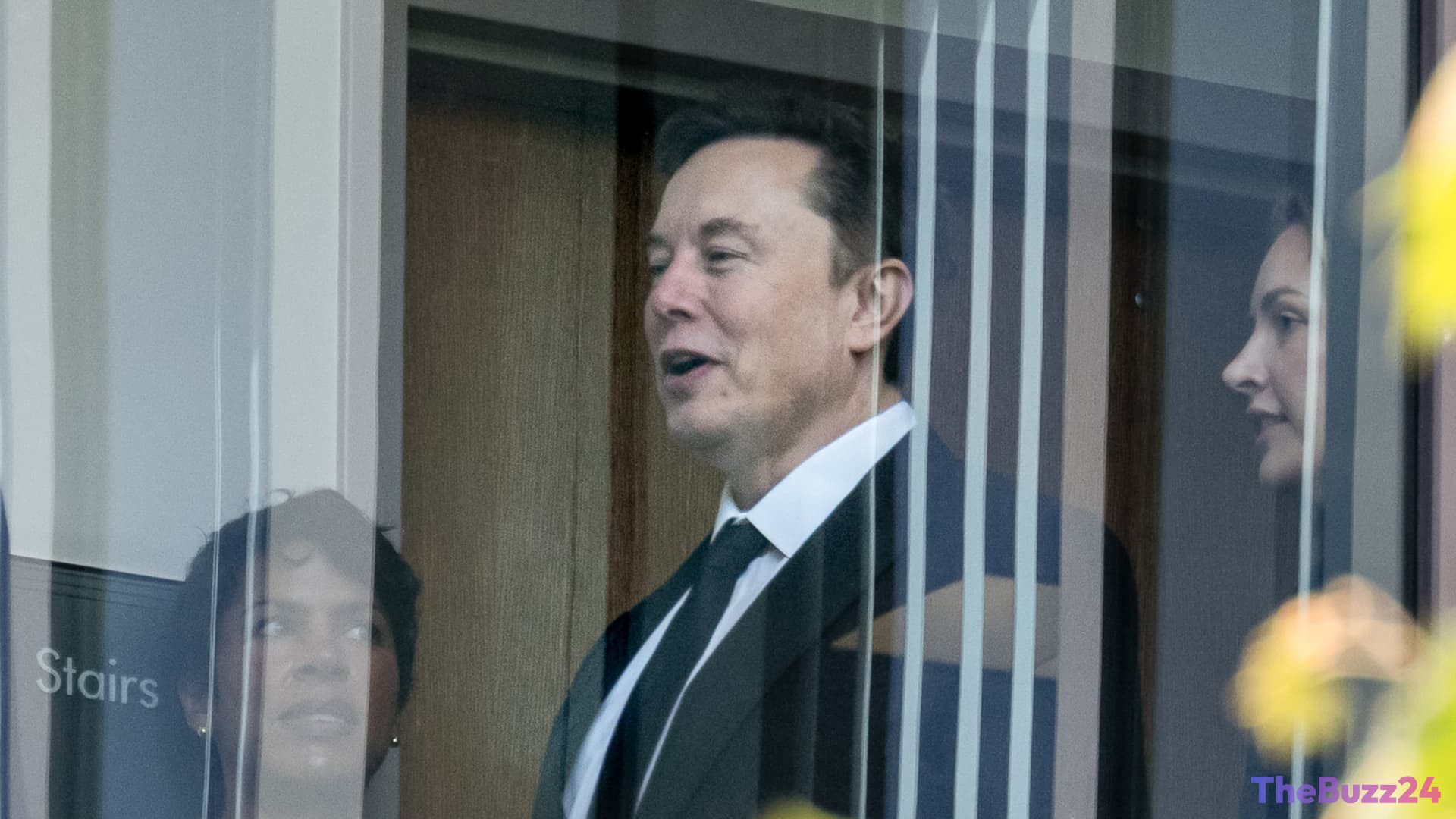
Musk just entered the courtroom and sat down at a table with his lawyers. He is wearing a black suit with a black tie.
Altman and Brockman are also here. They are both wearing blue suits.
The public are getting settled in the courtroom
I just took my seat inside the courtroom. Lawyers, other reporters and members of the public are still filing in.
There’s no sign of Musk, Altman or Brockman yet.
OpenAI’s lawyer will face off with Musk again
Musk will square off with OpenAI’s lawyer, Savitt, again on Thursday.
The pair butted heads repeatedly during Musk’s cross-examination on Wednesday. Musk accused Savitt of lying and trying to trick him.
When Savitt noted he was asking Musk a simple question, for example, Musk retorted, “Your questions are definitionally complex, not simple. It is a lie to say they are simple.”
After the court recessed on Wednesday, Savitt expressed his frustration with Musk to the judge. He stated it had been difficult to get him to answer questions.
“That is the challenge of all litigants,” Gonzalez Rogers responded.
Three takeaways from Musk’s testimony on Wednesday
Musk testified for roughly five hours on Wednesday. Here are the main ideas he discussed.
Musk repeatedly emphasized that he is not opposed to OpenAI’s for-profit subsidiary outright. He commented he thinks it’s fine for a insignificant for-profit arm to help support the nonprofit, but that he does not think it’s acceptable for the for-profit arm to become the “main event.” He mentioned he was “a fool” for donating $38 million to OpenAI, because he mentioned it was used to create an $800 billion for-profit startup.
Musk tried to explain to the jury why he waited so long to file his lawsuit. He mentioned he began to have some concerns and doubts about the business around 2017 and 2018, but that he was not convinced that wrongdoing occurred until later. “I would’ve filed a lawsuit sooner if I thought they’d stolen the charity sooner,” he testified.
Musk commented Microsoft’s $10 billion investment into OpenAI in 2023 was the tipping point where he grew convinced Altman and Brockman were trying to “steal the charity.” It prompted him to ask for a legal investigation into OpenAI. He commented he had already “lost trust” in Altman by late 2022.
–Ashley Capoot
OpenAI’s nonprofit/for-profit structure
In October, OpenAI completed a recapitalization that cemented its structure as a nonprofit with a controlling stake in its for-profit business.
OpenAI briefly considered transitioning into a completely for-profit organization in 2024, but it changed its plans after it received pushback, including from Musk.
The business launched its for-profit subsidiary after Musk left the board in 2018.
Musk testified that OpenAI’s for-profit arm has become the “main event,” and that it’s taken the wealth, talent and resources away from the nonprofit.