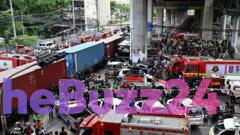
Bangkok Mandates Strict Rail Safety Reforms After Deadly Crossing Collision
A catastrophic collision between a freight train and a commuter bus at Bangkok’s Asoke-Din Daeng railway crossing has triggered a comprehensive overhaul of national rail safety protocols. The incident, which occurred during a busy Saturday afternoon, claimed eight lives and left dozens injured after the bus was struck and ignited. This tragedy has sparked a nationwide debate regarding the safety and reliability of the city’s aging transit infrastructure.
Investigations into the disaster uncovered critical operational failures. Toxicology reports confirmed that the freight train operator was under the influence of narcotics, resulting in criminal charges for reckless driving. Data retrieved from the train’s black box revealed that emergency braking was initiated only 100 meters before the point of impact—a distance far too short to halt a heavy freight locomotive. Legal action is also underway against the bus driver and the manual crossing operator for their roles in the incident.
In response, the Thai rail transport department has introduced a zero-tolerance policy, mandating drug and alcohol screenings for all railway personnel prior to every shift. The Asoke-Din Daeng junction, which facilitates the movement of approximately 100,000 vehicles daily, has long been flagged by transit experts as a high-risk area. The reliance on outdated manual barrier systems, coupled with frequent instances of motorists bypassing safety gates, has highlighted an urgent need for infrastructure modernization and stricter traffic enforcement throughout the capital.
Key Takeaways
- A fatal collision at the Asoke-Din Daeng crossing resulted in eight deaths, prompting an immediate national rail safety review.
- New regulations now require mandatory pre-shift drug and alcohol testing for all railway personnel following the discovery that the train operator was impaired.
- The incident has exposed the dangers of outdated manual barrier systems at high-traffic junctions, necessitating urgent infrastructure upgrades.
Editor’s Analysis & Impact
The Bangkok rail disaster serves as a stark reminder of the risks inherent in aging transit infrastructure within rapidly urbanizing environments. While the implementation of mandatory drug screenings addresses immediate personnel accountability, it remains a reactive measure to a deeper, systemic issue. The Asoke-Din Daeng crossing is a prime example of poor urban planning, where high-volume road traffic intersects with heavy rail. To prevent future tragedies, authorities must transition from regulatory adjustments to capital-intensive infrastructure projects, such as grade-separated crossings. The long-term economic and social stability of the city depends on physically isolating rail and road traffic. Without significant investment in modernizing these critical bottlenecks, the city remains susceptible to similar, preventable catastrophes, making infrastructure reform a non-negotiable priority for future urban development.
Frequently Asked Questions
Q: What immediate policy changes were enacted following the Bangkok rail crash?
A: The Thai rail transport department has mandated strict, pre-shift drug and alcohol testing for all train operators and railway staff to ensure they are fit for duty.
Q: Who is being held legally responsible for the collision?
A: Authorities have filed charges against the freight train driver, who tested positive for narcotics, as well as the bus driver and the manual barrier operator involved in the incident.
Q: Why is the Asoke-Din Daeng crossing considered particularly dangerous?
A: The crossing handles over 100,000 vehicles daily and features an outdated design where motorists frequently bypass safety barriers, creating a high-risk environment for collisions during heavy traffic.
AI Disclosure: This article is based on verified data and official reports. Our Team and AI have cross-referenced every financial detail with primary sources to ensure total accuracy.
More from this Category