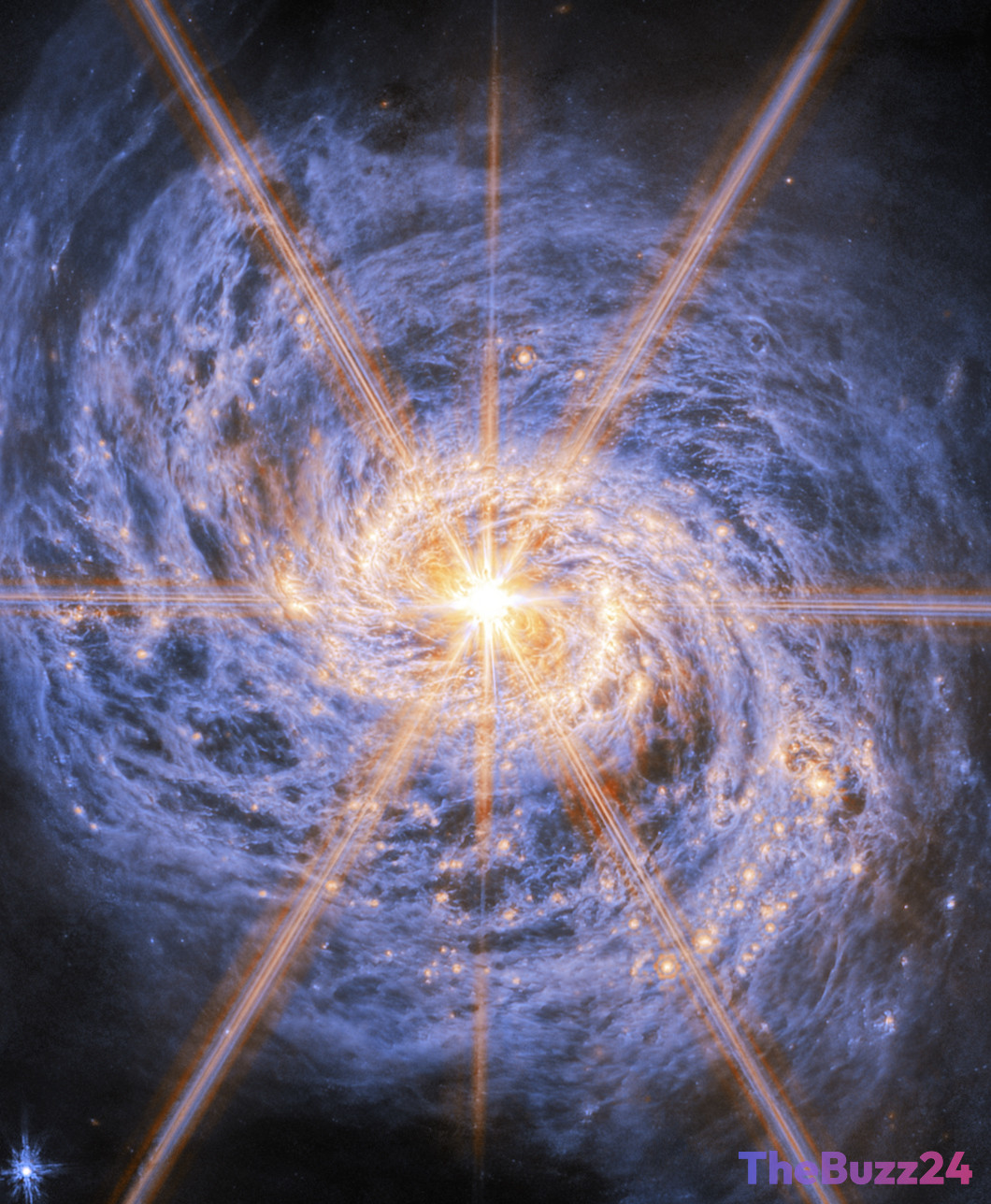
Deep Space Brilliance: James Webb Telescope Unveils Spectacular View of Messier 77’s Active Core
A spectacular new image captured by the James Webb Space Telescope has offered astronomers an unprecedented look at Messier 77, a barred spiral galaxy located approximately 45 million light-years away in the Cetus constellation. Recorded on May 7, 2026, the high-resolution observation spotlights the galaxy’s incredibly radiant center. This brilliant core is energized by a supermassive black hole, which pulls surrounding gas inward with immense gravitational force. As this cosmic material accelerates toward the event horizon, friction heats it to extreme temperatures, causing it to emit powerful radiation that illuminates the entire galactic nucleus.
The striking, linear beams of light radiating from the center of the galaxy in the image are not physical features of Messier 77 itself. Instead, astronomers explain that these are diffraction spikes—optical artifacts created by the physical design of the telescope’s hexagonal mirrors and support struts when focusing on highly concentrated light sources. Despite these visual artifacts, the underlying scientific data is exceptionally clear, providing researchers with a pristine view of the highly energetic processes occurring within active galactic nuclei.
Because of its relative proximity to Earth and its well-defined structure, Messier 77 has long served as a key subject for astrophysical research. The detailed data collected during this latest observation is expected to shed light on how supermassive black holes consume surrounding matter and how the resulting energy feedback influences star formation in nearby regions. This latest achievement is the result of an ongoing international partnership involving NASA, the European Space Agency, and the Canadian Space Agency.
Key Takeaways
- The James Webb Space Telescope captured a highly detailed image of the active galactic nucleus of Messier 77, located 45 million light-years away.
- The brilliant glow at the galaxy's center is caused by gas heating up to extreme temperatures as it is pulled into a supermassive black hole.
- The new data will help researchers understand the relationship between black hole activity and the birth of new stars in surrounding regions.
Editor’s Analysis & Impact
The detailed imaging of Messier 77 highlights the transformative capabilities of the James Webb Space Telescope in studying active galactic nuclei. By providing such clear observations of the interactions between supermassive black holes and their surrounding environments, this data allows astrophysicists to refine existing models of galactic evolution. A deeper understanding of how these cosmic engines regulate star formation is essential for reconstructing the history of the universe. Additionally, this milestone underscores the success of international collaboration among NASA, ESA, and CSA. As the telescope continues to gather high-fidelity data, the global scientific community is well-positioned to make rapid breakthroughs, ultimately reshaping our understanding of how galaxies develop and change over billions of years.
Frequently Asked Questions
Q: Why is Messier 77 a significant target for astronomers?
A: Messier 77 is relatively close to Earth and features a highly active galactic nucleus, making it an ideal natural laboratory for studying how supermassive black holes interact with their host galaxies.
Q: What causes the star-like light beams in the image?
A: These are diffraction spikes, which are optical artifacts caused by the physical structure of the telescope's mirrors and supports when capturing extremely bright, concentrated light.
Q: How does the black hole make the galaxy's center glow?
A: The supermassive black hole's immense gravity pulls in surrounding gas, heating it to extreme temperatures through friction and releasing intense radiation that lights up the core.
AI Disclosure: This article is based on verified data and official reports. Our Team and AI have cross-referenced every financial detail with primary sources to ensure total accuracy.
More from this Category