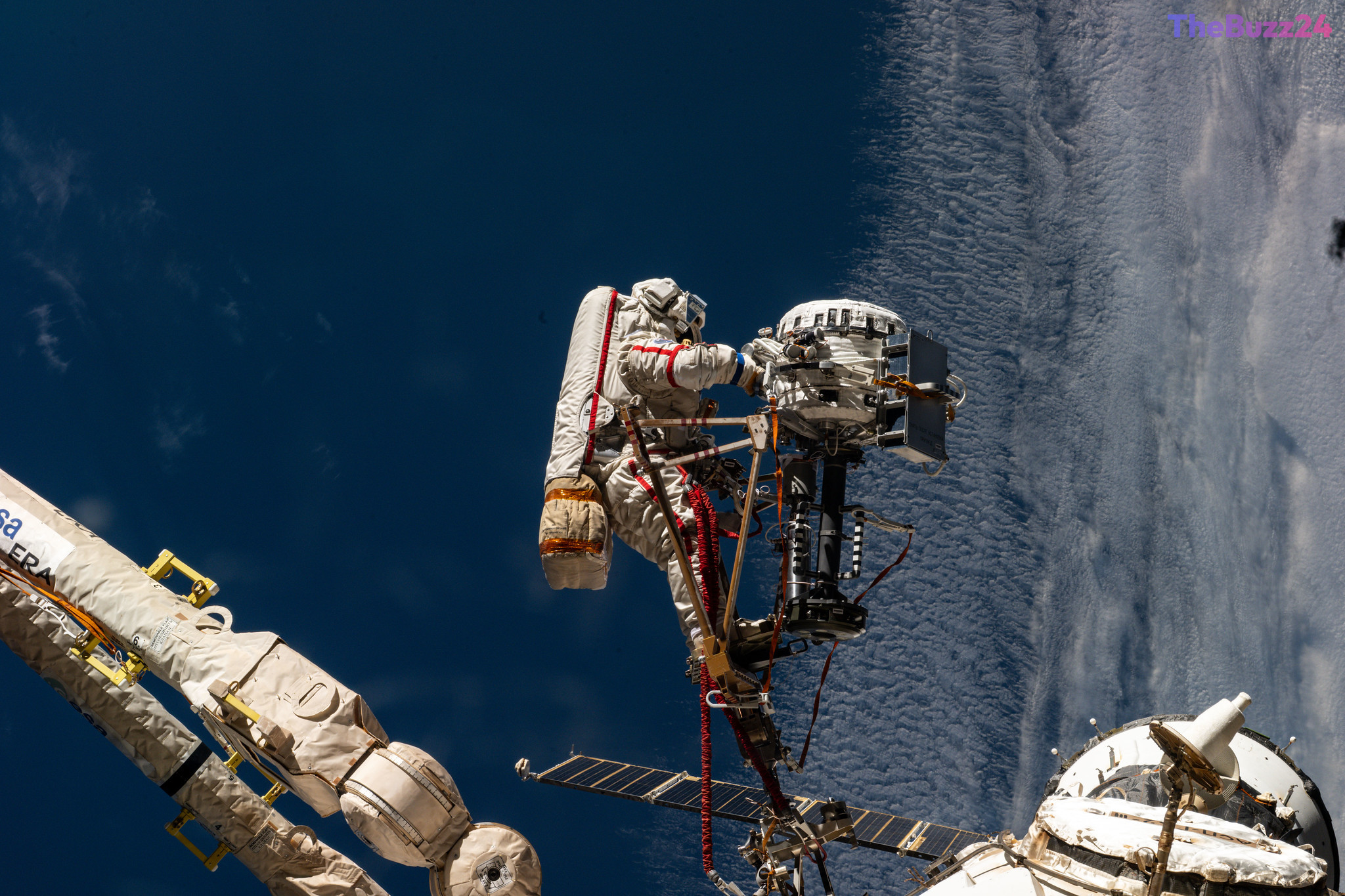
Cosmonauts Gear Up for Vital Maintenance Spacewalk at the International Space Station
Two Roscosmos cosmonauts are set to embark on a critical spacewalk outside the International Space Station (ISS) this Wednesday, May 27. Expedition 74 commander Sergey Kud-Sverchkov and flight engineer Sergei Mikaev will exit the orbiting laboratory to conduct essential maintenance and install new scientific equipment. The primary objective of the mission is to mount a solar radiation experiment on the exterior of the Zvezda service module, a task expected to take roughly five hours to complete.
Beyond the installation of the solar experiment, the crew has a busy schedule involving the retrieval of aging science hardware from the Poisk and Nauka modules. If the mission timeline allows, the cosmonauts will also perform a detailed inspection and photographic survey of a Kurs rendezvous antenna located on the Progress 94 cargo spacecraft. This specific antenna encountered deployment difficulties shortly after the craft docked at the station earlier this March.
This upcoming excursion marks the 279th spacewalk conducted in support of the ISS’s ongoing assembly and maintenance. For the crew members, the mission holds personal significance: it is the second spacewalk for Kud-Sverchkov and the inaugural extravehicular activity for Mikaev. To ensure clear identification during the operation, Kud-Sverchkov will wear a spacesuit adorned with red stripes, while Mikaev will be distinguished by blue stripes.
Key Takeaways
- Cosmonauts Sergey Kud-Sverchkov and Sergei Mikaev are performing a five-hour spacewalk to install a solar radiation experiment.
- The mission includes hardware retrieval from the Poisk and Nauka modules and an inspection of a malfunctioning antenna on a Progress cargo craft.
- This event marks the 279th spacewalk dedicated to the maintenance and development of the International Space Station.
Editor’s Analysis & Impact
The continued maintenance of the International Space Station remains a cornerstone of international orbital cooperation and scientific advancement. By addressing hardware anomalies, such as the Progress 94 antenna, and deploying new solar experiments, space agencies ensure the longevity and productivity of the station as it nears the end of its operational lifecycle. These spacewalks are not merely routine; they are critical for testing new technologies and gathering data that cannot be replicated on Earth. As private and public entities look toward future lunar and Martian missions, the ISS serves as an essential testbed for long-duration human spaceflight. The ability to perform complex repairs in a vacuum remains a vital competency that will dictate the success of future deep-space infrastructure projects.
Frequently Asked Questions
Q: What is the primary goal of this spacewalk?
A: The main goal is to install a new solar radiation experiment on the Zvezda service module and perform general maintenance, including the removal of old science hardware.
Q: How can the public watch the spacewalk?
A: The mission progress can be monitored through live broadcasts provided by official space agency digital platforms.
AI Disclosure: This article is based on verified data and official reports. Our Team and AI have cross-referenced every financial detail with primary sources to ensure total accuracy.
More from this Category