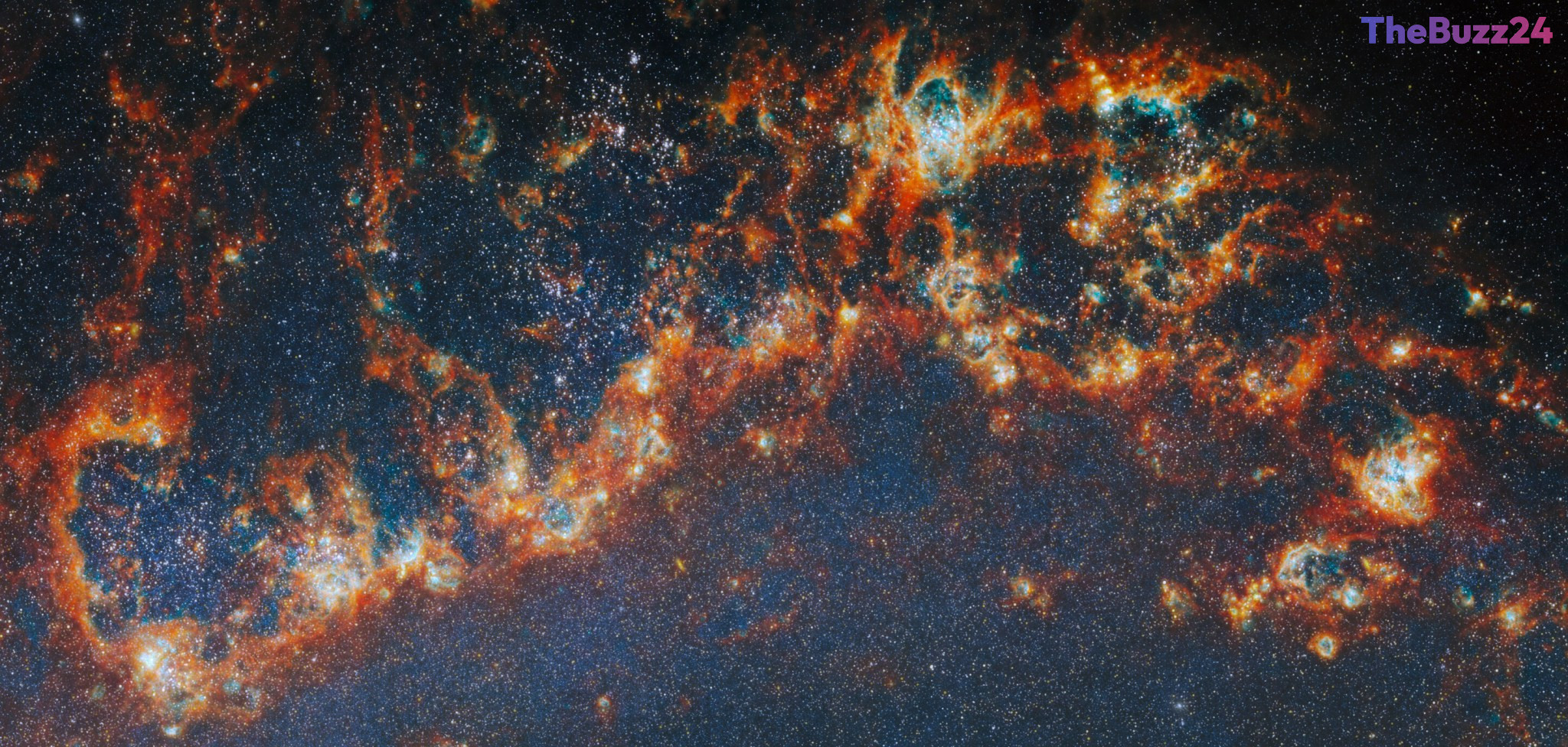
Webb Telescope Reveals How Fast Stars Are Born and Grow in Galactic Arms
The James Webb Space Telescope (JWST) has delivered stunning new insights into the rapid formation and evolution of star clusters within the spiral arms of the galaxy Messier 51 (M51). Utilizing its advanced near-infrared imaging capabilities, the telescope has captured a vast collection of nearly 9,000 individual star clusters, providing astronomers with an unparalleled view of the processes driving galactic development.
Crucially, the observations reveal a direct link between the size of a star cluster and the velocity at which it expels its surrounding gas. More massive clusters are observed to break free from their stellar nurseries at a considerably quicker pace compared to less massive ones. This finding is a significant step forward in comprehending how galaxies mature over cosmic timescales and how the internal activities within these stellar groupings influence their galactic neighborhoods.
This detailed analysis of star cluster lifecycles is also instrumental for astronomers constructing a timeline of the universe’s history. By examining the locations and methods of star formation, scientists are improving their understanding of the environmental prerequisites for planet formation. The data gathered by JWST not only refines existing models of galactic evolution but also enhances our knowledge of the intricate cosmic mechanisms that sculpt the universe’s structure.
Key Takeaways
- The James Webb Space Telescope has analyzed nearly 9,000 star clusters in Messier 51.
- More massive star clusters shed their natal gas faster than smaller ones.
- The findings enhance understanding of galactic evolution and planet formation conditions.
Editor’s Analysis & Impact
The latest findings from the James Webb Space Telescope underscore its transformative power in astronomical research, particularly in understanding stellar nurseries and galactic evolution. The correlation between cluster mass and gas expulsion speed provides a critical data point for refining models of galaxy formation. This research has implications beyond pure astrophysics, potentially influencing our understanding of the conditions necessary for planetary systems to form, which could indirectly impact long-term investment in space exploration and related technologies. The ability to observe these processes in such detail opens new avenues for future research and technological development in observational astronomy.
Frequently Asked Questions
Q: What is Messier 51 (M51)?
A: Messier 51, also known as the Whirlpool Galaxy, is a grand-design spiral galaxy located approximately 28 million light-years away in the constellation Canes Venatici. It is a popular target for astronomical observation due to its prominent spiral structure.
Q: How does the James Webb Space Telescope help study star formation?
A: The James Webb Space Telescope's advanced infrared capabilities allow it to peer through dust clouds that obscure visible light, enabling it to observe the birth of stars and the environments where they form in unprecedented detail. Its high resolution and sensitivity capture crucial data about the composition, temperature, and dynamics of these regions.
Q: Why is understanding star cluster formation important?
A: Understanding how star clusters form and evolve is fundamental to comprehending the broader processes of galaxy formation and evolution. It also provides insights into the conditions under which planets, including potentially habitable ones, can form around stars.
AI Disclosure: This article is based on verified data and official reports. Our Team and AI have cross-referenced every financial detail with primary sources to ensure total accuracy.
More from this Category