Mars Curiosity Rover Bids Farewell to ‘Campo Marte’ After Successful 47th Drilling Campaign
The Mars Curiosity rover is packing up and moving on from its 47th successful drilling site, “Campo Marte,” as it prepares to ascend further up the slopes of Mount Sharp. Having spent several Martian days (Sols) analyzing the immediate area, the robotic explorer is transitioning from intensive drilling operations back to its journey uphill, leaving behind a wealth of geological data that scientists will analyze for months to come.
During its stay at Campo Marte, the rover deployed its sophisticated suite of scientific instruments to scrutinize the drilled rock and surrounding soil. The Chemistry & Mineralogy (CheMin) instrument and the Sample Analysis at Mars (SAM) suite worked in tandem to evaluate the mineralogical composition and volatile gas releases from the drill samples. Meanwhile, the Alpha Particle X-ray Spectrometer (APXS) conducted extended, overnight measurements of the drill fines to maximize data quality, culminating in a nighttime imaging session illuminated by the Mars Hand Lens Imager’s (MAHLI) onboard LEDs.
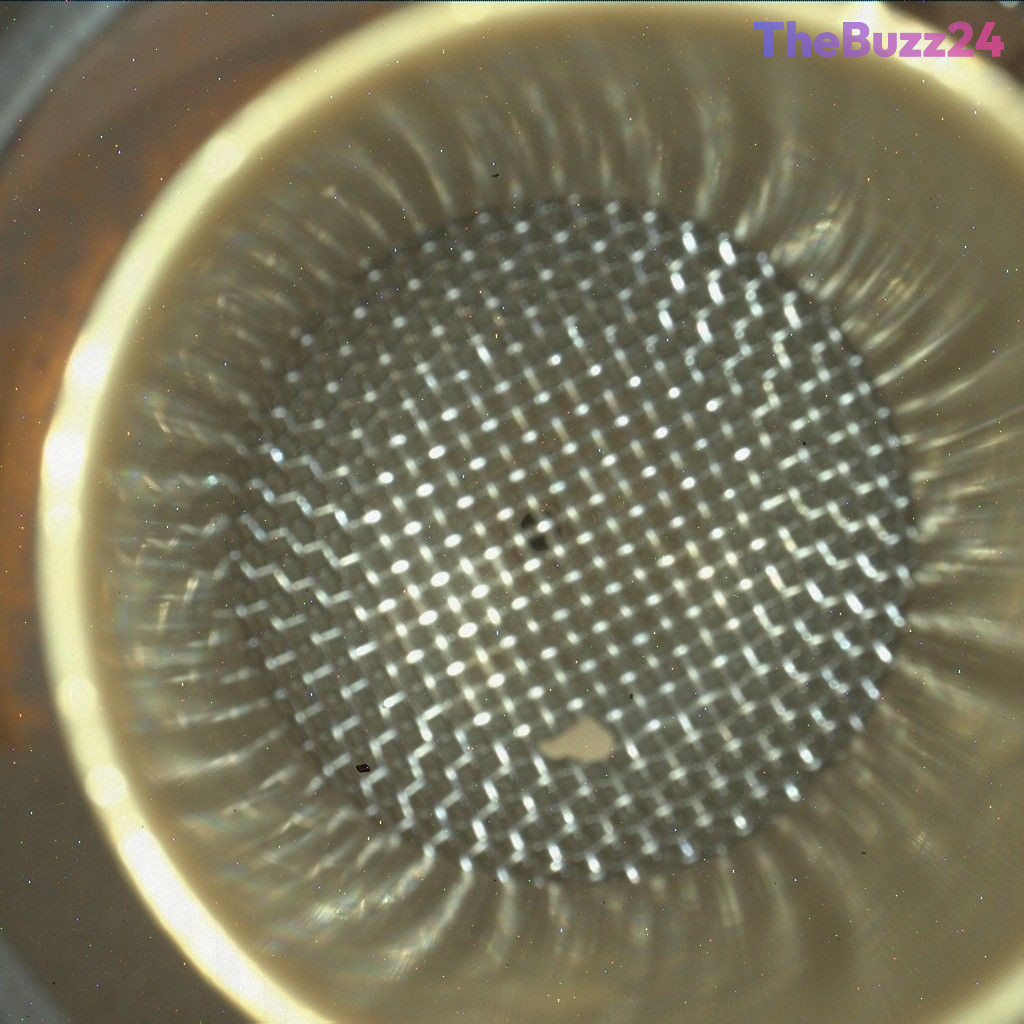
Beyond the drill hole itself, Curiosity’s ChemCam instrument executed high-precision targeting on millimeter-sized sedimentary layers located roughly three meters away, aiming to determine if subtle chemical variations exist between adjacent strata. ChemCam also captured a massive 24-frame Remote Micro-Imager (RMI) mosaic of nearby sedimentary structures, potentially setting a new record for the longest continuous RMI strip captured during the rover’s 13-year mission. Additionally, Mastcam documented the workspace and sample drop-off zones, while MAHLI monitored the instrument inlets—revealing a tiny, harmless pebble that the mission team has affectionately dubbed their “pet rock.”
With the scientific checklist at Campo Marte complete, Curiosity is set to resume its climb up Mount Sharp. The next phase of the mission will focus on exploring sedimentary formations characterized by cross-bedding, which could provide critical clues about the ancient environmental and depositional conditions of the Martian surface. Environmental sensors will continue to monitor atmospheric opacity, dust-devil activity, and local weather patterns as the rover travels.
Key Takeaways
- Curiosity successfully completed its 47th drilling operation at the 'Campo Marte' site on Mount Sharp, gathering extensive mineralogical and chemical data.
- The rover utilized its ChemCam instrument to capture a potentially record-breaking 24-frame mosaic of nearby sedimentary structures, alongside high-precision targeting of millimeter-sized rock layers.
- With operations at Campo Marte wrapped up, Curiosity is heading further uphill to investigate cross-bedded sedimentary formations.
Editor’s Analysis & Impact
The continued success of the Curiosity rover, now more than 13 years into its Martian journey, underscores the incredible durability and engineering excellence of modern deep-space robotic explorers. By successfully executing its 47th drill campaign at Campo Marte, Curiosity demonstrates that older hardware can still perform highly complex, multi-instrument science operations. The data gathered from these sedimentary layers on Mount Sharp is vital for reconstructing Mars’ paleoclimate and understanding its historical habitability. Furthermore, the operational methodologies refined during this mission—such as high-precision remote targeting and extended overnight spectrometer readings—directly inform the planning of future robotic and crewed missions to Mars. As Curiosity climbs higher, each layer of Mount Sharp acts as a geological timeline, offering humanity an unprecedented look into the transition of Mars from a wet, potentially life-supporting world to the arid desert it is today.
Frequently Asked Questions
Q: What was the primary objective of Curiosity's stop at Campo Marte?
A: The primary objective was to conduct the rover's 47th successful drilling operation, allowing its onboard instruments (like CheMin and SAM) to analyze the mineralogy and chemical composition of the rock samples to understand the area's geological history.
Q: What is the significance of the 'pet rock' mentioned by the team?
A: The 'pet rock' is a tiny pebble that became lodged near the inlet of the CheMin instrument. It does not interfere with operations, and the engineering team has safely monitored it while continuing normal scientific activities.
Q: Where is the Curiosity rover heading next?
A: Curiosity is traveling further up Mount Sharp to investigate an area characterized by sedimentary cross-bedding, which will help scientists study ancient depositional and environmental conditions on Mars.
AI Disclosure: This article is based on verified data and official reports. Our Team and AI have cross-referenced every financial detail with primary sources to ensure total accuracy.
More from this Category