The Rise of Pre-IPO Perpetual Futures: How Crypto Rails Are Predicting Market Debuts
The landscape of financial speculation is undergoing a significant shift as perpetual futures contracts on crypto-native platforms begin to offer real-time price discovery for private companies. Historically, access to pre-IPO valuations was restricted to institutional investors and private equity funds, leaving retail participants with limited insight into the true market sentiment surrounding high-profile companies. However, the emergence of synthetic derivative markets on platforms like Hyperliquid is bridging this gap, allowing for 24/7 trading on the implied value of companies long before they officially list on public exchanges.
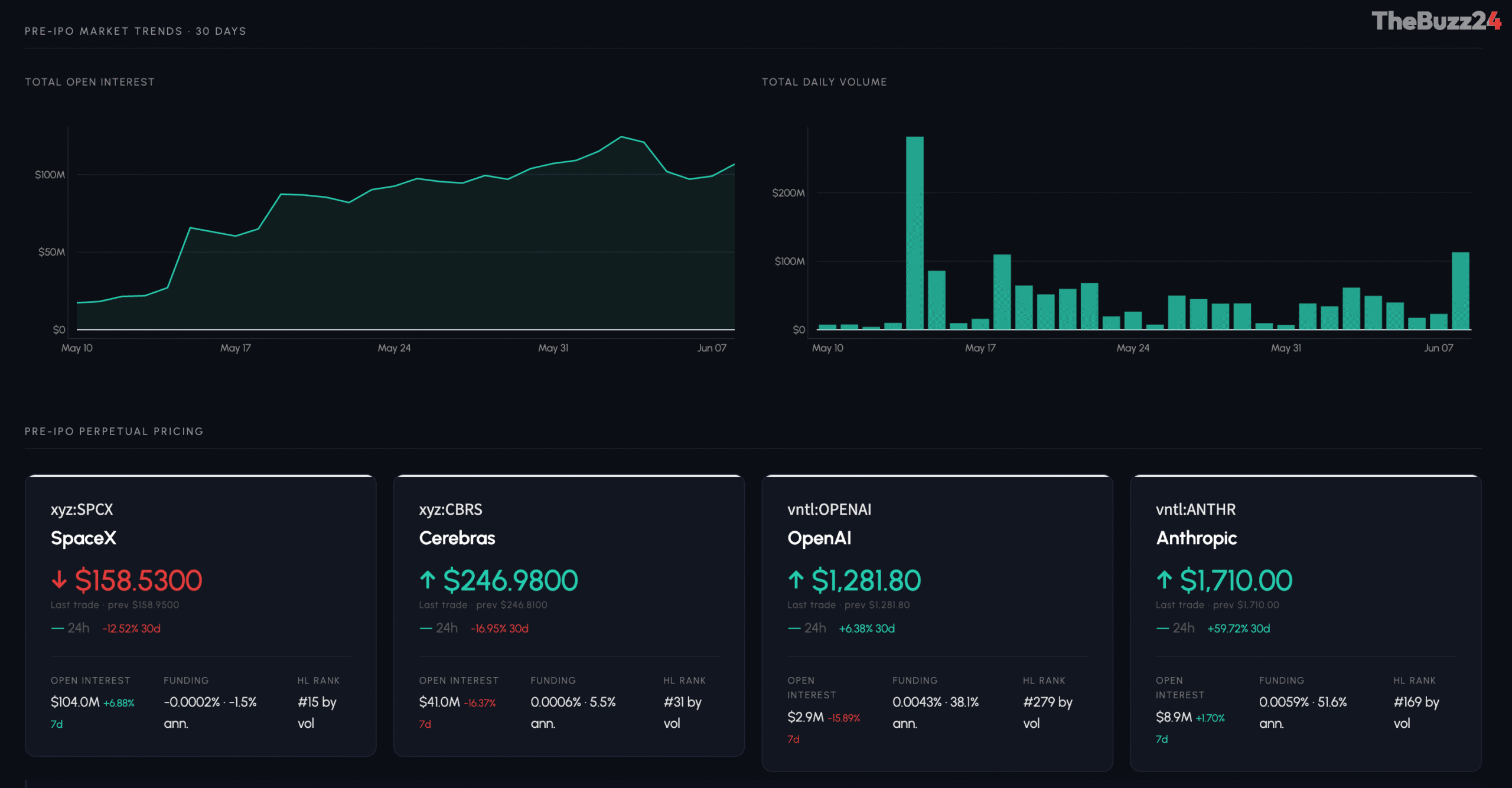
These pre-IPO perpetuals function as synthetic instruments that track the expected share price or valuation of a private entity. Unlike traditional stock ownership, these contracts do not grant voting rights or equity; instead, they rely on funding rates and market-driven order books to maintain a price tethered to the anticipated public valuation. The effectiveness of this model was recently highlighted by the debut of Cerebras Systems (CBRS). In the days leading up to its Nasdaq listing, the pre-IPO perpetual on Hyperliquid traded within a remarkably close margin of the eventual opening price, proving that these decentralized markets can serve as a credible barometer for investor demand.
As the market prepares for the highly anticipated SpaceX IPO, these synthetic instruments have seen a surge in activity. With hundreds of millions of dollars in open interest across various venues, traders are actively hedging and speculating on the company’s valuation before it hits the public market. This trend is expected to continue with other major tech firms like OpenAI and Anthropic, signaling a broader evolution in how private market assets are priced and traded in a global, digital-first economy.
While these markets offer unprecedented transparency and accessibility, they also introduce new complexities regarding execution quality and liquidity. As the infrastructure matures, the narrowing of bid-ask spreads and the increase in cumulative volume suggest that these crypto-based derivatives are becoming an essential tool for market participants looking to gauge the pulse of the private sector before the opening bell rings on traditional exchanges.
Key Takeaways
- Pre-IPO perpetual futures allow for 24/7 synthetic trading of private companies, providing a continuous signal for IPO pricing.
- The Cerebras Systems (CBRS) IPO demonstrated the accuracy of these tools, with pre-IPO perpetuals trading within 1.3% of the actual Nasdaq opening price.
- High-profile companies like SpaceX are seeing significant liquidity in pre-IPO markets, with open interest reaching hundreds of millions of dollars across multiple platforms.
Editor’s Analysis & Impact
The emergence of pre-IPO perpetual futures represents a disruptive evolution in market structure, effectively democratizing access to valuation discovery that was once the exclusive domain of venture capital and institutional desks. By leveraging crypto-native rails, these platforms bypass the traditional ‘black box’ of private equity, providing a transparent, liquid, and continuous feedback loop for companies preparing for public offerings. The broader implication is a potential shift in how IPOs are priced; if synthetic markets consistently provide accurate signals, underwriters may face increased pressure to align their initial pricing with market-driven expectations. However, this also introduces risks, as these synthetic markets are highly speculative and can be subject to extreme volatility. As more companies utilize these platforms, we expect to see a tighter integration between decentralized finance (DeFi) and traditional equity markets, potentially forcing a re-evaluation of the IPO process itself.
Frequently Asked Questions
Q: Do pre-IPO perpetual futures grant me ownership of company shares?
A: No. These are synthetic derivative contracts. They do not provide actual equity, voting rights, or ownership in the underlying company; they are purely for speculating on or hedging against the company's future valuation.
Q: How is the price of a pre-IPO perpetual determined?
A: The price is determined by market-driven order books on the trading platform. Some platforms use internal order books as the primary oracle, while others use hybrid models that incorporate off-chain data such as private funding rounds and secondary market activity.
AI Disclosure: This article is based on verified data and official reports. Our Team and AI have cross-referenced every financial detail with primary sources to ensure total accuracy.
More from this Category