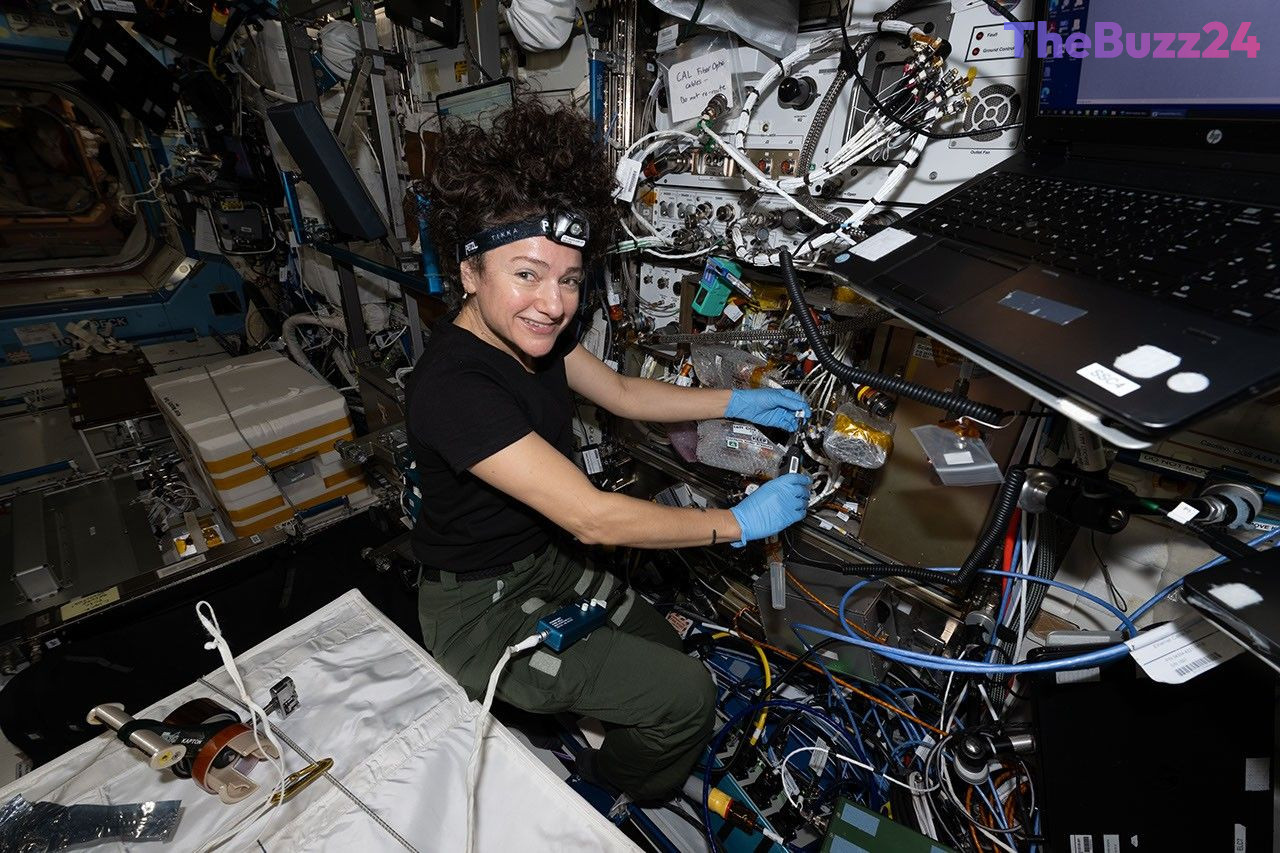
Quantum Frontiers in Orbit: Astronaut Jessica Meir Upgrades Space Station’s Cold Atom Lab
In a significant step forward for quantum research in space, astronaut Jessica Meir has successfully installed critical hardware updates to the Cold Atom Lab (CAL) aboard the International Space Station. Working in the microgravity environment of the orbital outpost, Meir meticulously inspected optical fibers and integrated new components into the facility. This upgrade ensures that the ground-controlled laboratory remains at the cutting edge of quantum physics research.
Roughly the size of a mini-refrigerator, the Cold Atom Lab is a unique facility operated remotely by scientists on Earth. It is designed to chill atoms to temperatures just a fraction of a degree above absolute zero—specifically below minus 459 degrees Fahrenheit (minus 273.15 degrees Celsius). At these extreme temperatures, atoms slow down dramatically and merge to form a Bose-Einstein condensate (BEC). This fifth state of matter allows researchers to observe quantum phenomena, such as wave-particle duality, on a macroscopic scale that is visible to the naked eye.
The Cold Atom Lab was designed, built, and is currently operated by the Jet Propulsion Laboratory in Pasadena, California, under the management of Caltech. The facility’s research is sponsored by the Biological and Physical Sciences (BPS) division of NASA’s Science Mission Directorate. By utilizing the unique environment of space, BPS aims to pioneer scientific discoveries that are impossible to replicate in Earth’s gravity. The insights gained from these extreme-condition experiments not only pave the way for long-duration space exploration but also yield technological advancements that benefit daily life on Earth.
Key Takeaways
- Astronaut Jessica Meir successfully performed hardware upgrades, including optical fiber inspections, on the ISS's Cold Atom Lab.
- The Cold Atom Lab chills atoms to near absolute zero to create Bose-Einstein condensates, allowing macroscopic observation of quantum behaviors.
- Managed by Caltech and operated by JPL, the facility leverages microgravity to conduct fundamental physics research that cannot be replicated on Earth.
Editor’s Analysis & Impact
The successful maintenance and upgrading of the Cold Atom Lab (CAL) highlight the growing importance of the International Space Station as a premier hub for quantum research. By utilizing microgravity, scientists can bypass the gravitational forces that collapse delicate quantum states on Earth, allowing for longer observation times of Bose-Einstein condensates. This research is not merely academic; the mastery of quantum mechanics in space is foundational for developing next-generation technologies, including ultra-precise quantum sensors, advanced atomic clocks, and quantum navigation systems that do not rely on GPS. As space agencies look toward deep-space missions to the Moon and Mars, the hardware reliability and scientific output of facilities like CAL will be critical. This upgrade demonstrates a seamless synergy between human astronauts performing delicate physical maintenance and Earth-bound scientists conducting complex, remote-controlled physics experiments.
Frequently Asked Questions
Q: What is the Cold Atom Lab (CAL)?
A: The Cold Atom Lab is a refrigerator-sized facility on the International Space Station that chills atoms to near absolute zero, enabling scientists to study quantum phenomena in microgravity.
Q: What is a Bose-Einstein condensate (BEC)?
A: Often referred to as the fifth state of matter, a Bose-Einstein condensate is formed when atoms are cooled to temperatures close to absolute zero, causing them to clump together and behave as a single quantum object.
Q: Why is quantum research conducted in space?
A: In the microgravity environment of space, scientists can observe quantum states for longer periods without the disruptive pull of Earth's gravity, which would otherwise cause the atoms to fall and interact prematurely with their container.
AI Disclosure: This article is based on verified data and official reports. Our Team and AI have cross-referenced every financial detail with primary sources to ensure total accuracy.
More from this Category