Hubble Captures Cosmic Collision: Merging Galaxy Clusters Revealed
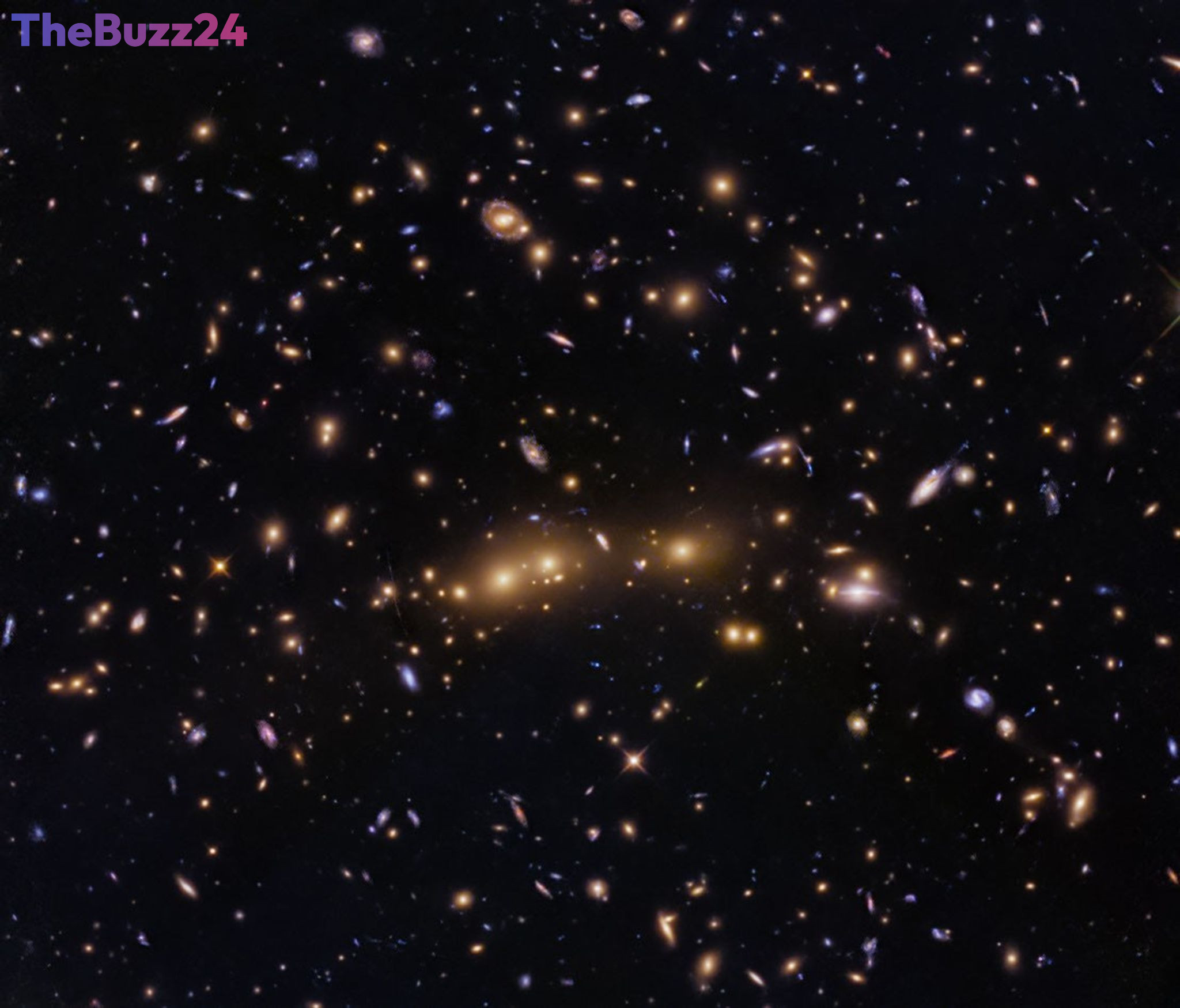
The Hubble Space Telescope has provided a stunning glimpse into a colossal cosmic event: the merger of two massive galaxy clusters. The image showcases CL0016+1609, also known as MACS J0018.5+1626, a celestial structure renowned for its intense X-ray emissions and extensive study across various wavelengths. Previous X-ray observations confirmed that this bright entity is, in fact, two distinct galaxy clusters in the process of merging along our line of sight.
Astronomers utilized Hubble’s Advanced Camera for Surveys to meticulously map the cluster’s dark matter distribution. While dark matter itself remains invisible to direct observation, its immense gravitational influence can be detected through gravitational lensing. Hubble’s ability to observe the distortion of light from background objects allows scientists to infer the presence and distribution of this elusive substance, providing crucial insights into the dynamics of the merger and the cluster’s role within the universe’s larger cosmic web.
This particular observation is part of the Reionization Lensing Cluster Survey (RELICS), a comprehensive program that captured the first infrared images of 46 massive galaxy clusters. The RELICS survey aims to identify distant galaxies that are magnified and distorted by the gravitational pull of these foreground clusters. The Hubble image reveals faint arcs, which are the stretched images of these ancient, gravitationally lensed galaxies, offering a rare look at the universe’s distant past.
Key Takeaways
- Hubble Space Telescope images a merging galaxy cluster, CL0016+1609 (MACS J0018.5+1626).
- The merger was identified through X-ray observations, and Hubble is used to study its dark matter distribution via gravitational lensing.
- The image is part of the RELICS survey, which uses massive clusters to find and study distant, lensed galaxies.
Editor’s Analysis & Impact
This Hubble observation underscores the telescope’s enduring value in unraveling complex cosmic phenomena. By studying merging galaxy clusters, scientists gain critical data on dark matter’s behavior and its role in cosmic structure formation. The RELICS survey, leveraging these massive gravitational lenses, opens a window to the early universe, allowing for the discovery and analysis of extremely distant galaxies that would otherwise be undetectable. This research not only advances our understanding of astrophysics but also highlights the synergy between different observational methods and the ongoing contributions of space-based observatories to fundamental science.
Frequently Asked Questions
Q: What is gravitational lensing?
A: Gravitational lensing is a phenomenon where the gravity of a massive object, such as a galaxy cluster, bends the path of light from objects behind it. This bending can distort, magnify, or even create multiple images of the background object, allowing astronomers to study distant objects and the distribution of mass, including dark matter.
Q: What is dark matter?
A: Dark matter is a hypothetical form of matter that is thought to account for approximately 85% of the matter in the universe. It does not emit, absorb, or reflect light, making it invisible to telescopes. Its existence is inferred from its gravitational effects on visible matter, radiation, and the large-scale structure of the universe.
Q: What is the RELICS survey?
A: RELICS stands for Reionization Lensing Cluster Survey. It is an observing program that uses Hubble to image 46 massive galaxy clusters. The goal is to use these clusters as natural lenses to find and study very distant galaxies that existed during the epoch of reionization, a crucial period in the early universe.
AI Disclosure: This article is based on verified data and official reports. Our Team and AI have cross-referenced every financial detail with primary sources to ensure total accuracy.
More from this Category