NASA’s Lucy Mission Uncovers Secrets of Wobbly, Peanut-Shaped Asteroid
The Lucy spacecraft has provided a groundbreaking look at the asteroid Donaldjohanson, revealing a complex, peanut-shaped body that exhibits a unique, wobbly rotation. During a high-speed flyby in April 2025, the probe captured detailed imagery and data from just 650 miles away, showing that the asteroid does not spin on a single axis like most celestial bodies. Instead, it performs a dual-axis rotation, tumbling end-over-end every 10.5 days while simultaneously wobbling along its long axis every 26.5 days.
Researchers believe the asteroid’s distinct bilobate, or peanut-like, structure is the result of two fragments merging due to mutual gravity following a violent collision approximately 155 million years ago. The data suggests that the asteroid has been gradually slowing its rotation over the last several million years, a phenomenon attributed to the YORP effect, where solar radiation exerts a subtle torque on the object’s non-symmetric surface. This process has caused loose surface material to shift, smoothing out craters and altering the asteroid’s topography over time.
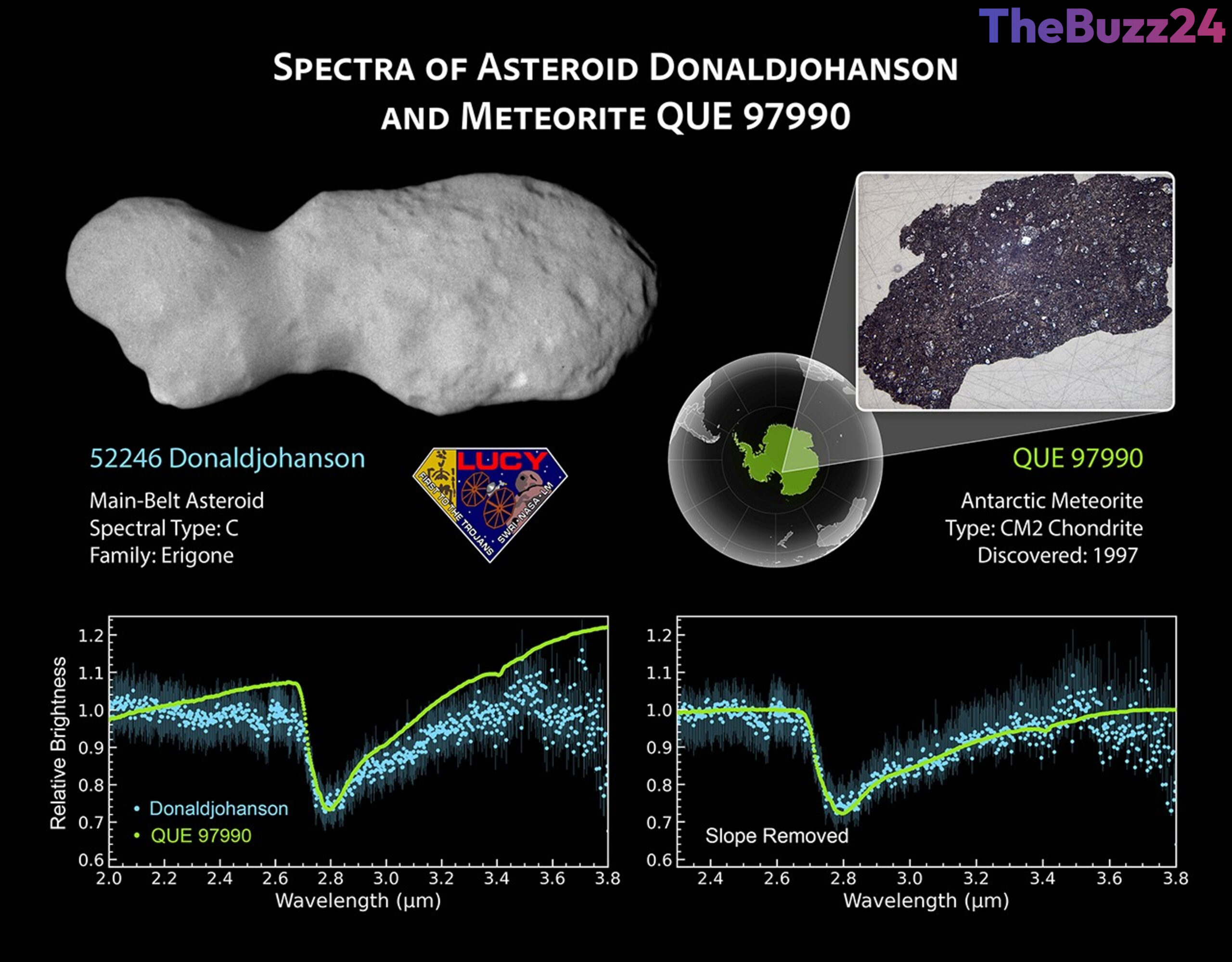
Beyond its physical shape, the mission detected signatures of iron-rich clay minerals on the surface, indicating that the asteroid was exposed to liquid water in its distant past. However, the brevity of this exposure distinguishes it from other well-studied asteroids like Bennu and Ryugu, which show evidence of prolonged water interaction. By comparing these findings, scientists are gaining critical insights into the diverse histories of objects within the main asteroid belt and the early formation of our solar system.
This flyby served as a successful dress rehearsal for the Lucy mission, which is currently en route to explore the Jupiter Trojan asteroids. These upcoming encounters are expected to provide further context on how planetary bodies formed and migrated during the infancy of the solar system, potentially challenging existing models of cosmic evolution.
Key Takeaways
- The asteroid Donaldjohanson exhibits a complex, two-axis 'wobbling' rotation rather than a simple spin.
- The asteroid's peanut-like shape is likely the result of two fragments merging after a collision 155 million years ago.
- Detection of iron-rich clays suggests the asteroid experienced a brief period of liquid water exposure in its history.
Editor’s Analysis & Impact
The findings from the Lucy mission represent a significant leap in our understanding of small-body dynamics within the solar system. By identifying the YORP effect as a primary driver of rotational changes in Donaldjohanson, researchers have confirmed a key mechanism that dictates the long-term evolution of asteroid shapes and spins. The comparative analysis between Donaldjohanson, Bennu, and Ryugu highlights that even asteroids with similar compositions can have vastly different geological histories, suggesting a more chaotic and varied formation environment in the early solar system than previously assumed. As the Lucy mission progresses toward the Trojan asteroids, the data gathered here will serve as a vital baseline, likely forcing a refinement of current planetary migration theories and providing a clearer picture of the building blocks that formed our neighborhood.
Frequently Asked Questions
Q: Why is the asteroid Donaldjohanson shaped like a peanut?
A: The asteroid is 'bilobate,' meaning it consists of two distinct lobes. Scientists believe these were originally separate fragments from a collision that were pulled together by their mutual gravity.
Q: What is the YORP effect mentioned in the study?
A: The YORP effect is a phenomenon where solar radiation hitting an irregularly shaped asteroid causes it to radiate heat unevenly. This creates a tiny recoil force that acts as a torque, causing the asteroid to either speed up or slow down its rotation over millions of years.
AI Disclosure: This article is based on verified data and official reports. Our Team and AI have cross-referenced every financial detail with primary sources to ensure total accuracy.
More from this Category