Crypto Markets Face Q2 Deleveraging as Capital Rotates to AI and ETF Outflows Accelerate
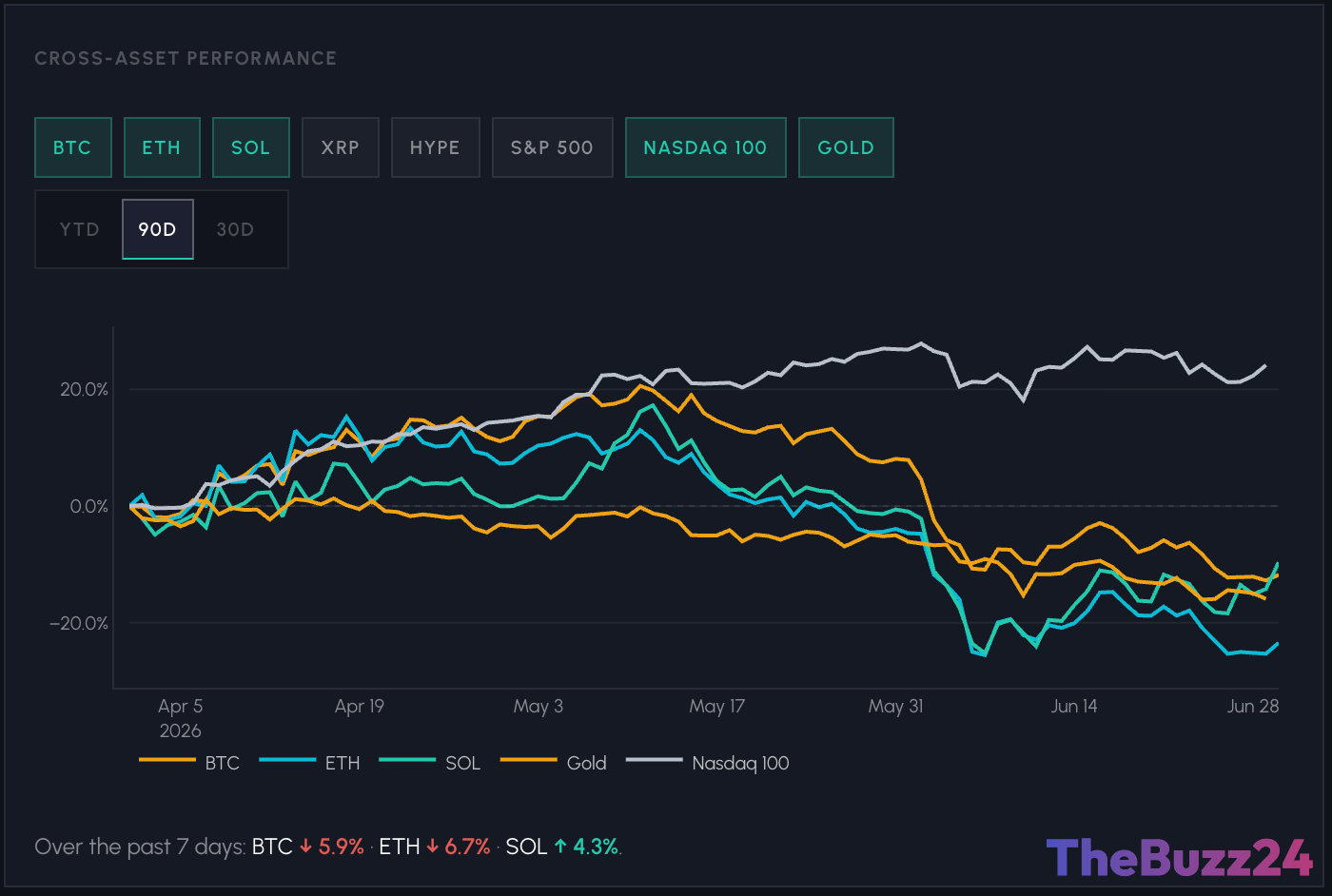
The digital asset market experienced a significant correction during the second quarter of 2026, erasing earlier gains as macroeconomic pressures and shifting investor sentiment took hold. After a promising start in April that saw Bitcoin rally toward the $82,000 mark, a combination of rising crude oil prices, a hawkish shift in Federal Reserve monetary policy expectations, and a massive rotation of capital into artificial intelligence (AI) equities triggered a broad market reversal. By the end of the quarter, Bitcoin had declined by approximately 11%, trading near $60,000—roughly 52% below its late-2025 all-time high of $126,000. Ethereum and Solana followed a similar downward trajectory, dropping 20% and 13% respectively, while traditional stock indices like the S&P 500 and Nasdaq 100 posted strong double-digit gains.
A major catalyst for the Q2 downturn was the simultaneous weakening of key liquidity channels, most notably spot exchange-traded funds (ETFs), corporate digital asset treasuries, and stablecoin supplies. Spot Bitcoin ETFs recorded a staggering $4.08 billion in net outflows over the three-month period, driven heavily by a brutal June. Meanwhile, corporate treasury activity slowed, highlighted by Strategy (STRC) experiencing a compression in its net asset value and executing a surprising 32 BTC sale that shook long-term holder sentiment. Additionally, the total stablecoin market capitalization contracted by $4.2 billion, led by a $3.4 billion decline in USDC and a $1.4 billion drop in Ethena’s USDe, reducing the available liquidity required to sustain on-chain activity.
Despite the spot market slowdown, derivatives activity remained highly active, leading to a massive deleveraging event. Combined long liquidations for Bitcoin and Ethereum reached $8.35 billion during the quarter, with more than half of these liquidations concentrated in a volatile two-week window between late May and early June. This flush-out of overleveraged positions caused open interest to drop significantly—by 32% for Bitcoin and 40% for Ethereum—leaving the market with thinner order books but a more stable foundation heading into the third quarter. Amidst this shift, decentralized perpetual exchange Hyperliquid emerged as a standout performer, capturing a 4.5% market share of futures volume and seeing its native token, HYPE, surge by 142% year-to-date.
Looking beyond immediate price action, several structural trends continued to mature throughout the quarter, signaling deeper integration between traditional finance and decentralized networks. Coinbase made waves by announcing 1:1 backed tokenized equities with full legal rights, while pre-IPO price discovery for private giants like SpaceX occurred on-chain. Furthermore, institutional interest in curated lending vaults, managed by protocols like Morpho and Aave and curated by traditional asset managers like Bitwise, demonstrated that the underlying infrastructure of decentralized finance (DeFi) is rapidly institutionalizing despite short-term market headwinds.
Key Takeaways
- Bitcoin fell 11% in Q2 2026, ending near $60,000, as capital rotated heavily into AI equities and traditional stock markets.
- Spot Bitcoin ETFs experienced $4.08 billion in net outflows, while the overall stablecoin supply shrank by $4.2 billion, severely reducing market liquidity.
- A massive $8.35 billion deleveraging event in BTC and ETH futures flushed out overleveraged long positions, leaving the market thinner but structurally healthier for Q3.
Editor’s Analysis & Impact
The second quarter of 2026 highlighted a critical maturation phase for the digital asset industry, characterized by a transition from speculative retail leverage to institutional structural integration. The rotation of capital from crypto to AI equities underscores that digital assets are no longer operating in a vacuum; they must actively compete with high-performing tech sectors for institutional liquidity. While the $4.08 billion outflow from spot ETFs and the contraction of stablecoin supplies present short-term headwinds, the $8.35 billion deleveraging event has effectively cleansed the market of excessive speculative froth. Looking forward, the rapid development of tokenized real-world assets (RWAs)—such as Coinbase’s tokenized stocks and pre-IPO pricing for SpaceX—suggests that the long-term value proposition of blockchain technology is shifting toward utility and financial infrastructure, which will likely drive the next cycle of sustainable growth.
Frequently Asked Questions
Q: Why did Bitcoin and other major cryptocurrencies decline in Q2 2026?
A: The decline was primarily driven by a hawkish shift in Federal Reserve interest rate expectations, rising oil prices, significant outflows from spot ETFs, and a major rotation of investor capital into high-performing artificial intelligence (AI) equities.
Q: What is deleveraging, and how did it affect the market in Q2?
A: Deleveraging occurs when overleveraged trading positions (specifically long positions) are forced to close or liquidate during a price drop. In Q2, $8.35 billion in long liquidations occurred, which temporarily accelerated price declines but ultimately left the market with less speculative risk heading into Q3.
Q: What major institutional trends emerged during the quarter?
A: Key trends included the expansion of tokenized real-world assets (RWAs), such as Coinbase introducing tokenized stocks with legal rights, pre-IPO price discovery for companies like SpaceX on-chain, and the growth of institutional lending vaults curated by asset managers like Bitwise.
AI Disclosure: This article is based on verified data and official reports. Our Team and AI have cross-referenced every financial detail with primary sources to ensure total accuracy.
More from this Category