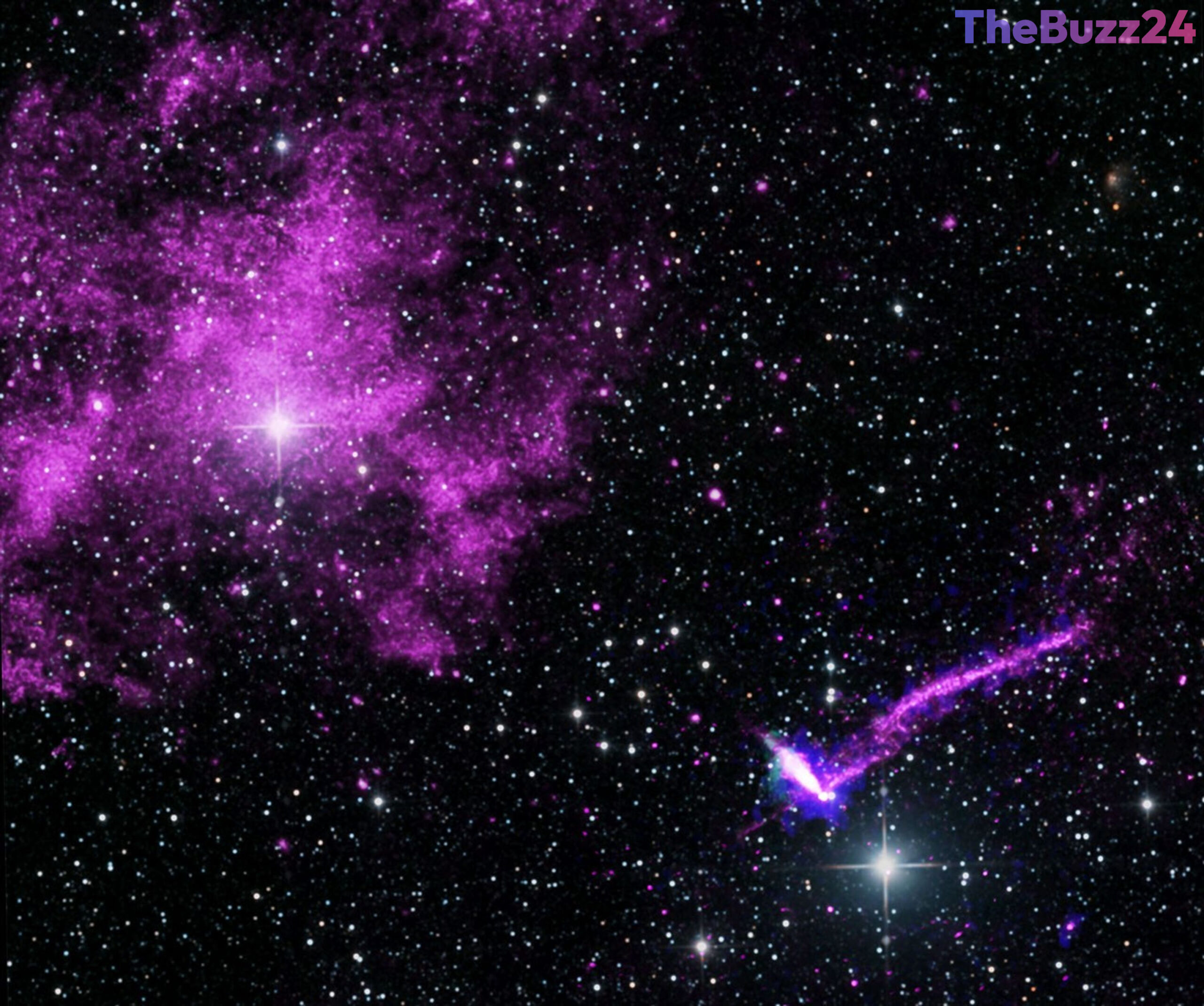
Cosmic Lighthouse Unlocked: Advanced Space Telescope Maps Magnetic Fields of Extreme Pulsar
Astronomers have successfully mapped the magnetic fields of PSR J1101−6101, a rapidly spinning pulsar located within the “Lighthouse Nebula.” Utilizing the Imaging X-ray Polarimetry Explorer (IXPE), researchers directly measured the polarization of X-rays emitted by this extreme stellar remnant. The findings, published in the Astrophysical Journal, confirm long-standing theories about how high-energy particles escape the pulsar’s environment and travel along galactic magnetic field lines.
PSR J1101−6101 is a neutron star—the ultra-dense collapsed core of a massive star—spinning at an astonishing 16 times per second. As it hurtles through space, it creates a bow shock, similar to the wave in front of a speeding boat. While most particles are trapped in a turbulent trail behind the pulsar, scientists have long suspected that the highest-energy particles escape this barrier, forming a long, thin “filament” that stretches into interstellar space.
To test this theory, a research team led by Stanford University analyzed the polarization of light from the nebula. By developing advanced data analysis techniques to overcome the faintness of the target, they confirmed with over 99% confidence that the magnetic field aligns perfectly with the flow of escaping particles. However, the high degree of polarization measured suggests far less magnetic turbulence than current theoretical models predict, challenging existing assumptions.
The study also revealed a striking discrepancy between X-ray and radio observations. While X-ray data showed a magnetic field parallel to the pulsar’s trail, radio observations indicated a field pointing almost completely perpendicular. This divergence suggests a highly structured environment where particles of different energy levels occupy distinct regions, pointing to multiple, complex acceleration mechanisms at play in these extreme cosmic laboratories.
Key Takeaways
- Scientists have successfully mapped the magnetic fields of the Lighthouse Nebula's pulsar (PSR J1101−6101) using advanced X-ray polarimetry.
- The measurements confirm that high-energy particles escape the pulsar's bow shock and flow along the galaxy's magnetic field lines, forming a long filament.
- A surprising divergence between X-ray and radio data suggests that particles of different energies occupy distinct regions, indicating multiple acceleration mechanisms.
Editor’s Analysis & Impact
This breakthrough represents a major leap forward in high-energy astrophysics, demonstrating the power of X-ray polarimetry to probe the universe’s most extreme environments. By confirming that particles escape pulsar bow shocks along magnetic field lines, researchers have validated a key model of cosmic ray propagation. However, the discovery of lower-than-expected turbulence and the stark divergence between X-ray and radio magnetic field orientations will force theorists to revise existing models of pulsar wind nebulae. This research highlights how advanced data analysis techniques can extract high-value science from faint cosmic sources, paving the way for future deep-space observational missions. Ultimately, understanding these natural particle accelerators helps scientists decode the fundamental laws of physics under conditions that can never be replicated on Earth.
Frequently Asked Questions
Q: What is a pulsar?
A: A pulsar is a highly magnetized, rapidly spinning neutron star formed from the collapsed core of a massive star at the end of its life cycle. They emit beams of electromagnetic radiation, appearing to pulse as they rotate.
Q: What is the Lighthouse Nebula?
A: The Lighthouse Nebula is a cosmic structure containing the pulsar PSR J1101−6101. It is famous for its long, thin filament of high-energy particles that escape the pulsar's immediate environment.
Q: Why is the divergence between X-ray and radio observations significant?
A: The perpendicular alignment between the X-ray and radio magnetic fields suggests that particles of different energy levels are segregated into distinct regions of the nebula, implying that multiple different acceleration mechanisms are at work.
AI Disclosure: This article is based on verified data and official reports. Our Team and AI have cross-referenced every financial detail with primary sources to ensure total accuracy.
More from this Category