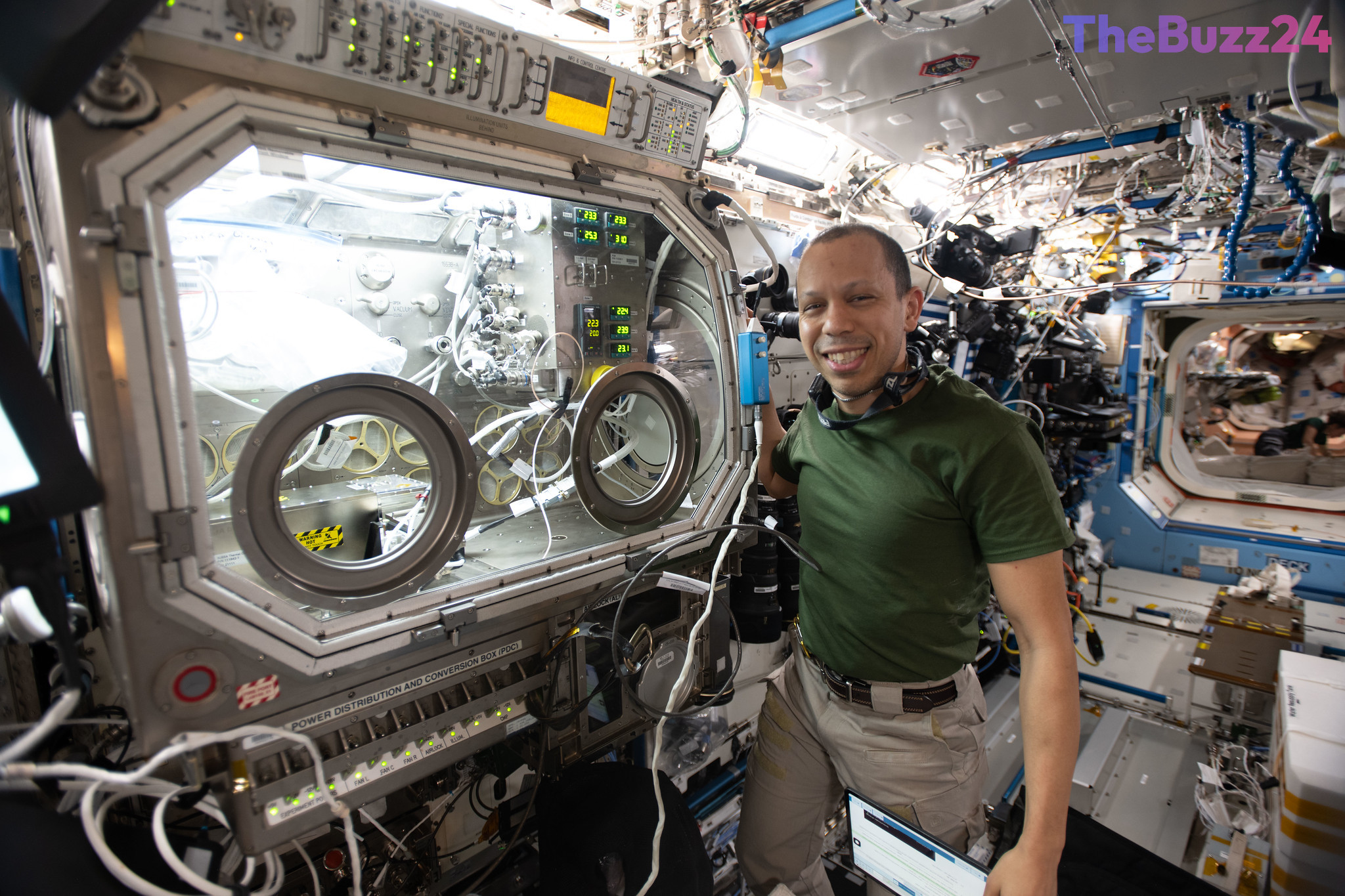
NASA Astronaut Chris Williams Set to Share Insights from 241-Day Space Station Journey
Following a successful return from a prolonged mission in low-Earth orbit, NASA astronaut and Expedition 74 flight engineer Chris Williams is preparing to share the comprehensive details of his historic voyage. Williams recently concluded a remarkable 241-day stay aboard the International Space Station, logging thousands of orbits and contributing to numerous technological and biological breakthroughs.
During his time orbiting the planet, Williams was heavily involved in cutting-edge research, including advancing semiconductor crystal growth to bolster the commercial space economy and improve terrestrial manufacturing. His workload also extended into the biomedical sector, where he assisted with studies aimed at developing novel cancer treatments. In addition to laboratory science, Williams undertook critical maintenance duties outside the orbital outpost, conducting two spacewalks to perform crucial upgrades on power systems and service the robotic arm.
The upcoming press conference at the agency’s Johnson Space Center in Houston will offer the public and journalists a direct look into the realities of long-duration spaceflight. Williams, alongside his fellow crew members, traveled over 100 million miles during their mission, witnessing the arrival and departure of multiple visiting spacecraft before safely splashing down.
As space agencies worldwide look toward establishing sustainable lunar outposts and eventually crewed missions to Mars, the data and operational experience gathered during missions like Williams’s remain invaluable. The upcoming briefing will highlight how these orbital laboratories continue to drive innovation that benefits both future deep-space exploration and daily life on Earth.
Key Takeaways
- NASA astronaut Chris Williams spent 241 days aboard the International Space Station as part of Expeditions 73 and 74.
- His mission included supporting advanced semiconductor research, cancer treatment studies, and performing two complex spacewalks.
- Williams and his crewmates logged 3,856 orbits and traveled over 102 million miles before returning to Earth on July 26.
Editor’s Analysis & Impact
The successful conclusion of long-duration missions like the one completed by Chris Williams underscores the growing maturity of low-Earth orbit commercialization and scientific research. As the International Space Station continues to serve as a microgravity testbed, the data gathered from semiconductor manufacturing and biological studies directly fuels the burgeoning space economy. Furthermore, the operational expertise gained from maintaining aging orbital infrastructure is critical for space agencies planning deep-space exploration. Looking forward, the transition from government-led orbital platforms to commercial space stations will rely heavily on the foundational research currently being conducted by astronauts on these extended missions.
Frequently Asked Questions
Q: How long was Chris Williams in space?
A: Chris Williams spent 241 days aboard the International Space Station as an Expedition 73/74 flight engineer.
Q: What were some of the key scientific tasks Williams performed in space?
A: Williams supported semiconductor crystal research for commercial applications, helped advance studies for new cancer treatments, and conducted two spacewalks for power system upgrades and hardware maintenance.
Q: When did Williams return to Earth?
A: Williams safely returned to Earth on July 26, alongside fellow crew members after completing thousands of orbits around the planet.
AI Disclosure: This article is based on verified data and official reports. Our Team and AI have cross-referenced every financial detail with primary sources to ensure total accuracy.
More from this Category