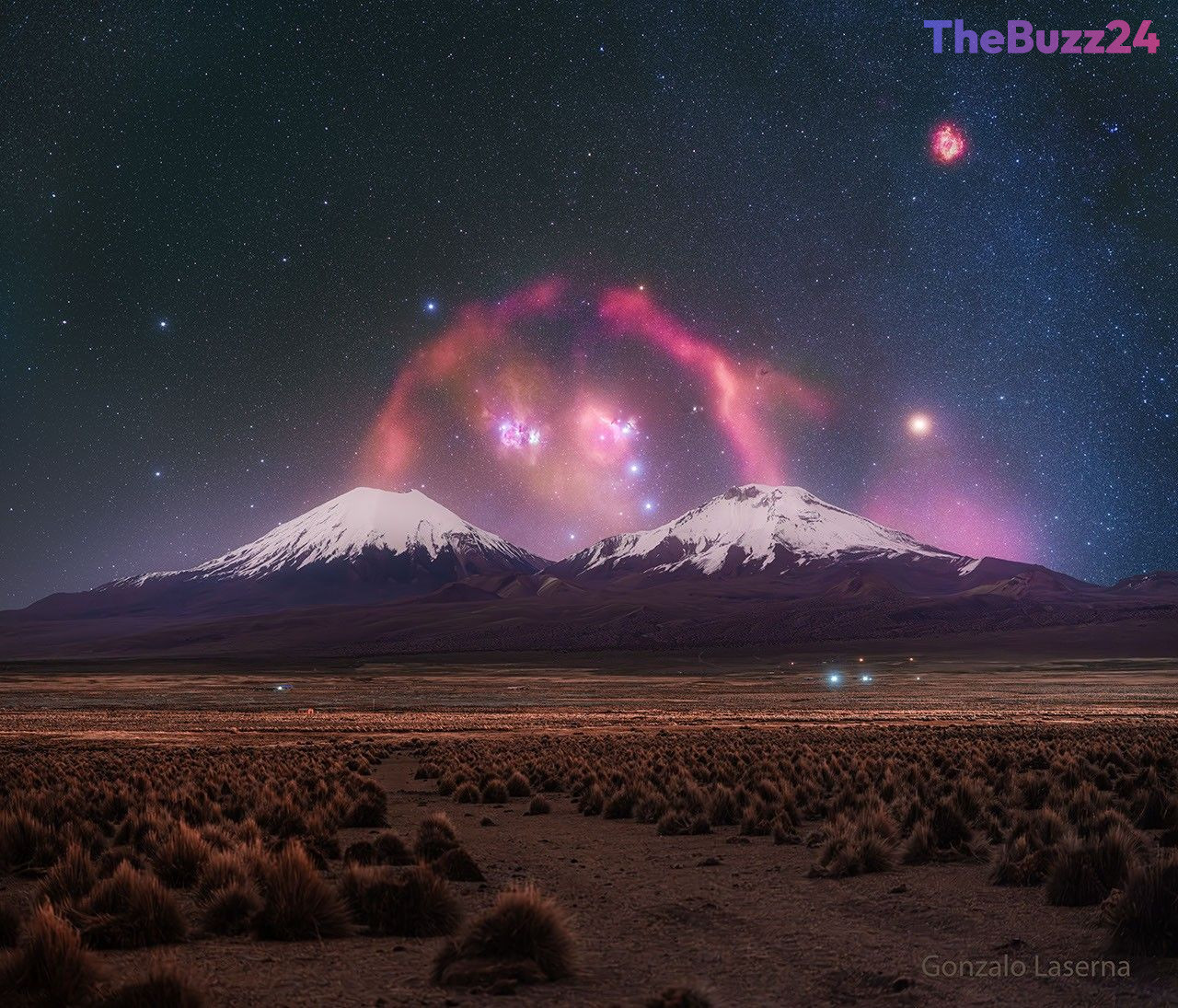
Cosmic Arch Over Twin Peaks: Stunning Astrophotography Captures Barnard’s Loop Above Bolivian Volcanoes
In a remarkable display of meticulous planning and celestial alignment, a newly published photograph captures the expansive cosmic emission nebula known as Barnard’s Loop forming a breathtaking visual bridge between two dormant Andean volcanoes. Captured from a high-altitude viewpoint in Bolivia, the composite image juxtaposes the majestic Earthly topography of the Parinacota and Pomerape peaks against deep-space structures located light-years away in the constellation Orion.
Geologically, the twin mountains—Parinacota on the left and Pomerape on the right—share a rich cultural narrative in local mythology, where lore likens them to a prince and princess bound in a tragic forbidden romance. Despite their physical proximity on the landscape, scientists confirm the peaks do not share a subterranean magma chamber, and both have remained quiet without an eruption for more than a millennium. Visually bridging them required meticulous astronomical calculations and specific alignment from the photographer’s vantage point on Earth.
Captured in mid-April through a carefully timed series of exposures from a static location on the same night, the image reveals far more than just the glowing red arc of Barnard’s Loop. Nestled between the volcanic summits is the iconic Orion Nebula, while the bright supergiant star Betelgeuse shines prominently to the right. Higher up in the night sky, the distinct stellar nursery known as the Rosette Nebula completes the rich astrophotographic scene, illustrating the magnificent intersection of human folklore, earth science, and deep-space exploration.
Key Takeaways
- A carefully planned photograph aligns the cosmic emission nebula Barnard's Loop across the peaks of Bolivia's twin volcanoes, Parinacota and Pomerape.
- The deep-sky scene also reveals prominent astronomical targets including the Orion Nebula, the red supergiant Betelgeuse, and the Rosette Nebula.
- While local mythology connects the twin dormant mountains as tragic lovers, geological surveys confirm they share no magma connection and have been inactive for over 1,000 years.
Editor’s Analysis & Impact
This striking alignment highlights the evolving art of modern astrophotography, where precision astronomical forecasting meets deep-landscape fine art. By visually weaving dramatic terrestrial geography with wide-field night-sky phenomena like Barnard’s Loop, such images effectively bridge the gap between abstract astrophysics and intuitive public engagement. The technical feat of executing long, aligned exposures from a fixed ground position to reveal faint cosmic gas clouds demonstrates the growing capabilities of field night-sky imaging. Beyond its visual impact, pairing indigenous folklore with volcanic history and deep-space structures delivers a compelling multi-layered narrative, illustrating humanity’s enduring fascination with both our planet’s landscape and the broader expanse of the universe.
Frequently Asked Questions
Q: What is Barnard's Loop?
A: Barnard's Loop is a massive arc of glowing gas and emission nebula located in the constellation Orion, named after astronomer E. E. Barnard.
Q: Are the volcanoes Parinacota and Pomerape active?
A: No, both volcanoes are considered dormant and have not experienced an eruption in more than 1,000 years.
Q: How was this image captured?
A: The image was created using a sequence of planned exposures taken on the same date and from the exact same location in Bolivia in mid-April to align the nebula directly over the mountain peaks.
AI Disclosure: This article is based on verified data and official reports. Our Team and AI have cross-referenced every financial detail with primary sources to ensure total accuracy.
More from this Category