Mars’ Dazzling Auroras Explained: A Cosmic Connection to Earth’s Skies
Scientists studying Mars have uncovered fascinating similarities between the auroras that grace the Red Planet’s skies and those seen on Earth. New findings from NASA’s MAVEN mission reveal that specific types of Martian auroras are generated through processes akin to those that create Earth’s own spectacular light shows.
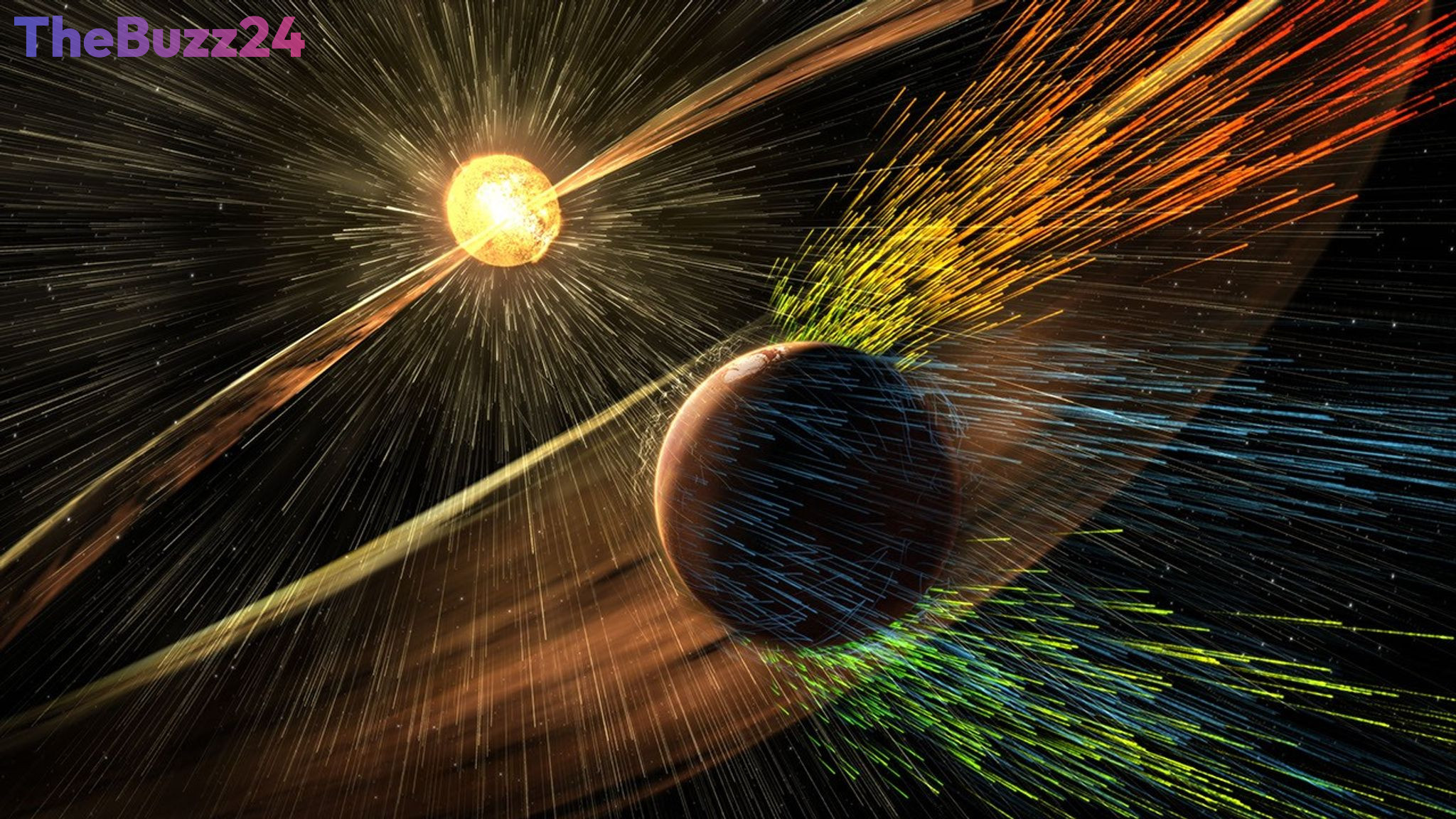
These Martian auroras are primarily driven by interactions between the solar wind and the planet’s upper atmosphere. When charged particles from the sun, propelled by solar storms, strike Mars’ atmosphere, they can strip away atmospheric gases. This process, a key mechanism in understanding Mars’ atmospheric evolution and loss over time, results in the emission of light, forming auroras.
While Earth’s auroras are often visible globally and are strongly influenced by the planet’s magnetic field, Mars lacks a global magnetic field. This fundamental difference means Martian auroras exhibit distinct characteristics. However, the underlying principle of charged particles exciting atmospheric gases to produce light remains a shared phenomenon between the two worlds, offering valuable insights into planetary atmospheric dynamics across the solar system.
Key Takeaways
- Martian auroras share formation processes with Earth's auroras, according to NASA's MAVEN mission.
- Charged particles from solar storms interacting with Mars' atmosphere are a primary cause of these auroras.
- The findings contribute to understanding Mars' atmospheric loss and evolution.
- Unlike Earth, Mars lacks a global magnetic field, leading to distinct characteristics in its auroral displays.
Editor’s Analysis & Impact
The discovery of similar aurora formation mechanisms on Mars and Earth underscores a fundamental principle of atmospheric physics that transcends planetary boundaries. For Mars, understanding these processes is crucial for piecing together its atmospheric history and the potential for past habitability. The MAVEN mission’s insights not only illuminate the current state of the Martian atmosphere but also provide a comparative framework for studying exoplanet atmospheres. This research deepens our appreciation for the dynamic interplay between stars and planets, suggesting that the visual spectacle of auroras might be a more common cosmic occurrence than previously thought, albeit with planetary-specific variations.
Frequently Asked Questions
Q: What is the MAVEN mission?
A: MAVEN (Mars Atmosphere and Volatile Evolution) is a NASA mission designed to study the Martian atmosphere, understand how it has been losing gases over time, and assess its past climate and potential for habitability.
Q: Why are auroras important for understanding Mars?
A: Auroras on Mars are direct indicators of how the solar wind interacts with the planet's atmosphere. Studying them helps scientists understand atmospheric escape, which is critical for comprehending Mars' climate history and why it differs so drastically from Earth's.
Q: How do Martian auroras differ from Earth's?
A: While the basic process of charged particles exciting atmospheric gases is similar, Earth's global magnetic field channels auroras towards the poles, creating widespread displays. Mars lacks a global magnetic field, so its auroras are more localized and can occur at different latitudes, often tied to crustal magnetic fields.
AI Disclosure: This article is based on verified data and official reports. Our Team and AI have cross-referenced every financial detail with primary sources to ensure total accuracy.
More from this Category