Unlocking the Cosmic Mystery: How Distant ‘Little Red Dots’ Reveal the Evolution of Supermassive Black Holes
Astronomers have taken a significant step forward in unraveling the mysteries of the early universe by tracing the evolutionary pathway of enigmatic astronomical phenomena known as “little red dots.” First uncovered by advanced space-based observatories, these extremely distant and compact red sources have baffled the scientific community since their initial detection, prompting intense debate over their true nature and where they fit into the cosmic timeline.
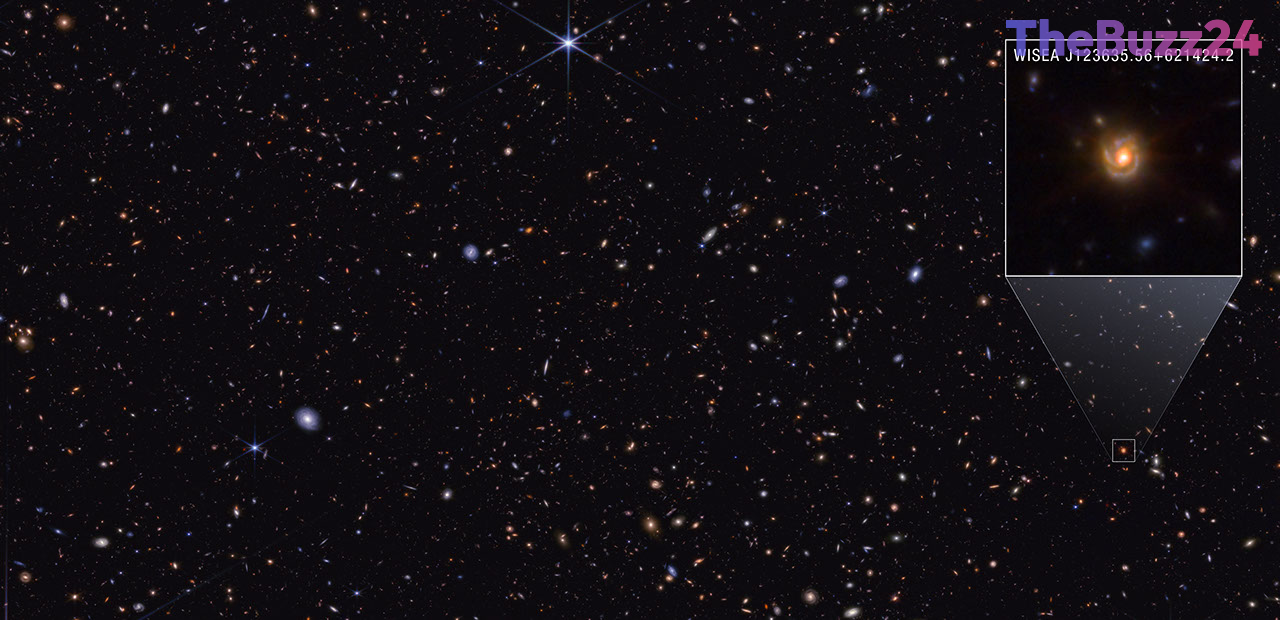
Researchers focusing on a unique lower-redshift spiral galaxy nicknamed the “Saguaro” have shed new light on the subject. Located approximately 3.3 billion years after the big bang, the Saguaro features a ruby-red core remarkably similar to the distant little red dots seen in the early universe. By combining archival ultraviolet data from the Hubble Space Telescope with high-resolution infrared imaging and spectroscopy from the James Webb Space Telescope, scientists were able to closely examine the relationship between the galaxy’s sprawling structure and its intensely active, dust-obscured central nucleus.
The investigation revealed that the Saguaro’s core shares the exact spectral characteristics of high-redshift little red dots, showing enhanced brightness in ultraviolet and infrared wavelengths compared to visible light. Furthermore, weak X-ray emissions detected by the Chandra X-ray Observatory confirmed the presence of a heavily obscured active galactic nucleus. When researchers synthetically shifted the Saguaro to simulate how it would appear in the distant early universe, the surrounding spiral structure completely faded from view, leaving behind only the deceptive appearance of a standalone red dot.
This simulation strongly supports the hypothesis that little red dots are not an entirely distinct population of galaxies, but rather a temporary, highly active evolutionary phase of supermassive black holes. Because current technology struggles to detect the faint surrounding environments of high-redshift objects, astronomers suffer from a distinct observational bias. Experts plan to comb through existing archival data to identify more “Saguaro-like” galaxies, ultimately building a comprehensive census to map out the complete family tree of these fascinating cosmic structures.
Key Takeaways
- Researchers studying a lower-redshift spiral galaxy nicknamed the "Saguaro" have linked early-universe "little red dots" to evolving supermassive black holes.
- Data from both the Hubble and James Webb space telescopes indicate that little red dots may simply be an observational bias where surrounding galactic structures are too faint to see at extreme distances.
- X-ray emissions confirmed that the Saguaro houses a heavily obscured active galactic nucleus, providing a vital missing puzzle piece in understanding these compact cosmic sources.
Editor’s Analysis & Impact
The discovery surrounding the Saguaro galaxy marks a pivotal turning point in observational astrophysics, bridging the gap between theoretical models of the early universe and tangible, observable local phenomena. By demonstrating that high-redshift ‘little red dots’ are likely an observational artifact masking larger, complex galactic environments, this research alleviates a major headache for cosmologists trying to reconcile early black hole growth with standard galaxy evolution timelines. Looking forward, this methodology paves the way for deeper archival mining using next-generation infrared capabilities. As astronomers identify more transition-phase galaxies, we can expect a paradigm shift in how the scientific community maps the symbiotic growth of supermassive black holes and their host galaxies across cosmic time.
Frequently Asked Questions
Q: What are 'little red dots' in astronomy?
A: Little red dots are extremely distant, compact sources discovered by the James Webb Space Telescope in the early universe, characterized by their reddish appearance and intense activity.
Q: Why is the Saguaro galaxy important to this research?
A: The Saguaro is a lower-redshift spiral galaxy with a core that mimics a little red dot. Because it is closer, scientists can study it in high detail to understand what distant little red dots actually are and how they evolve.
Q: Are little red dots independent galaxies?
A: Current research suggests they are not a unique galaxy population, but rather a temporary, highly active phase of supermassive black holes whose surrounding structures are too faint to detect at high redshifts.
AI Disclosure: This article is based on verified data and official reports. Our Team and AI have cross-referenced every financial detail with primary sources to ensure total accuracy.
More from this Category