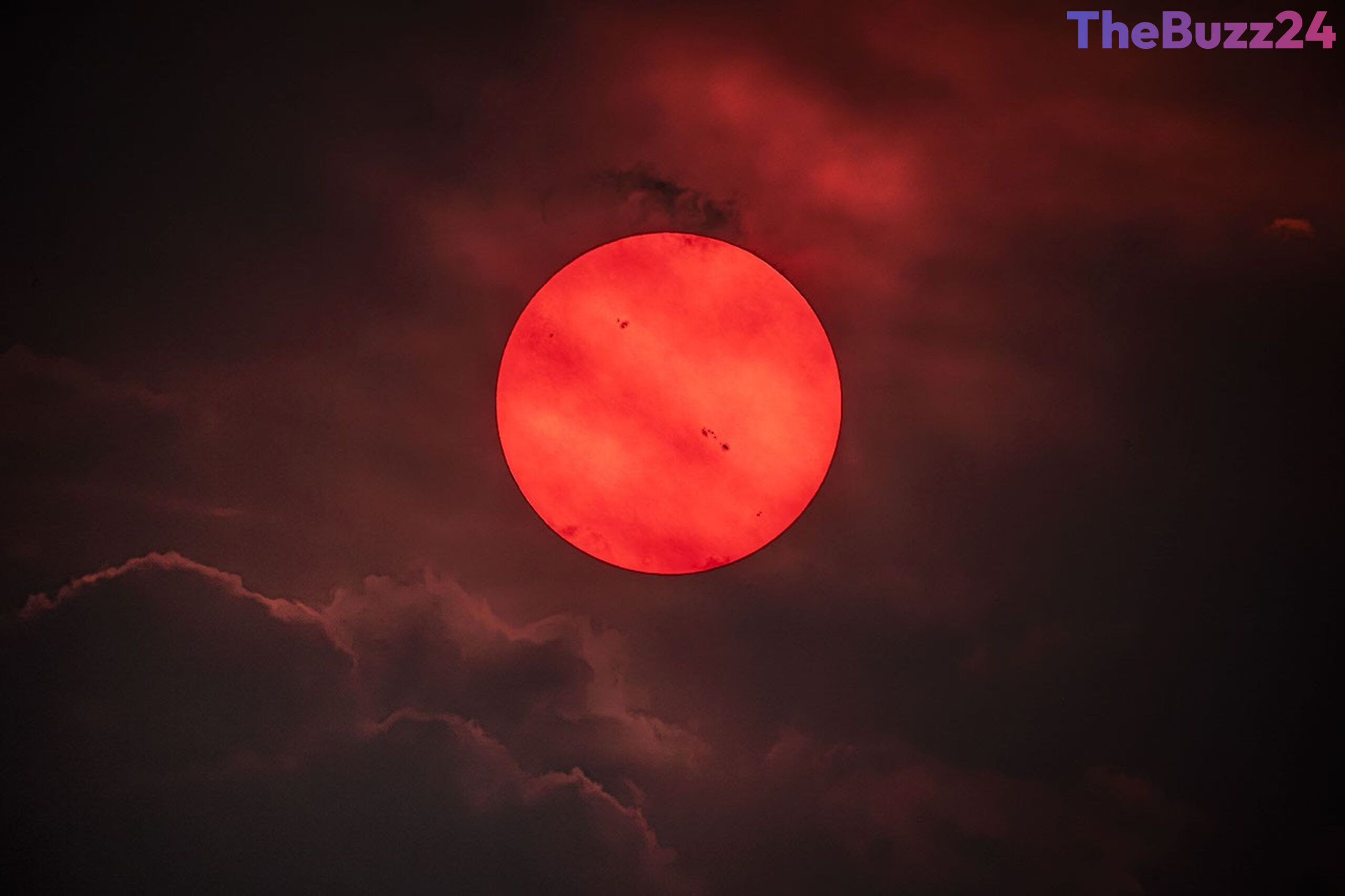
Eerie Skies over British Columbia Capture Sun Through Wildfire Smoke
A striking astronomical photograph captured in British Columbia’s Okanagan region presents the Sun in a dramatic crimson hue, resembling an alien world orbiting a red dwarf star. Taken on July 22, the image was made possible by thick wildfire smoke drifting from the Pacific Northwest, which functioned as a natural solar filter. This atmospheric haze allowed photographers to capture the solar disk directly, revealing prominent details such as the rapidly evolving sunspot group AR 4493 positioned near the center.
The unique optical phenomenon occurs because microscopic particles suspended in the wildfire smoke selectively scatter and block shorter, bluer wavelengths of light. Consequently, the remaining light passing through the haze is significantly dimmer and shifts toward the red spectrum, intensifying the visual impact of sunrises and sunsets in affected regions. While the resulting imagery offers a fascinating glimpse of solar activity, experts consistently emphasize the importance of eye safety, noting that viewing the unfiltered Sun directly remains dangerous.
Astronomers point out that this striking preview of a red sun offers a glimpse into the distant future of our solar system. Approximately six billion years from now, natural stellar evolution will cause the Sun to expand and cool, transitioning into its red giant phase. Until then, seasonal wildfire smoke combined with high-resolution imaging continues to provide terrestrial observers with rare, albeit concerning, opportunities to study solar features without specialized professional equipment.
Key Takeaways
- A striking photograph captured in British Columbia's Okanagan region shows the Sun glowing red due to Pacific Northwest wildfire smoke.
- The smoke acts as a natural solar filter, scattering blue light and allowing observers to view prominent sunspot groups like AR 4493.
- Scientists note that this atmospheric phenomenon offers a visual preview of what the Sun will look like billions of years from now in its red giant phase.
Editor’s Analysis & Impact
The intersection of atmospheric science and astronomical observation frequently yields valuable public engagement opportunities, even when driven by adverse environmental events like wildfires. As climate patterns shift and wildfire seasons become more severe globally, smoke-induced optical phenomena are increasingly documented by amateur and professional astrophotographers alike. While these events create hazardous air quality conditions on the ground, they inadvertently provide striking visual data regarding particulate light scattering. Furthermore, such imagery serves as a powerful educational tool for communicating complex concepts ranging from solar dynamics to stellar evolution. Moving forward, the documentation of atmospheric anomalies will likely remain a crucial component of public science outreach, bridging the gap between Earth-bound environmental crises and broader astrophysical concepts.
Frequently Asked Questions
Q: Why did the Sun appear red in the British Columbia photograph?
A: The Sun appeared red because wildfire smoke from the Pacific Northwest acted as a natural filter, scattering bluer wavelengths of light and allowing only dimmer, redder light to pass through.
Q: What prominent feature was visible on the Sun in this image?
A: Several sunspots were visible, most notably AR 4493, which is a fast-evolving, giant active solar region located near the center of the solar disk.
Q: Will the Sun naturally turn red permanently in the future?
A: Yes, approximately six billion years from now, the Sun will begin transitioning into its red giant phase, causing it to naturally appear much redder than it does today.
AI Disclosure: This article is based on verified data and official reports. Our Team and AI have cross-referenced every financial detail with primary sources to ensure total accuracy.
More from this Category