Deep-Space Breakthrough: Rubin Observatory Unveils Dynamic View of 500,000 Galaxies in COSMOS Field
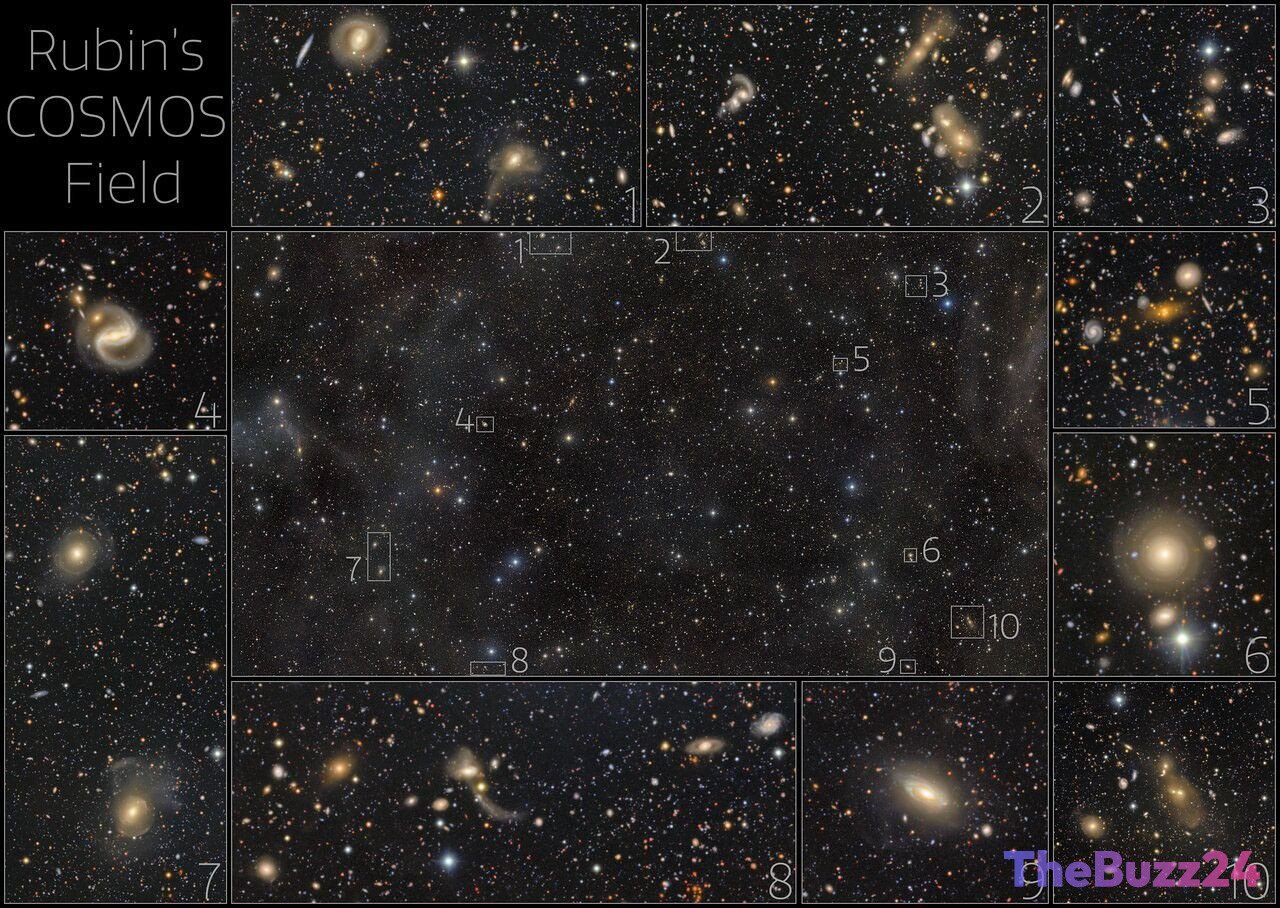
The NSF-DOE Vera C. Rubin Observatory in Chile has captured a breathtaking new perspective of the famous COSMOS field, revealing more than half a million galaxies in a single central panel. This specific patch of the night sky, which spans an area several times larger than a full moon, serves as a crucial window into the deep universe. Because this region contains very few bright stars from our own Milky Way galaxy, astronomers are granted an exceptionally clear, unobstructed view of the cosmos beyond our galactic neighborhood.
While the COSMOS field has previously been studied by landmark space observatories like the Hubble Space Telescope and the James Webb Space Telescope, the Rubin Observatory’s latest imaging showcases an astonishing variety of galactic structures. Detailed close-ups of specific regions within the field highlight galaxies of diverse shapes, sizes, and evolutionary stages. Many of these distant systems are so far away that the light captured by the observatory’s advanced sensors has traveled for billions of years across the expanding universe before finally reaching Earth.
This newly released image is just the beginning of a long-term scientific endeavor. Over the next decade, the Rubin Observatory will repeatedly target the COSMOS field every few days as part of its ambitious Legacy Survey of Space and Time (LSST). This systematic, repetitive imaging campaign will allow researchers to construct a dynamic, time-lapse view of the universe, monitoring how celestial objects and the wider night sky change over time.
Key Takeaways
- The Vera C. Rubin Observatory has imaged the COSMOS field, capturing over 500,000 distinct galaxies in a single view.
- The COSMOS field is highly valued by astronomers because its lack of bright Milky Way stars provides an unobstructed view of the deep universe.
- As part of the 10-year Legacy Survey of Space and Time, the observatory will revisit this field every few days to monitor cosmic changes over time.
Editor’s Analysis & Impact
The Vera C. Rubin Observatory’s ongoing work in the COSMOS field represents a paradigm shift in observational astronomy. By transitioning from static deep-space snapshots to a continuous, time-domain survey, the Legacy Survey of Space and Time (LSST) will fundamentally alter our understanding of cosmic evolution. The ability to capture half a million galaxies in a single field of view—and monitor them repeatedly—will enable scientists to track transient events, such as supernovae and variable stars, with unprecedented temporal resolution. Furthermore, this massive dataset will feed directly into dark matter and dark energy research, helping map the expansion of the universe. For the broader scientific community, the Rubin Observatory is paving the way for a new era of big-data astronomy, where machine learning and automated pipelines will be essential to process the petabytes of incoming cosmic data.
Frequently Asked Questions
Q: What makes the COSMOS field so important for astronomers?
A: The COSMOS field is a relatively clear patch of sky with very few bright foreground stars from our own Milky Way galaxy. This lack of local interference allows telescopes to peer incredibly deep into space and observe distant galaxies without obstruction.
Q: What is the Legacy Survey of Space and Time (LSST)?
A: The LSST is a planned 10-year survey conducted by the Vera C. Rubin Observatory. It aims to photograph the entire available night sky every few nights, creating a massive, dynamic map of the universe to track moving objects, variable stars, and cosmic changes over time.
Q: How far away are the galaxies captured in this image?
A: Many of the galaxies visible in the COSMOS field are billions of light-years away, meaning the light we see today was emitted when the universe was in its early stages of development.
AI Disclosure: This article is based on verified data and official reports. Our Team and AI have cross-referenced every financial detail with primary sources to ensure total accuracy.
More from this Category